Senecal Conor, Collazo-Clavell Maria, Larrabee Beth R, de Andrade Mariza, Lin Weihua, Chen Bing, Lerman Lilach O, Lerman Amir, Lopez-Jimenez Francisco
Department of Cardiovascular Medicine, Mayo Clinic, USA.
Division of Endocrinology, Department of Medicine, Mayo Clinic, USA.
Digit Health. 2020 Mar 4;6:2055207620910279. doi: 10.1177/2055207620910279. eCollection 2020 Jan-Dec.
Severe obesity is a growing epidemic that causes significant morbidity and mortality, and is particularly difficult to reverse. Efficacious and cost-effective interventions are needed to combat this epidemic. This study hypothesized that obese people (body mass index (BMI) ≥35 kg/m) using a remote weight-loss program combining a mobile application, wireless scales, and low-calorie meal replacement would experience clinically significant weight loss.
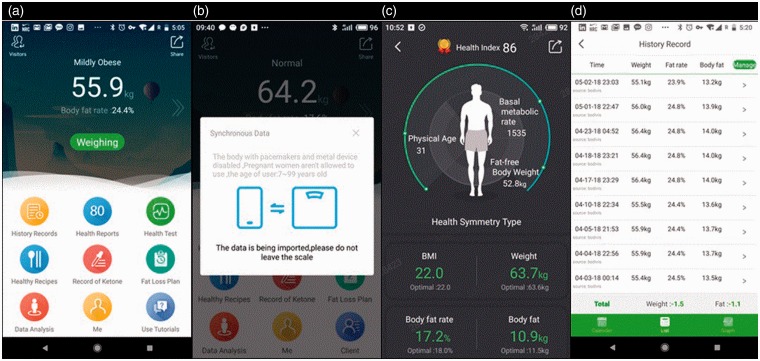
This study was a retrospective observational analysis of 8275 individuals with a baseline BMI ≥35 kg/m who used a remote weight-loss program combining mobile applications, frequent self-weighing, and calorie restriction via meal replacement for a minimum of 35 days. Weight changes were evaluated at multiple intervals (42, 60, 90, and 120 days), and weight loss was evaluated for all and for pre-specified subgroups based on demographic features and frequency of self-weighing.
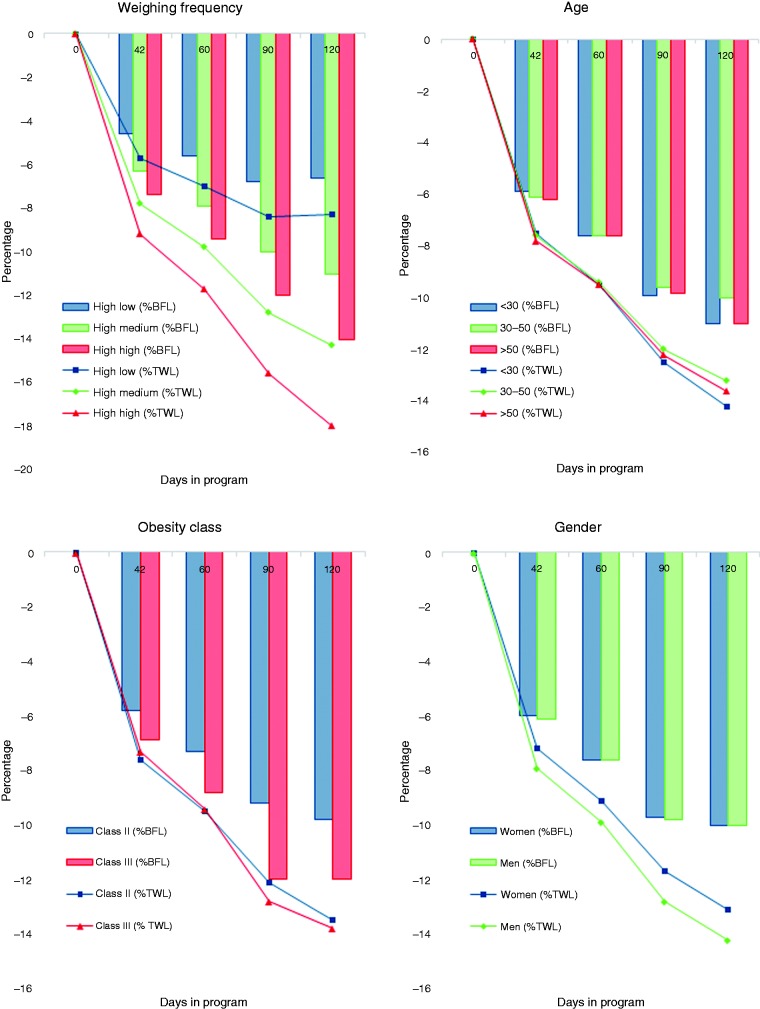
Mean weight loss at 42 days ( = 6781) was 8.1 kg (margin of error (MOE) = 0.126 kg) with 73.6% of users experiencing >5% total body weight loss. Both men (9.1 kg; MOE = 0.172 kg; 7.9% from baseline) and women (7.1 kg; MOE = 0.179 kg; 7.2% from baseline) experienced significant weight loss. At the 120-day interval ( = 2914), mean weight loss was 14 kg (MOE = 0.340 kg), 13% total body weight loss from baseline, and 82.3% of participants had lost >5% of their initial body weight. The decrease in body-fat percent correlated well with weight loss ( = 0.92; < 0.001).
In a large cohort of individuals with class II or III obesity, a remote weight-loss program combining mobile applications, daily self-weighing, and calorie restriction via meal replacement resulted in dramatic weight loss among subjects who were active users when evaluated through a retrospective observational analysis.
重度肥胖是一种日益流行的疾病,会导致严重的发病率和死亡率,而且尤其难以逆转。需要有效且具成本效益的干预措施来应对这一流行病。本研究假设,使用结合了移动应用程序、无线秤和低热量代餐的远程减肥计划的肥胖人群(体重指数(BMI)≥35 kg/m²)会实现具有临床意义的体重减轻。
本研究是一项回顾性观察分析,对8275名基线BMI≥35 kg/m²的个体进行研究,这些个体使用了结合移动应用程序、频繁自我称重以及通过代餐进行热量限制的远程减肥计划,为期至少35天。在多个时间间隔(42、60、90和120天)评估体重变化,并根据人口统计学特征和自我称重频率对所有个体以及预先指定的亚组进行体重减轻评估。
42天时(n = 6781)平均体重减轻8.1 kg(误差幅度(MOE)= 0.126 kg),73.6%的用户总体重减轻超过5%。男性(9.1 kg;MOE = 0.172 kg;较基线下降7.9%)和女性(7.1 kg;MOE = 0.179 kg;较基线下降7.2%)均经历了显著的体重减轻。在120天时间间隔时(n = 2914),平均体重减轻14 kg(MOE = 0.340 kg),较基线总体重减轻13%,82.3%的参与者体重减轻超过初始体重的5%。体脂百分比的下降与体重减轻密切相关(r = 0.92;P < 0.001)。
在一大群患有II级或III级肥胖的个体中,通过回顾性观察分析评估,结合移动应用程序、每日自我称重和通过代餐进行热量限制的远程减肥计划,使积极使用该计划的受试者实现了显著的体重减轻。