Foundation for Innovative New Diagnostics (FIND), Geneva, Switzerland.
Medical Department, Médecins Sans Frontières, Geneva, Switzerland.
BMJ Glob Health. 2020 Feb 28;5(2):e002067. doi: 10.1136/bmjgh-2019-002067. eCollection 2020.
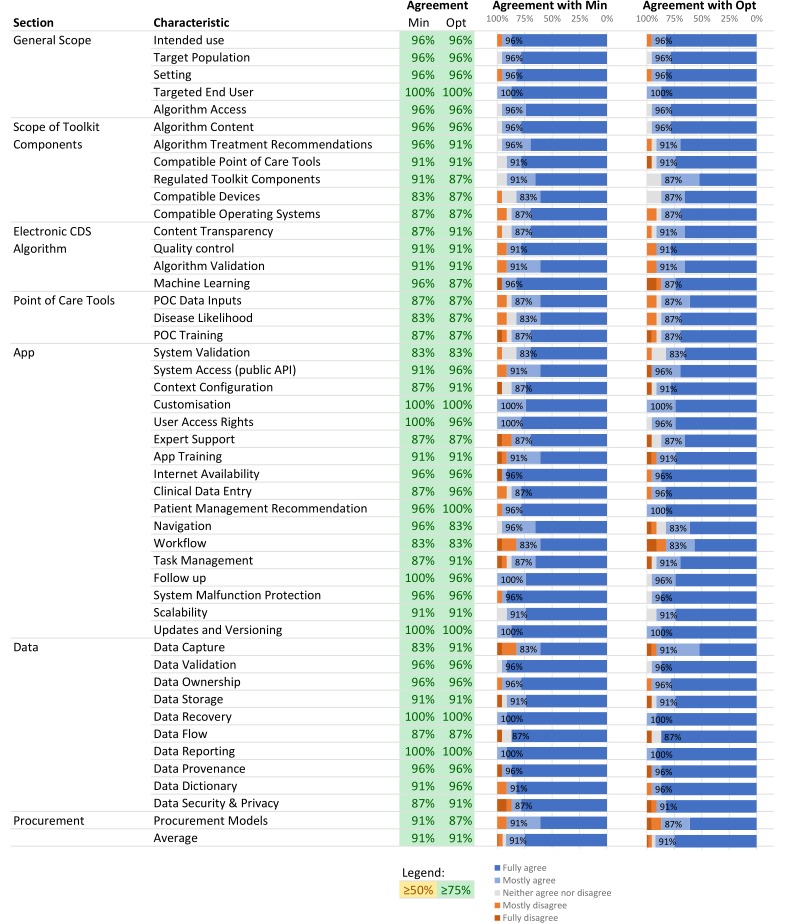
Health workers in low-resource settings often lack the support and tools to follow evidence-based clinical recommendations for diagnosing, treating and managing sick patients. Digital technologies, by combining patient health information and point-of-care diagnostics with evidence-based clinical protocols, can help improve the quality of care and the rational use of resources, and save patient lives. A growing number of electronic clinical decision support algorithms (CDSAs) on mobile devices are being developed and piloted without evidence of safety or impact. Here, we present a target product profile (TPP) for CDSAs aimed at guiding preventive or curative consultations in low-resource settings. This document will help align developer and implementer processes and product specifications with the needs of end users, in terms of quality, safety, performance and operational functionality. To identify the characteristics of CDSAs, a multidisciplinary group of experts (academia, industry and policy makers) with expertise in diagnostic and CDSA development and implementation in low-income and middle-income countries were convened to discuss a draft TPP. The TPP was finalised through a Delphi process to facilitate consensus building. An agreement greater than 75% was reached for all 40 TPP characteristics. In general, experts were in overwhelming agreement that, given that CDSAs provide patient management recommendations, the underlying clinical algorithms should be human-interpretable and evidence-based. Whenever possible, the algorithm's patient management output should take into account pretest disease probabilities and likelihood ratios of clinical and diagnostic predictors. In addition, validation processes should at a minimum show that CDSAs are implementing faithfully the evidence they are based on, and ideally the impact on patient health outcomes. In terms of operational needs, CDSAs should be designed to fit within clinic workflows and function in connectivity-challenged and high-volume settings. Data collected through the tool should conform to local patient privacy regulations and international data standards.
在资源匮乏的环境中,卫生工作者往往缺乏遵循循证临床建议来诊断、治疗和管理病患所需的支持和工具。数字技术将患者健康信息和即时诊断与基于证据的临床方案相结合,可以帮助提高医疗质量和资源利用的合理性,并拯救患者生命。越来越多的移动设备上的电子临床决策支持算法(CDSAs)正在被开发和试点,但没有安全性或效果的证据。在这里,我们提出了一个针对 CDSAs 的目标产品概况(TPP),旨在指导资源匮乏环境中的预防性或治疗性咨询。本文件将有助于使开发者和实施者的流程和产品规格与最终用户的需求保持一致,包括质量、安全性、性能和操作功能。为了确定 CDSAs 的特征,召集了一组多学科专家(学术界、产业界和政策制定者),他们在低收入和中等收入国家具有诊断和 CDSA 开发和实施方面的专业知识,讨论了 TPP 草案。通过 Delphi 流程达成了共识,以促进达成一致。对于所有 40 个 TPP 特征,都达成了超过 75%的一致协议。总的来说,专家们一致认为,鉴于 CDSAs 提供了患者管理建议,那么底层的临床算法应该是可以由人解释和基于证据的。只要有可能,算法的患者管理输出应考虑到预先测试的疾病概率和临床和诊断预测因素的似然比。此外,验证过程至少应表明 CDSAs 忠实地实施了其依据的证据,而理想情况下应表明对患者健康结果的影响。就操作需求而言,CDSAs 应设计为适应诊所工作流程,并在连接困难和高容量的环境中运行。通过工具收集的数据应符合当地患者隐私法规和国际数据标准。