Department of Cardiology, VU University Medical Center, Amsterdam University Medical Center, Amsterdam, the Netherlands.
Erasmus University, Rotterdam, the Netherlands.
JAMA Netw Open. 2020 Mar 2;3(3):e201177. doi: 10.1001/jamanetworkopen.2020.1177.
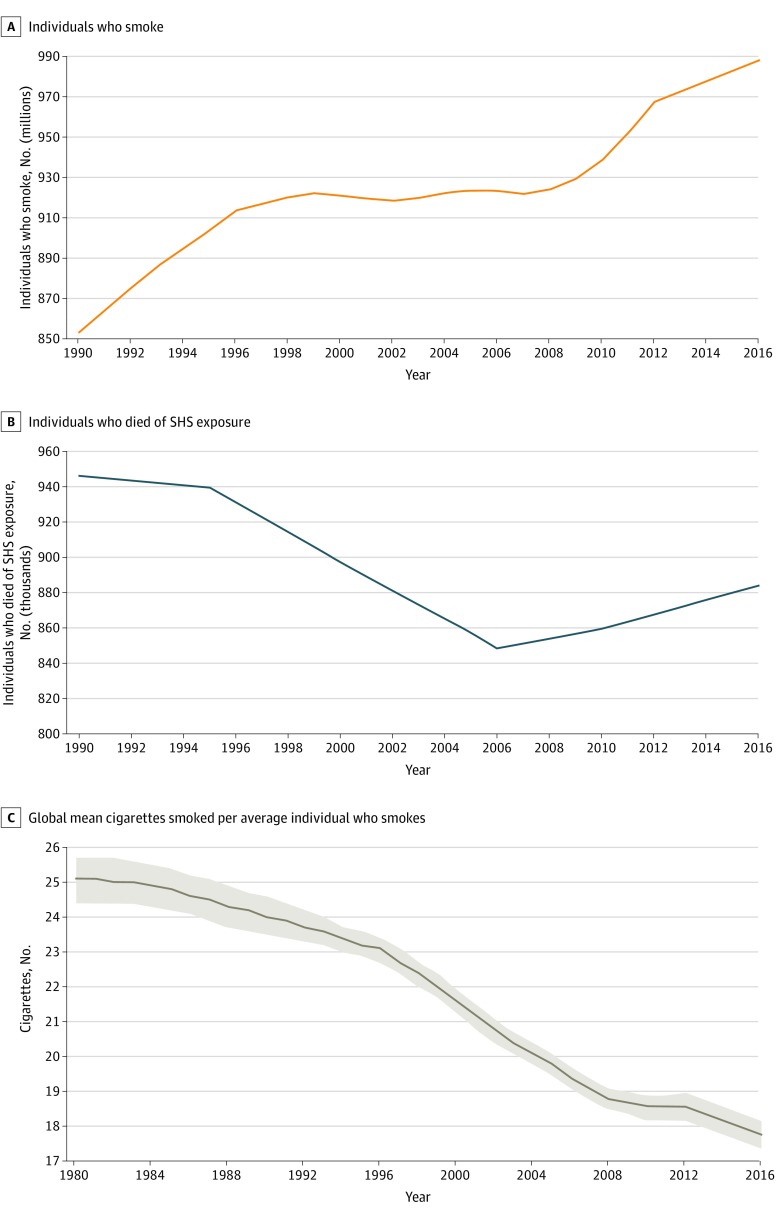
The World Health Organization estimates that the 1 billion individuals who smoke worldwide contribute to the 880 000 secondhand smoke (SHS)-related deaths among individuals who do not smoke each year. A better understanding of the scale of harm of SHS to those who do not smoke could increase awareness of the consequences of smoking and help to design measures to protect individuals who do not smoke, especially children.
To calculate the number of individuals who smoke associated with the death of 1 individual who died of SHS exposure both on a global scale and in various World Bank regions.
DESIGN, SETTING, AND PARTICIPANTS: In this cross-sectional epidemiologic assessment, data from Our World in Data were used to tabulate the number of individuals who smoke in each country and number of premature deaths related to SHS in that country from 1990 to 2016. The mean number of cigarettes consumed in all countries was also included in analyses. Data were collected for the following World Bank regions: North America, Latin America and the Caribbean, Europe and Central Asia, the Middle East and North Africa, sub-Saharan Africa, South Asia, and East Asia and the Pacific from 1990 and 2016. Statistical analysis was conducted in July 2019.
Secondhand smoke.
The pack-year index, calculated as the number of pack-years associated with the death of 1 individual who does not smoke but was exposed to SHS, and the SHS index, calculated as the number of individuals who smoked for 24 years (ie, the mean duration of smoking) associated with the death of 1 individual who does not smoke.
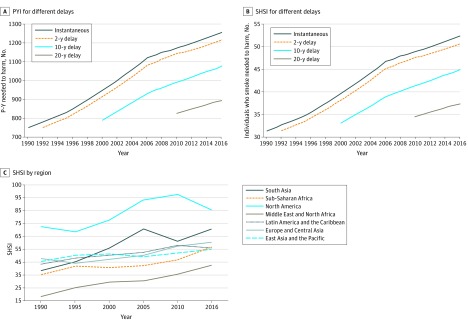
Globally, the SHS index changed favorably, from 31.3 (95% CI, 30.6-32.0) individuals who smoked associated with the death of 1 individual who did not smoke in 1990 to 52.3 (95% CI, 51.2-53.5) individuals who smoked in 2016. There was a wide regional variation in the 2016 secondhand smoke index, from 42.6 (95% CI, 41.6-43.5) individuals who smoked in the Middle East and North Africa to 85.7 (95% CI, 83.8-87.7) individuals who smoked in North America. Worldwide, the pack-year index also changed favorably from 751.9 (95% CI, 736.3-770.7) pack-years associated with 1 death in 1990 to 1255.9 (95% CI, 1227.2-1284.4) pack-years in 2016.
In this study, the substantial disparity among regions in both the SHS index and pack-year index reflected large differences in the scale of the harm of SHS on those who do not smoke. This information may help local policy makers implement measures to better protect those who do not smoke and increase public engagement. Although the number of pack-years and the number of individuals who smoke associated with the death of 1 individual who did not smoke favorably changed over the study period, as of 2016, 52.3 individuals who smoked were associated with the death of 1 individual who did not smoke.
世界卫生组织估计,全球 10 亿烟民每年导致 88 万不吸烟的人因接触二手烟(SHS)而死亡。更深入地了解 SHS 对不吸烟人群的危害程度,可以提高人们对吸烟后果的认识,并有助于设计保护不吸烟人群(尤其是儿童)的措施。
计算因 1 人因接触 SHS 而死亡,导致全球范围内和世界银行各地区的吸烟者死亡人数。
设计、设置和参与者:在这项横断面流行病学评估中,使用 Our World in Data 的数据,对各国的吸烟人数和该国因 SHS 导致的过早死亡人数进行了统计,同时还纳入了所有国家的平均吸烟量。数据收集时间为 1990 年至 2016 年,涵盖了世界银行以下地区:北美、拉丁美洲和加勒比、欧洲和中亚、中东和北非、撒哈拉以南非洲、南亚以及东亚和太平洋。统计分析于 2019 年 7 月进行。
二手烟。
包年指数,即导致 1 名不吸烟者因接触 SHS 而死亡的吸烟者人数;以及 SHS 指数,即导致 1 名不吸烟者因接触 SHS 而死亡的吸烟者人数乘以吸烟者平均吸烟年限(24 年)。
全球范围内,1990 年因接触 SHS 而导致 1 名不吸烟者死亡的吸烟者人数为 31.3(95%CI,30.6-32.0),到 2016 年降至 52.3(95%CI,51.2-53.5)。2016 年 SHS 指数在各地区差异显著,从 1990 年中东和北非的 42.6(95%CI,41.6-43.5)名吸烟者,到 2016 年北美的 85.7(95%CI,83.8-87.7)名吸烟者。全球范围内,1990 年因 1 人死亡而导致的包年指数为 751.9(95%CI,736.3-770.7)包年,到 2016 年降至 1255.9(95%CI,1227.2-1284.4)包年,这一指数也呈有利变化。
在这项研究中,SHS 指数和包年指数在各地区之间的巨大差异反映了 SHS 对不吸烟者危害程度的巨大差异。这些信息可能有助于地方政策制定者实施更好地保护不吸烟者并提高公众参与度的措施。尽管 1 名不吸烟者死亡相关的包年指数和吸烟者人数在研究期间呈有利变化,但截至 2016 年,仍有 52.3 名吸烟者与 1 名不吸烟者的死亡相关。