Office on Smoking and Health, National Center for Chronic Disease Prevention and Health Promotion, Centers for Disease Control and Prevention, 4770 Buford Highway, Atlanta, GA 30341, USA.
Tob Control. 2013 Jul;22(4):e5. doi: 10.1136/tobaccocontrol-2012-050582. Epub 2012 Sep 27.
Exposure to secondhand smoke (SHS) from burning tobacco products causes disease and premature death among non-smoking adults and children. The objective of this study was to determine the nature, extent and demographic correlates of SHS exposure among adults in low- and middle-income countries with a high burden of tobacco use.
Data were obtained from the Global Adult Tobacco Survey (GATS), a nationally representative household survey of individuals 15 years of age or older. Interviews were conducted during 2008-2010 in Bangladesh, Brazil, China, Egypt, India, Mexico, the Philippines, Poland, Russia, Thailand, Turkey, Ukraine, Uruguay and Vietnam. Descriptive statistics were used to determine the prevalence and correlates of SHS exposure in homes, workplaces, government buildings, restaurants, public transportation and healthcare facilities.
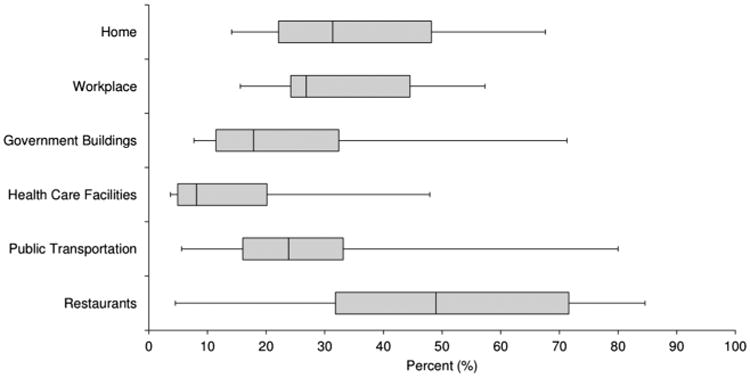
Exposure to SHS in the home ranged from 17.3% (Mexico) to 73.1% (Vietnam). Among those who work in an indoor area outside the home, SHS exposure in the workplace ranged from 16.5% (Uruguay) to 63.3% (China). Exposure to SHS ranged from 6.9% (Uruguay) to 72.7% (Egypt) in government buildings, 4.4% (Uruguay) to 88.5% (China) in restaurants, 5.4% (Uruguay) to 79.6% (Egypt) on public transportation, and 3.8% (Uruguay) to 49.2% (Egypt) in healthcare facilities.
A large proportion of adults living in low- and middle-income countries are exposed to SHS in their homes, workplaces, and other public places. Countries can enact and enforce legislation requiring 100% smoke-free public places and workplaces, and can also conduct educational initiatives to reduce SHS exposure in homes.
燃烧烟草制品产生的二手烟会导致非吸烟的成年人和儿童患病和早逝。本研究的目的是确定在烟草使用负担较重的中低收入国家中,成年人接触二手烟的性质、程度和人口统计学相关因素。
数据来自全球成人烟草调查(GATS),这是一项针对 15 岁及以上人群的全国代表性家庭调查。2008-2010 年期间在孟加拉国、巴西、中国、埃及、印度、墨西哥、菲律宾、波兰、俄罗斯、泰国、土耳其、乌克兰、乌拉圭和越南进行了访谈。使用描述性统计方法来确定家庭、工作场所、政府大楼、餐馆、公共交通工具和医疗机构中接触二手烟的流行率和相关因素。
在家中接触二手烟的比例从 17.3%(墨西哥)到 73.1%(越南)不等。在那些在家庭以外的室内区域工作的人中,工作场所接触二手烟的比例从 16.5%(乌拉圭)到 63.3%(中国)不等。在政府大楼中,接触二手烟的比例从 6.9%(乌拉圭)到 72.7%(埃及)不等,在餐馆中为 4.4%(乌拉圭)到 88.5%(中国)不等,在公共交通工具上为 5.4%(乌拉圭)到 79.6%(埃及)不等,在医疗机构中为 3.8%(乌拉圭)到 49.2%(埃及)不等。
很大一部分生活在中低收入国家的成年人在家中、工作场所和其他公共场所接触二手烟。各国可以制定和执行要求 100%无烟公共场所和工作场所的立法,还可以开展教育活动,减少家庭中接触二手烟的情况。