Adsorption & Advanced Materials Laboratory (AAML), Department of Chemical Engineering & Biotechnology, University of Cambridge, Philippa Fawcett Drive, Cambridge CB3 0AS, U.K.
WestCHEM School of Chemistry, University of Glasgow, Joseph Black Building, University Avenue, Glasgow G12 8QQ, U.K.
J Am Chem Soc. 2020 Apr 8;142(14):6661-6674. doi: 10.1021/jacs.0c00188. Epub 2020 Mar 27.
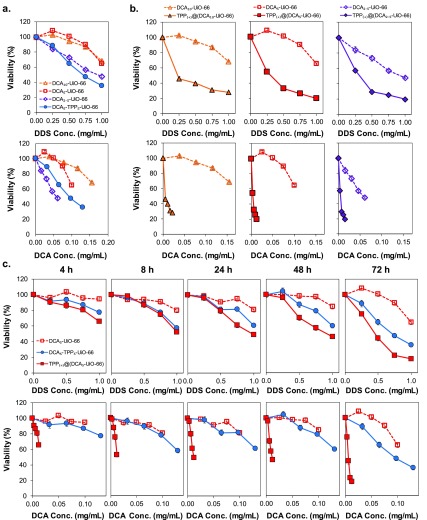
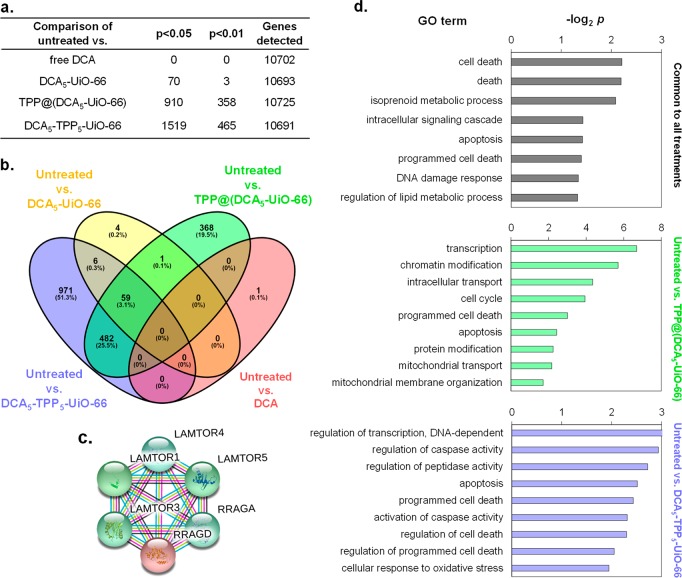
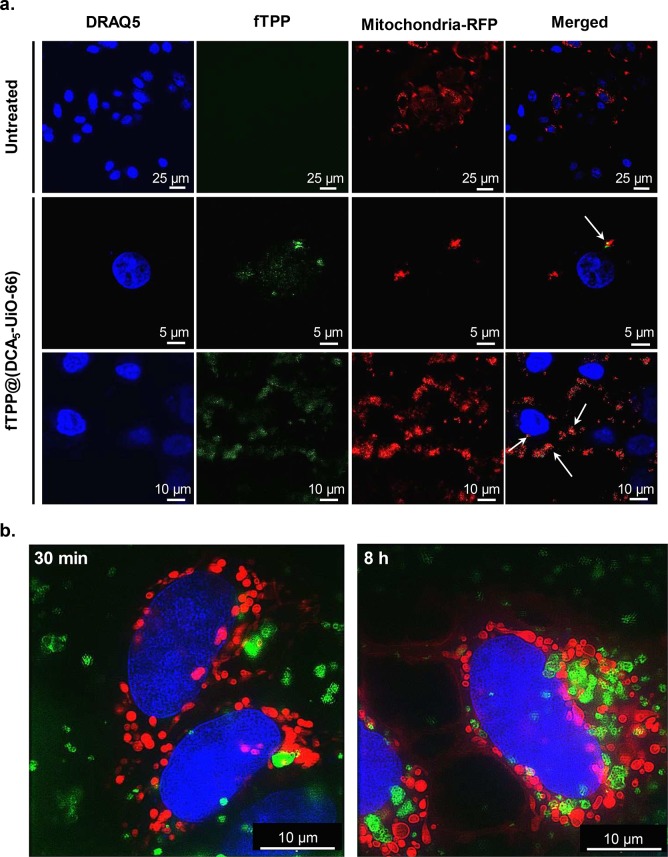
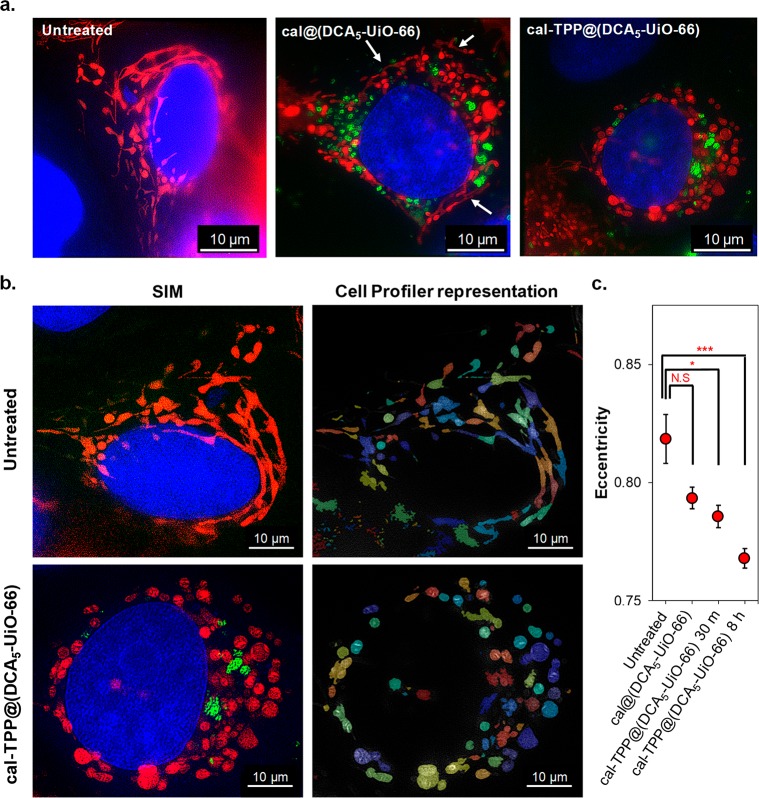
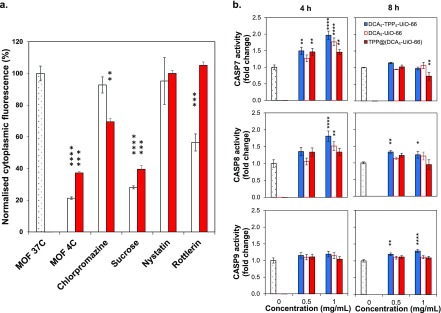
Mitochondria play a key role in oncogenesis and constitute one of the most important targets for cancer treatments. Although the most effective way to deliver drugs to mitochondria is by covalently linking them to a lipophilic cation, the delivery of free drugs still constitutes a critical bottleneck. Herein, we report the design of a mitochondria-targeted metal-organic framework (MOF) that greatly increases the efficacy of a model cancer drug, reducing the required dose to less than 1% compared to the free drug and ca. 10% compared to the nontargeted MOF. The performance of the system is evaluated using a holistic approach ranging from microscopy to transcriptomics. Super-resolution microscopy of MCF-7 cells treated with the targeted MOF system reveals important mitochondrial morphology changes that are clearly associated with cell death as soon as 30 min after incubation. Whole transcriptome analysis of cells indicates widespread changes in gene expression when treated with the MOF system, specifically in biological processes that have a profound effect on cell physiology and that are related to cell death. We show how targeting MOFs toward mitochondria represents a valuable strategy for the development of new drug delivery systems.
线粒体在肿瘤发生中起着关键作用,是癌症治疗的最重要靶点之一。尽管将药物共价连接到亲脂阳离子是将药物递送到线粒体的最有效方法,但游离药物的递送仍然是一个关键的瓶颈。在此,我们报告了一种线粒体靶向金属有机骨架(MOF)的设计,该设计大大提高了模型癌症药物的疗效,与游离药物相比,所需剂量降低到低于 1%,与非靶向 MOF 相比,降低到约 10%。该系统的性能通过从显微镜到转录组学的整体方法进行评估。用靶向 MOF 系统处理的 MCF-7 细胞的超分辨率显微镜显示出重要的线粒体形态变化,这些变化与孵育后 30 分钟内的细胞死亡明显相关。用 MOF 系统处理的细胞的全转录组分析表明,当处理细胞时,基因表达发生广泛变化,特别是在对细胞生理学有深远影响且与细胞死亡相关的生物学过程中。我们展示了将 MOF 靶向线粒体作为开发新药物递送系统的有价值的策略。