Department of Early Childhood and Family Education, College of Education, National Taipei University of Education, Taipei 10671, Taiwan.
Department of Pediatrics, National Cheng Kung University Hospital, College of Medicine, National Cheng Kung University, Tainan 70101, Taiwan.
Int J Environ Res Public Health. 2020 Mar 13;17(6):1878. doi: 10.3390/ijerph17061878.
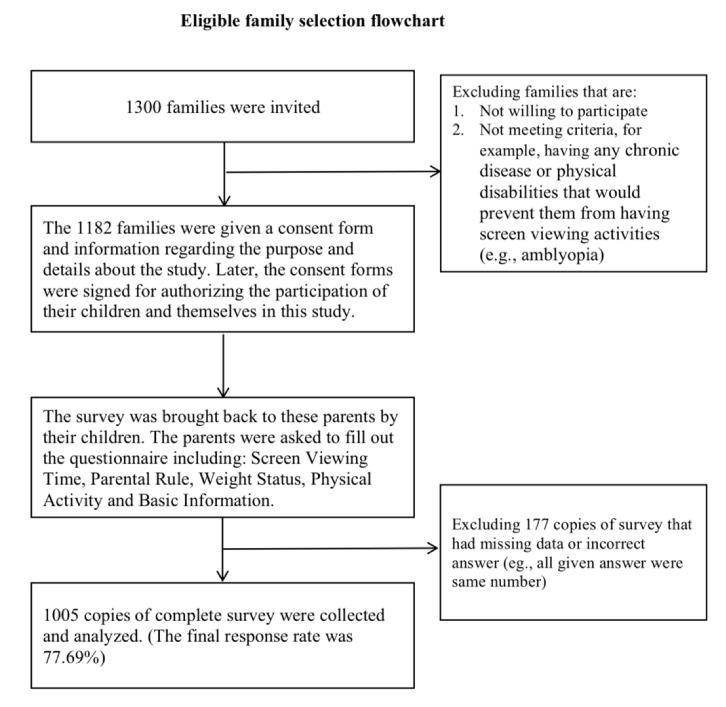
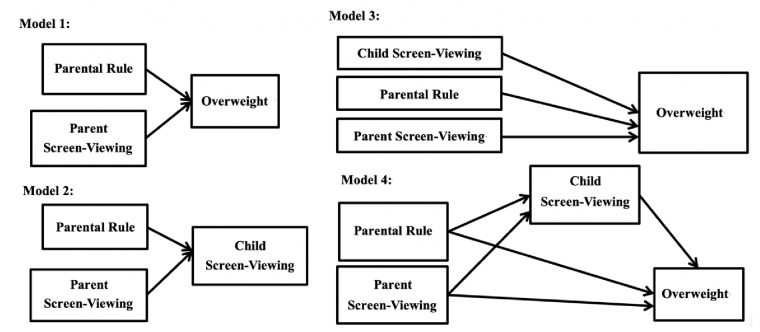
Children's screen-viewing behavior is influenced by parents' own screen-viewing hours and the parental rules set for screen-viewing time. However, whether childhood obesity is associated with these three factors has not been widely investigated in Chinese populations. We examined the relationships between parental rules, parental screen-viewing, child screen-viewing and child overweight. Questionnaires were distributed to 1300 parents who had children studying in two elementary schools in an eastern Taiwanese City (Yi-Lan). We collected the data (the final response rate was 77.7%) on children's health states, the length of screen-viewing time, and whether parental rules of screen-viewing time have been set ( = 1005). Models using structural equation modeling, with controlling of age, gender, and physical activity of the participants, were carried out, to examine the mediated effect of child screen-viewing. The results of model testing showed that child screen-viewing could be a mediator in the associations between parental rule and child overweight (parental rule: coefficient = -0.18, < 0.001); and between parent screen-viewing and child overweight (parent screen-viewing: coefficient = 0.072, < 0.001). These findings suggested that parental factors (rules and little screen viewing time) effectively decreased the level of children's screen-viewing time, and the child screen-viewing time could mediate the association between parental factors and child overweight in the Chinese population.
儿童的屏幕观看行为受到父母自身的屏幕观看时间和父母设定的屏幕观看时间规则的影响。然而,在中国人中,童年肥胖是否与这三个因素有关尚未得到广泛研究。我们研究了父母规则、父母屏幕观看时间、儿童屏幕观看时间与儿童超重之间的关系。我们向在台湾东部一个城市(宜兰)的两所小学就读的 1300 名家长发放了问卷(最终回复率为 77.7%),收集了儿童健康状况、屏幕观看时间长度以及是否制定了父母的屏幕观看时间规则等数据(n=1005)。采用结构方程模型,控制参与者的年龄、性别和身体活动,对儿童屏幕观看时间的中介效应进行了检验。模型检验结果表明,儿童屏幕观看时间可以在父母规则与儿童超重之间的关联(父母规则:系数=-0.18,<0.001)以及父母屏幕观看时间与儿童超重之间的关联中起到中介作用(父母屏幕观看时间:系数=0.072,<0.001)。这些发现表明,父母因素(规则和较少的屏幕观看时间)可以有效地降低儿童的屏幕观看时间,儿童的屏幕观看时间可以在父母因素与中国人群儿童超重之间的关联中起到中介作用。