Siemens Waldemar, Schönsteiner Stefan S, Orellana-Rios Claudia Lorena, Schaekel Ulrike, Kessler Jens, Eschbach Corinna, Viehrig Marén, Mayer-Steinacker Regine, Becker Gerhild, Gaertner Jan
Clinic for Palliative Care, Medical Center, Faculty of Medicine, University of Freiburg, Robert-Koch-Str 3, 79106, Freiburg, Germany.
Department of Internal Medicine III, University Hospital Ulm, Ulm, Germany.
Support Care Cancer. 2020 Nov;28(11):5547-5555. doi: 10.1007/s00520-020-05388-y. Epub 2020 Mar 17.
The aim of this study was to identify symptoms of severe intensity or very low scores for quality of life (QoL) domains in newly diagnosed outpatients with advanced cancer.
This multicenter cohort study from a state-wide palliative care network included adult outpatients with advanced cancer diagnosed within the preceding 8 weeks from four comprehensive cancer centers (DRKS00006162, registered on 19 May 2014). We used the Palliative Outcome Scale (POS), Hospital Anxiety and Depression Scale, and European Organization for Research and Treatment of Cancer QoL Questionnaire-C30. For each questionnaire, cut-off scores defined symptoms and QoL domains that were considered "severe" or "very low."
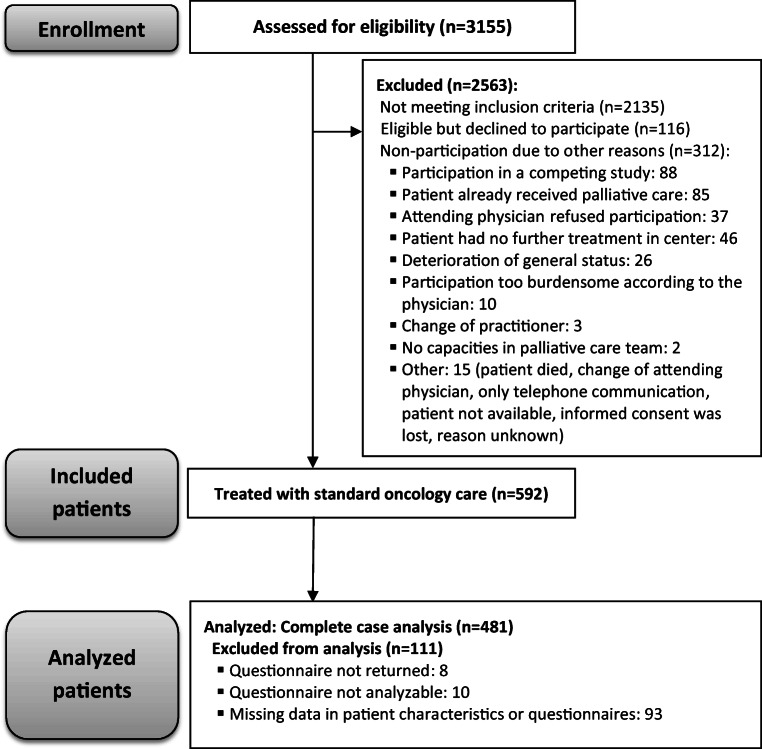
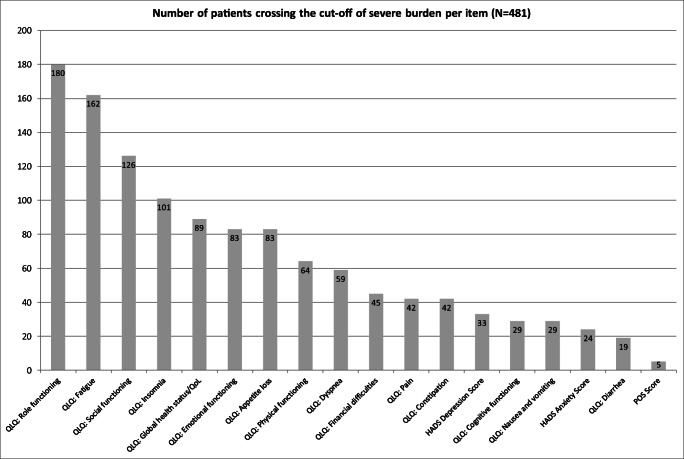
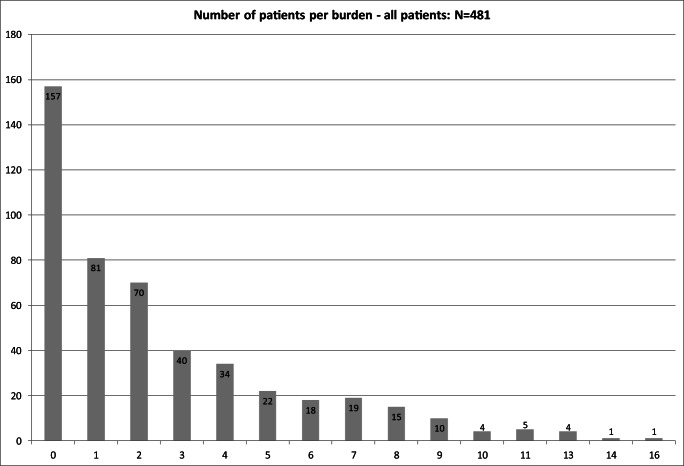
Of 3155 patients screened, 481/592 (81.3%) were analyzed (mean age 62.4; women n = 245, 50.9%). We identified 324/481 (67.4%) patients experiencing at least one severe symptom or a very low QoL domain (median 2; range 0 to 16). Role functioning (n = 180, 37.4%), fatigue (n = 162, 33.7%), and social functioning (n = 126, 26.2%) were most commonly affected. QoL was very low in 89 patients (18.5%). Women experienced more anxiety symptoms, fatigue, and had lower POS scores. Patients often mentioned physical symptoms and fears of adverse events resulting from disease-modifying therapies (e.g., chemotherapy) as most relevant problems.
Already within the first 8 weeks after diagnosis, the majority of patients reported at least one severe symptom or a very low QoL domain. Gender differences were evident. The findings illustrate the value of early routine assessment of patient burden and the development of multi-professional and interdisciplinary palliative care.
本研究旨在确定新诊断的晚期癌症门诊患者中严重程度的症状或生活质量(QoL)领域的极低评分。
这项来自全州姑息治疗网络的多中心队列研究纳入了在过去8周内由四个综合癌症中心诊断为晚期癌症的成年门诊患者(DRKS00006162,于2014年5月19日注册)。我们使用了姑息治疗结果量表(POS)、医院焦虑和抑郁量表以及欧洲癌症研究与治疗组织生活质量问卷-C30。对于每份问卷,临界值分数定义了被认为是“严重”或“极低”的症状和QoL领域。
在3155名筛查患者中,分析了481/592名患者(81.3%)(平均年龄62.4岁;女性n = 245,50.9%)。我们确定324/481名患者(67.4%)经历了至少一种严重症状或一个极低QoL领域(中位数为2;范围为0至16)。角色功能(n = 180,37.4%)、疲劳(n = 162,33.7%)和社会功能(n = 126,26.2%)受影响最为常见。89名患者(18.5%)的生活质量极低。女性经历更多焦虑症状、疲劳,且POS评分更低。患者经常提到身体症状以及对疾病改善疗法(如化疗)导致的不良事件的恐惧是最相关的问题。
在诊断后的前8周内,大多数患者就报告了至少一种严重症状或一个极低QoL领域。性别差异明显。这些发现说明了早期常规评估患者负担以及开展多专业和跨学科姑息治疗的价值。