Shen Erdong, Wang Xin, Liu Xin, Lv Mingyue, Zhang Liang, Zhu Guolian, Sun Zhe
1Department of Surgical Oncology and General Surgery, Key Laboratory of Precision Diagnosis and Treatment of Gastrointestinal Tumors, Ministry of Education, The First Affiliated Hospital of China Medical University, No. 155, Nanjing North Road, Heping District, Shenyang, 110001 Liaoning People's Republic of China.
Department of Oncology, Yueyang First People's Hospital, Yueyang, 414000 P. R. China.
Cancer Cell Int. 2020 Mar 12;20:76. doi: 10.1186/s12935-019-1092-7. eCollection 2020.
Gastric cancer (GC) is a common cause of cancer-related mortality worldwide, and microRNAs (miRNAs) have been shown to play an important role in GC development. This study aims to explore the effect of microRNA-93-5p (miR-93-5p) on the epithelial-mesenchymal transition (EMT) in GC, via AHNAK and the Wnt signaling pathway.
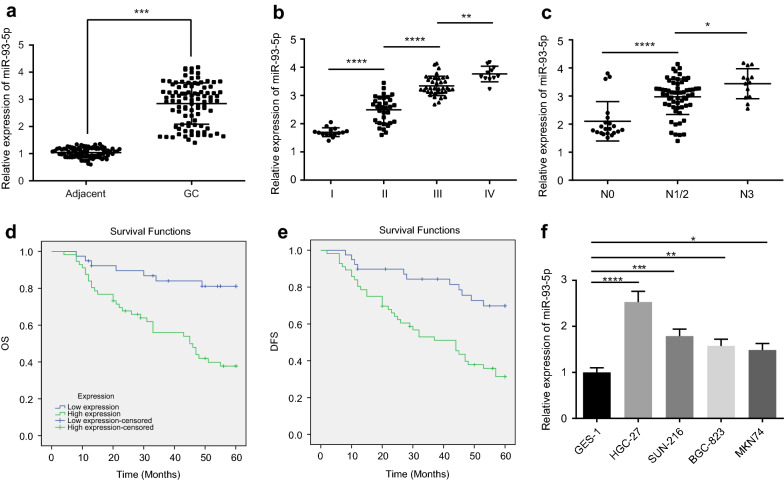
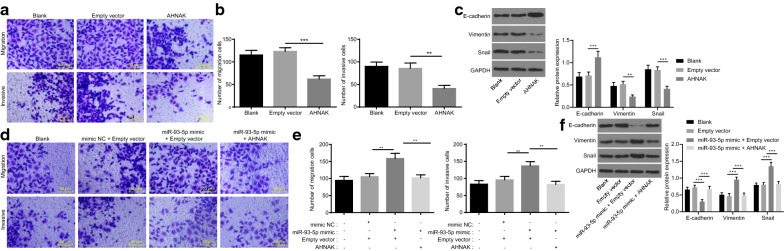
Microarray-based gene expression analysis was performed to identify GC-related differentially expressed miRNAs and genes. Then the expression of the miR-93-5p was examined in GC tissues and GC cell lines. The targeting relationship between miR-93-5p and AHNAK was verified by a dual luciferase reporter gene assay. In an attempt to ascertain the contributory role of miR-93-5p in GC, miR-93-5p mimic or inhibitor, as well as an AHNAK overexpression vector, were introduced to HGC-27 cells. HGC-27 cell migration and invasive ability, and EMT were assayed using Transwell assay and western blot analysis. Regulation of the Wnt signaling pathway was also assessed using TOP/FOP flash luciferase assay.
miR-93-5p was highly expressed in GC tissue samples and cells. Notably, miR-93-5p could target and negatively regulate AHNAK. Down-regulation of miR-93-5p or overexpression of AHNAK could suppress the migration and invasion abilities, in addition to EMT in GC cells via inactivation of the Wnt signaling pathway.
Taken together, downregulation of miR-93-5p attenuated GC development via the Wnt signaling pathway by targeting AHNAK. These findings provide an enhanced understanding of miR-93-5p as a therapeutic target for GC treatment.
胃癌(GC)是全球癌症相关死亡的常见原因,且已证明微小RNA(miRNA)在胃癌发展中起重要作用。本研究旨在通过AHNAK和Wnt信号通路探讨微小RNA-93-5p(miR-93-5p)对胃癌上皮-间质转化(EMT)的影响。
进行基于微阵列的基因表达分析以鉴定与胃癌相关的差异表达miRNA和基因。然后检测miR-93-5p在胃癌组织和胃癌细胞系中的表达。通过双荧光素酶报告基因检测验证miR-93-5p与AHNAK之间的靶向关系。为确定miR-93-5p在胃癌中的作用,将miR-93-5p模拟物或抑制剂以及AHNAK过表达载体导入HGC-27细胞。使用Transwell检测和蛋白质印迹分析检测HGC-27细胞的迁移和侵袭能力以及EMT。还使用TOP/FOP闪光荧光素酶检测评估Wnt信号通路的调节。
miR-93-5p在胃癌组织样本和细胞中高表达。值得注意的是,miR-93-5p可以靶向并负向调节AHNAK。miR-9-5p的下调或AHNAK的过表达可通过Wnt信号通路失活抑制胃癌细胞的迁移和侵袭能力以及EMT。
综上所述,miR-93-5p的下调通过靶向AHNAK减弱了Wnt信号通路对胃癌发展的影响。这些发现有助于加深对miR-93-5p作为胃癌治疗靶点的理解。