Jowkar Zahra, Omidi Yekta, Shafiei Fereshteh
Assistant professor, Oral and Dental Disease Research Center, Department of Operative Dentistry, School of Dentistry, Shiraz University of Medical Sciences, Shiraz, Iran.
Undergraduate Student, Department of Operative Dentistry, School of Dentistry, Shiraz University of Medical Sciences, Shiraz, Iran.
J Clin Exp Dent. 2020 Mar 1;12(3):e249-e256. doi: 10.4317/jced.56126. eCollection 2020 Mar.
This study was undertaken to investigate the effect of intraradicular dentin pretreatment with silver nanoparticles (SNPs), zinc oxide nanoparticles (ZNPs), and titanium oxide nanoparticles (TNPs) on the push-out bond strength (PBS) of fiber posts to root dentin using two types of resin cements.
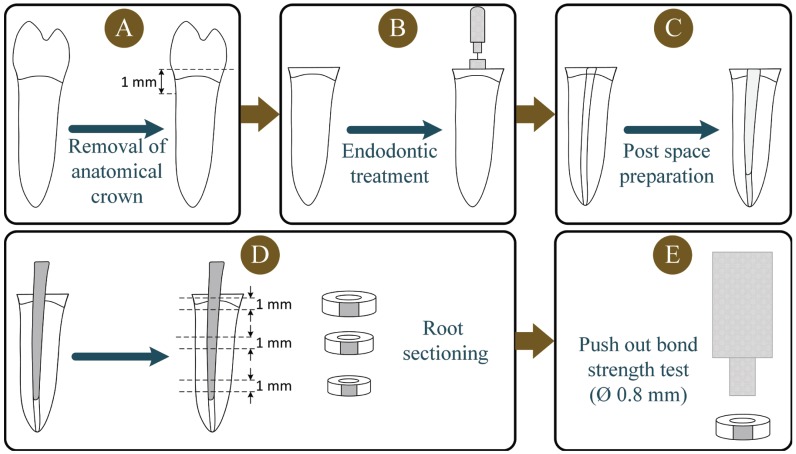
Eighty single-rooted human premolar roots were randomly divided into eight groups after endodontic treatment and post space preparation, according to the type of intraradicular dentin pretreatment with different nanoparticle solutions (n=20). The groups included no pretreatment (control) and pretreatments with SNPs, ZNPs, and TNPs. Each group was divided into 2 subgroups (n=10) according to cementation: Excite DSC/Variolink II and ED Primer II/Panavia F2.0. The PBS values were measured in different areas of the post space. The data were subjected to the three-way analysis of variance and Tukey tests (p=0.05).
The SNP-pretreated groups showed significantly higher PBS values than the other groups. No significant differences in PBS were noted among the control, ZNP-pretreated, and TNP-pretreated groups. There was no significant difference in the PBS of the fiber posts with respect to cement type. The PBS was significantly lower in the apical region than in the other two regions. There was no statistically significant difference between the PBSs of the cervical and middle thirds.
Intraradicular dentin pretreatment with SNPs, TNPs, and ZNPs did not interfere with the PBS of the fiber posts. The best result was obtained for the SNP-pretreated groups for both types of cement. Also, the lowest PBS was found in the apical third of the root canal spaces. Fiber post, nanoparticles, push-out bond strength.
本研究旨在使用两种树脂水门汀,研究用银纳米颗粒(SNPs)、氧化锌纳米颗粒(ZNPs)和二氧化钛纳米颗粒(TNPs)对根管内牙本质进行预处理对纤维桩与根管牙本质之间推出粘结强度(PBS)的影响。
80颗单根人前磨牙在进行根管治疗和制备桩道后,根据根管内牙本质用不同纳米颗粒溶液预处理的类型随机分为8组(n = 20)。这些组包括未预处理(对照组)以及用SNPs、ZNPs和TNPs进行的预处理。根据粘结情况,每组又分为2个亚组(n = 10):Excite DSC/Variolink II和ED Primer II/Panavia F2.0。在桩道的不同区域测量PBS值。数据进行三因素方差分析和Tukey检验(p = 0.05)。
经SNP预处理的组显示出比其他组显著更高的PBS值。在对照组、经ZNP预处理组和经TNP预处理组之间,PBS未观察到显著差异。纤维桩的PBS在水门汀类型方面无显著差异。根尖区域的PBS显著低于其他两个区域。颈部和中三分之一区域的PBS之间无统计学显著差异。
用SNPs、TNPs和ZNPs对根管内牙本质进行预处理不会干扰纤维桩的PBS。对于两种类型的水门汀,经SNP预处理的组均获得了最佳结果。此外,在根管空间的根尖三分之一处发现了最低的PBS。纤维桩、纳米颗粒、推出粘结强度。