Jowkar Zahra, Hamidi Seyed Ahmadreza, Shafiei Fereshteh, Ghahramani Yasamin
Oral and Dental Disease Research Center, Department of Operative Dentistry, School of Dentistry, Shiraz University of Medical Sciences, Shiraz, Iran.
Department of Operative Dentistry, School of Dentistry, Shiraz University of Medical Sciences, Shiraz, Iran.
Clin Cosmet Investig Dent. 2020 Apr 22;12:141-148. doi: 10.2147/CCIDE.S253251. eCollection 2020.
This study was conducted to evaluate the effect of three nanoparticle solutions used as final root canal irrigants on the fracture resistance of endodontically treated roots.
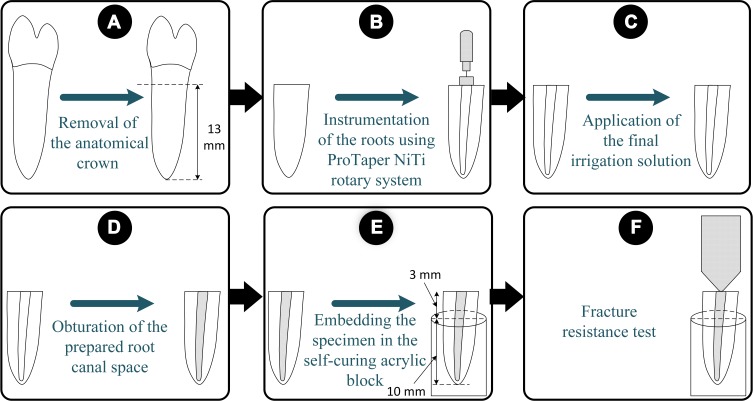
Sixty intact single-rooted premolar teeth were used after removing the crowns below the cementum-enamel junction to standardize the length of the remaining roots to 13 mm. After instrumenting the roots using ProTaper Universal rotary instruments up to size F4, the roots were randomly divided into six groups (n=10) according to the final irrigating solutions: Group 1: normal saline; Group 2: 2% chlorhexidine (CHX); Group 3: 17% EDTA+2.5% NaOCl; Group 4: 17% EDTA+0.1% silver nanoparticle (SNP) solution; Group 5: 17% EDTA+0.1% titanium dioxide nanoparticle (TNP) solution; Group 6: 17% EDTA+0.1% zinc oxide nanoparticle (ZNP) solution. After filling the root canals with gutta-percha and AH Plus sealer, the fracture resistance (FR) values were measured. The data were subjected to the one-way analysis of variance and the Tamhane post hoc test (p=0.05).
EDTA + NaOCl had the lowest FR value, followed by normal saline and CHX (p values < 0.05). No significant difference was found between the FR of roots irrigated with CHX and normal saline (p > 0.05). The application of nanoparticles (SNP, TNP, and ZNP) was associated with a significantly greater FR than that of other irrigation solutions (p values < 0.05).
The final irrigation of root canals with nanoparticles enhanced the fracture resistance of the endodontically treated roots. The lowest FR value was observed for NaOCl.
本研究旨在评估三种用作根管最终冲洗剂的纳米颗粒溶液对经根管治疗的牙根抗折性的影响。
选取60颗完整的单根前磨牙,在牙骨质-釉质界下方去除牙冠,将剩余牙根长度标准化为13mm。使用ProTaper通用旋转器械对牙根进行预备至F4号,然后根据最终冲洗液将牙根随机分为六组(n = 10):第1组:生理盐水;第2组:2%氯己定(CHX);第3组:17%乙二胺四乙酸(EDTA)+2.5%次氯酸钠(NaOCl);第4组:17% EDTA + 0.1%银纳米颗粒(SNP)溶液;第5组:17% EDTA + 0.1%二氧化钛纳米颗粒(TNP)溶液;第6组:17% EDTA + 0.1%氧化锌纳米颗粒(ZNP)溶液。用牙胶和AH Plus封闭剂充填根管后,测量抗折性(FR)值。数据进行单因素方差分析和Tamhanepost hoc检验(p = 0.05)。
EDTA + NaOCl的FR值最低,其次是生理盐水和CHX(p值<0.05)。CHX冲洗组和生理盐水冲洗组的牙根FR值之间无显著差异(p>0.05)。纳米颗粒(SNP、TNP和ZNP)的应用与其他冲洗液相比,FR值显著更高(p值<0.05)。
用纳米颗粒进行根管最终冲洗可增强经根管治疗牙根的抗折性。NaOCl的FR值最低。