Guangzhou Jinan Biomedicine Research and Development Center, National Engineering Research Center of Genetic Medicine, Jinan University, Guangzhou, Guangdong, China.
School of Pharmaceutical Sciences, Health Science Center, Shenzhen University, Shenzhen, China.
Virol J. 2020 Mar 19;17(1):41. doi: 10.1186/s12985-020-01315-z.
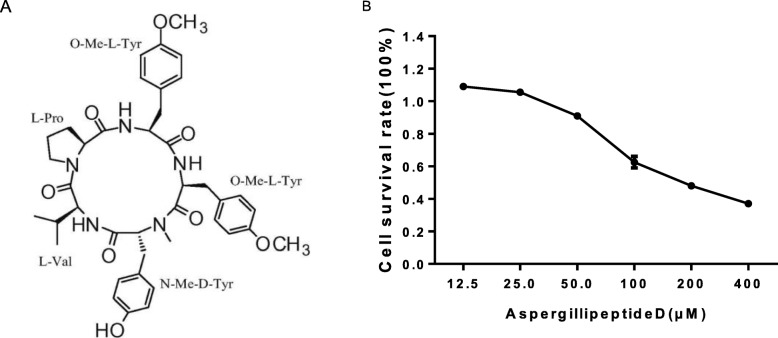
Herpes simplex virus 1, an enveloped DNA virus belonging to the Herpesviridae family, spreads to neurons and causes pathological changes in the central nervous system. The purpose of this study was to investigate the potency and mechanism of antiviral activity of Aspergillipeptide D, a cyclic pentapeptide isolated from a culture broth of marine gorgonian-derived fungus Aspergillus sp. SCSIO 41501, At present, there are many studies on the anti-tumor, anti-clotting, anti-oxidant and immunoinflammatory effects of Aspergillipeptide D, but little research has been done on the anti-HSV-1 activity of Aspergillipeptide D.
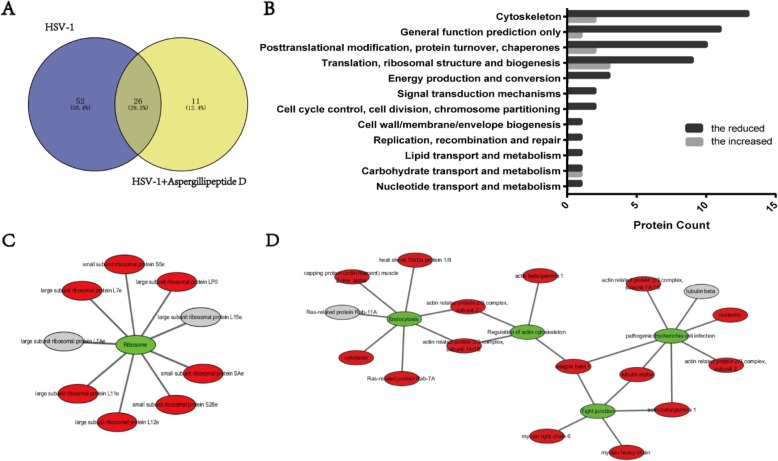
The anti-HSV-1 activity of Aspergillipeptide D was evaluated by plaque reduction assay. The mechanism of action against HSV-1 was determined from the effective stage. Then we assayed the viral DNA replication, viral RNA synthesis and protein expression, respectively. We also identified the proteins that interact with gB by mass spectrometry, and assayed the effect of Aspergillipeptide D on the interaction between the virus gB protein and cell proteins.
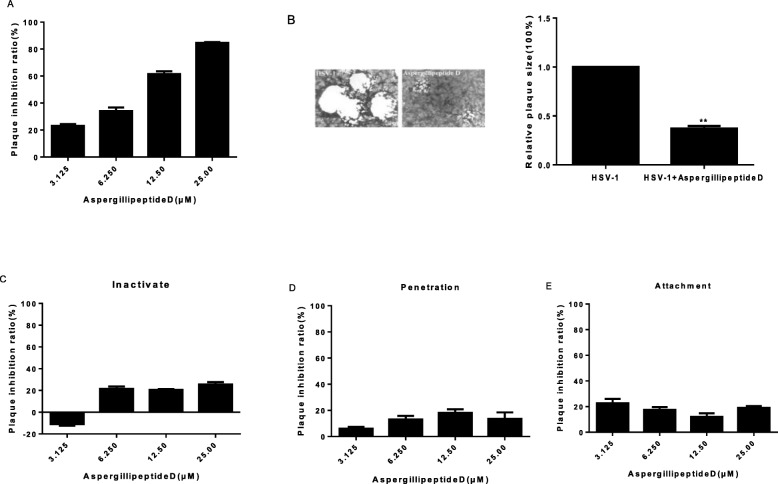
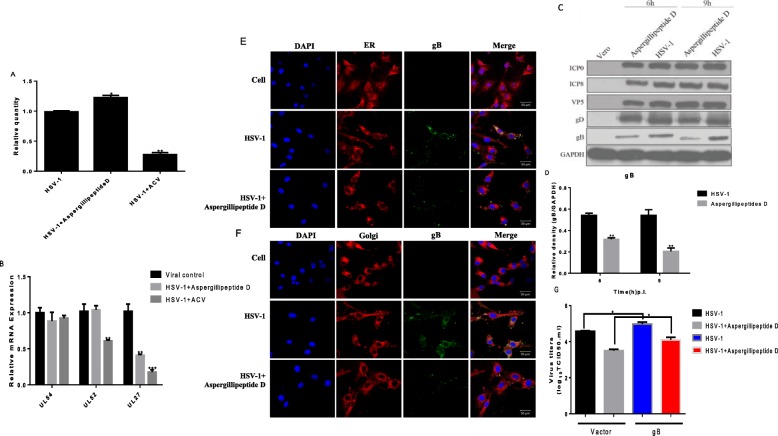
Plaque reduction experiments showed that Aspergillipeptide D did not affect HSV-1 early infection events, including viral inactivation, attachment and penetration. Interestingly, Aspergillipeptide D dramatically reduced both the gene and protein levels of viral late protein gB, and suppressed its location in the endoplasmic reticulum and Golgi apparatus. In contrast, overexpression of gB restored viral production. Finally, proteomic analysis revealed that the numbers of cellular proteins that interacted with gB protein was largely decreased by Aspergillipeptide D. These results suggested that Aspergillipeptide D inhibited gB function to affect HSV-1 intercellular spread.
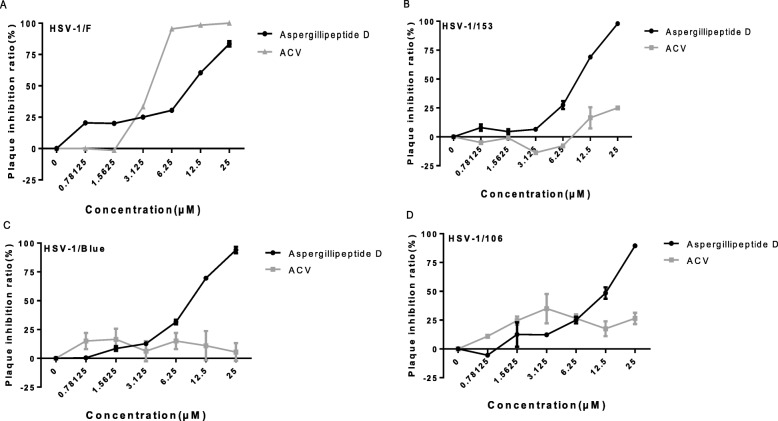
Our results indicated that Aspergillipeptide D might be a potential candidate for HSV-1 therapy, especially for ACV-resistant strains.
单纯疱疹病毒 1 是一种包膜 DNA 病毒,属于疱疹病毒科,可传播至神经元并导致中枢神经系统发生病变。本研究旨在探究从海洋柳珊瑚来源真菌 Aspergillus sp. SCSIO 41501 的发酵液中分离得到的环五肽化合物 Aspergillipeptide D 的抗病毒活性及其机制。目前已有许多关于 Aspergillipeptide D 的抗肿瘤、抗凝血、抗氧化和免疫调节作用的研究,但对 Aspergillipeptide D 抗单纯疱疹病毒 1(HSV-1)活性的研究甚少。
通过噬斑减少试验评估 Aspergillipeptide D 的抗 HSV-1 活性。从有效阶段确定其针对 HSV-1 的作用机制。然后,我们分别检测病毒 DNA 复制、病毒 RNA 合成和蛋白表达。我们还通过质谱鉴定与 gB 相互作用的蛋白,并检测 Aspergillipeptide D 对病毒 gB 蛋白与细胞蛋白相互作用的影响。
噬斑减少实验表明,Aspergillipeptide D 不影响 HSV-1 的早期感染事件,包括病毒失活、附着和穿透。有趣的是,Aspergillipeptide D 显著降低了病毒晚期蛋白 gB 的基因和蛋白水平,并抑制其在内质网和高尔基体中的定位。相比之下,gB 的过表达恢复了病毒的产生。最后,蛋白质组学分析表明,Aspergillipeptide D 大大减少了与 gB 蛋白相互作用的细胞蛋白数量。这些结果表明,Aspergillipeptide D 通过抑制 gB 功能来影响 HSV-1 的细胞间传播。
我们的结果表明,Aspergillipeptide D 可能是治疗 HSV-1 的潜在候选药物,特别是对 ACV 耐药株。