School of Biological Sciences, University of Reading, Whiteknights, Reading, RG6 6AJ, UK.
College of Arts, Sciences and Education, Biology Department, Texarkana, TX, 75503, USA.
Curr Microbiol. 2020 Aug;77(8):1438-1447. doi: 10.1007/s00284-020-01952-1. Epub 2020 Mar 19.
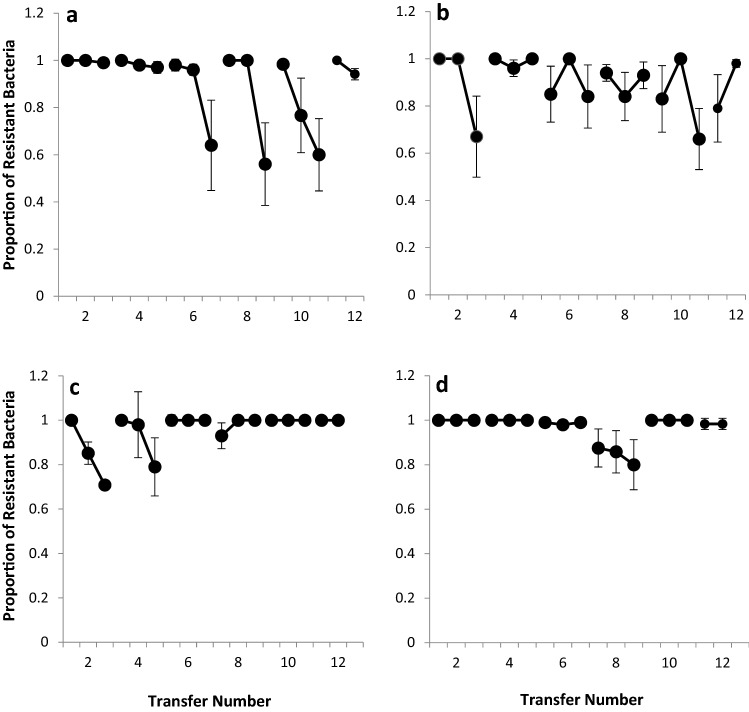
Bleeding canker of horse chestnut trees is a bacterial disease, caused by the bacterium Pseudomonas syringae pv. aesculi, estimated to be present in ~ 50% of UK horse chestnut trees. Currently, the disease has no cure and tree removal can be a common method of reducing inoculum and preventing spread. One potential method of control could be achieved using naturally occurring bacteriophages infective to the causative bacterium. Bacteriophages were isolated from symptomatic and asymptomatic horse chestnut trees in three locations in the South East of England. The phages were found to be belonging to both the Myoviridae and Podoviridae families by RAPD PCR and transmission electron microscopy. Experimental coevolution was carried out to understand the dynamics of bacterial resistance and phage infection and to determine whether new infective phage genotypes would emerge. The phages exhibited different coevolution patterns with their bacterial hosts across time. This approach could be used to generate novel phages for use in biocontrol cocktails in an effort to reduce the potential emergence of bacterial resistance.
栗疫病是一种细菌性疾病,由丁香假单胞菌 pv. aesculi 引起,据估计,这种细菌存在于英国约 50%的七叶树中。目前,这种疾病尚无治愈方法,移除树木通常是减少接种体和防止传播的常见方法。一种潜在的控制方法可能是利用自然存在的、能感染致病细菌的噬菌体。从英格兰东南部的三个地点的有症状和无症状的七叶树中分离出了噬菌体。通过 RAPD PCR 和透射电子显微镜发现,这些噬菌体属于肌尾噬菌体科和短尾噬菌体科。通过实验共进化来了解细菌抗性和噬菌体感染的动态,并确定是否会出现新的感染性噬菌体基因型。噬菌体与细菌宿主在不同时间表现出不同的共进化模式。这种方法可用于生成新型噬菌体,以用于生物防治鸡尾酒中,以减少细菌产生抗性的可能性。