Zhang Qian, Song Wei, Liang Xiaochun, Xie Jun, Shi Yue, Shi Xiaohu, Qiu Bintao, Chen Xiuting
Department of Traditional Chinese Medicine, Peking Union Medical College Hospital, Peking Union Medical College, Chinese Academy of Medical Sciences, Beijing, China.
Medical Research Center, Peking Union Medical College Hospital, Peking Union Medical College, Chinese Academy of Medical Sciences, Beijing, China.
Front Pharmacol. 2020 Mar 5;11:221. doi: 10.3389/fphar.2020.00221. eCollection 2020.
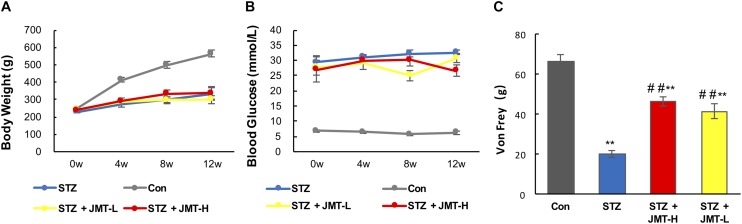
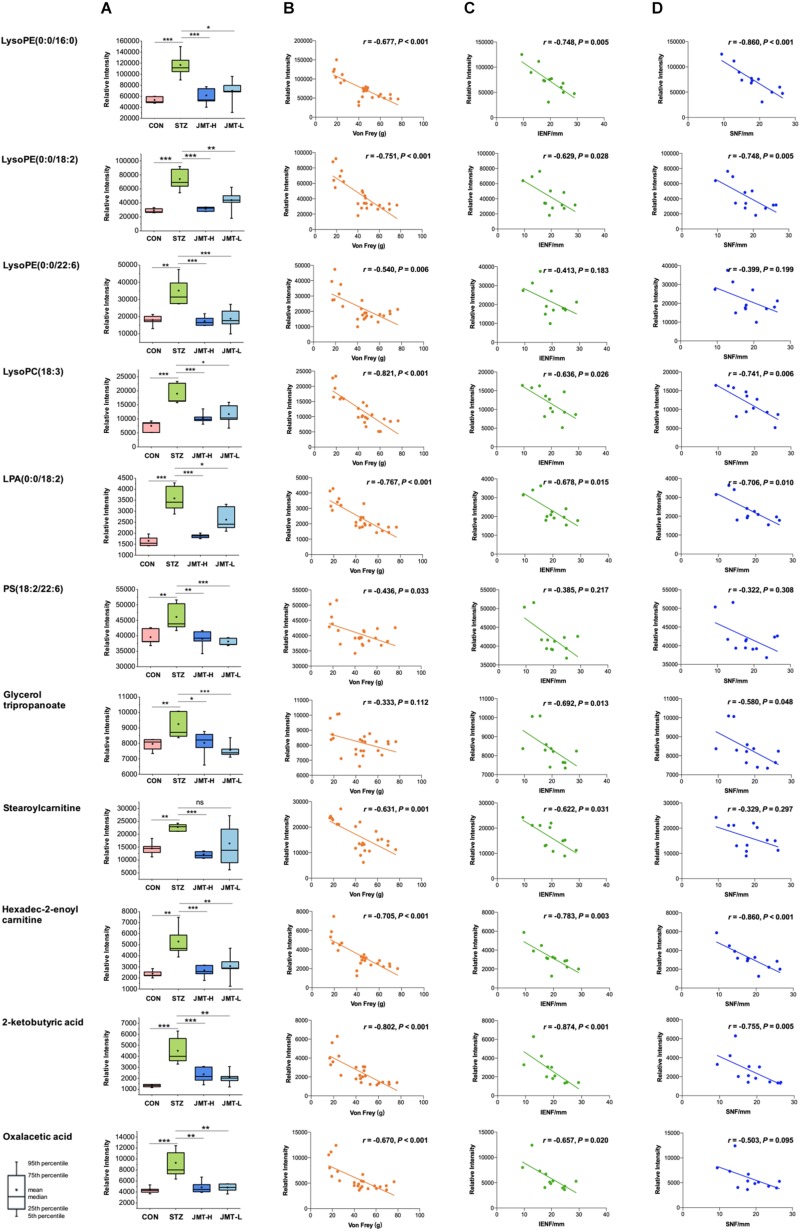
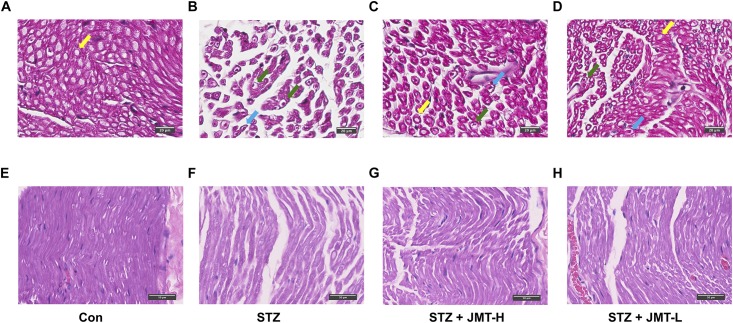
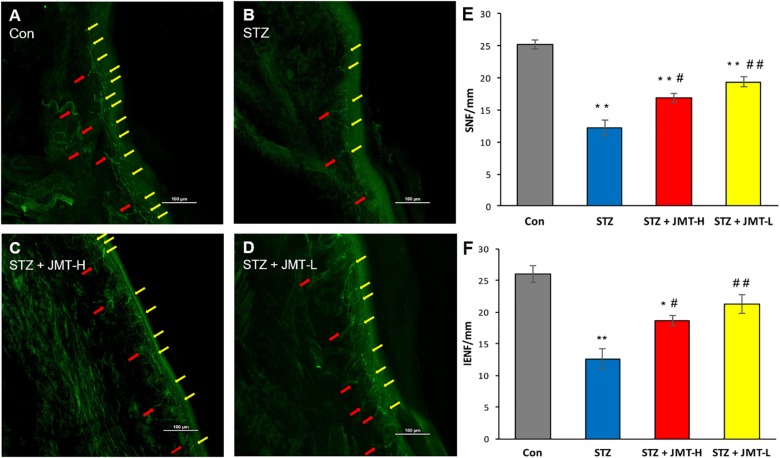
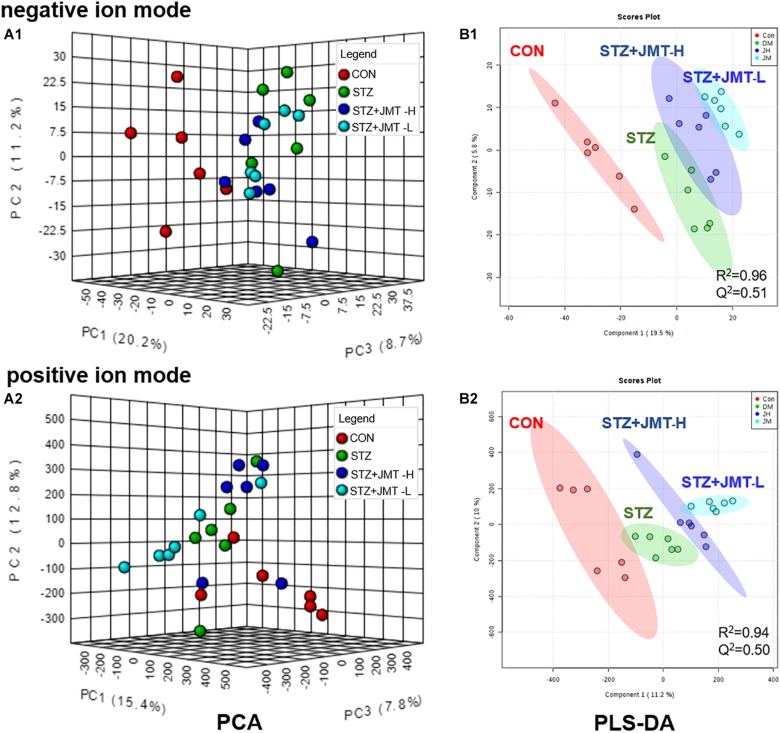
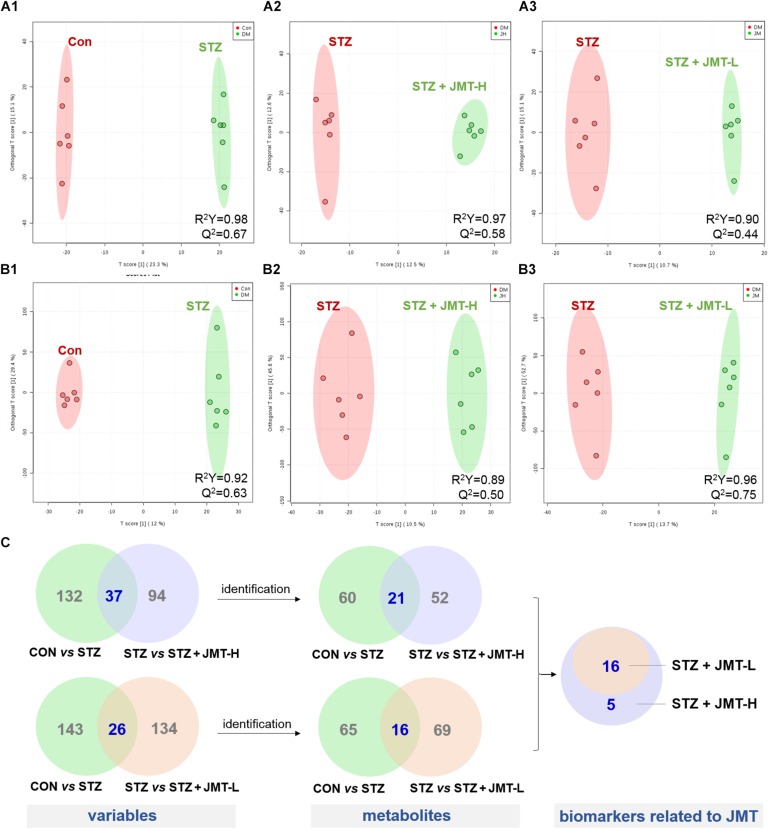
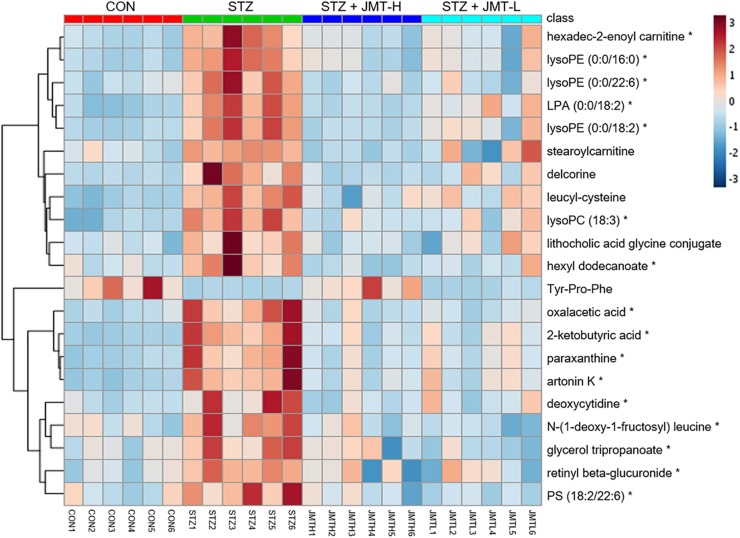
Jin-Mai-Tong (JMT) decoction is a traditional Chinese compound prescription for treating diabetic peripheral neuropathy (DPN). The aim of this study is to investigate the neuroprotective effect of JMT decoction on diabetic rats with peripheral neuropathy and to elucidate the potential mechanism based on a metabolomics approach. Sprague-Dawley (SD) rats were randomly divided into four groups: control group, Streptozotocin (STZ) induced model group, JMT low dose (JMT-L) treated group and JMT high dose (JMT-H) treated group. After 12 weeks of treatment, behavioral changes, small fiber loss, and histopathological damages of sciatic nerves were estimated. Serum samples were collected for untargeted metabolomics analysis based on UPLC/QTOF-MS and multivariate statistics. As a result, JMT treatment at two dosages (13.9 and 27.8 g/kg⋅d) evidently improved the mechanical pain threshold ( < 0.05), increased the intraepidermal nerve fiber density (IENFD) and subepidermal nerve fiber density (SNFD) ( < 0.05), and renovated the demyelination and axonal atrophy of sciatic nerves on DPN rats. Furthermore, metabolomics study revealed that the serum metabolic profiles altered significantly among the control group and the STZ-induced model group. A total of 21 metabolites were identified as potential biomarkers related to the therapeutic effect of JMT decoction. Among them, 16 biomarkers were found in both JMT-H and JMT-L treated groups, while the five others were specific to JMT-H group. These metabolites mainly involved in lipid metabolism, tricarboxylic acid (TCA) cycle, amino acid metabolism, and so on. Besides, correlation analysis indicated that both mechanical pain threshold and distal nerve fiber density were negatively correlated with the serum levels of metabolites from lipid metabolism and TCA cycle. In conclusion, the results demonstrated that JMT decoction has an obvious protective effect against DPN, which could be mediated via ameliorating the metabolic disorders in diabetic rats with peripheral neuropathy.
金脉通(JMT)汤是一种用于治疗糖尿病周围神经病变(DPN)的传统中药复方制剂。本研究旨在探讨JMT汤对糖尿病周围神经病变大鼠的神经保护作用,并基于代谢组学方法阐明其潜在机制。将Sprague-Dawley(SD)大鼠随机分为四组:对照组、链脲佐菌素(STZ)诱导模型组、JMT低剂量(JMT-L)治疗组和JMT高剂量(JMT-H)治疗组。治疗12周后,评估行为变化、小纤维丢失以及坐骨神经的组织病理学损伤。收集血清样本,基于超高效液相色谱/四极杆飞行时间质谱(UPLC/QTOF-MS)和多变量统计进行非靶向代谢组学分析。结果显示,两种剂量(13.9和27.8 g/kg⋅d)的JMT治疗均显著提高了机械痛阈(P<0.05),增加了表皮内神经纤维密度(IENFD)和表皮下神经纤维密度(SNFD)(P<0.05),并改善了DPN大鼠坐骨神经的脱髓鞘和轴突萎缩。此外,代谢组学研究表明,对照组和STZ诱导模型组之间血清代谢谱发生了显著改变。共鉴定出21种代谢物作为与JMT汤治疗效果相关的潜在生物标志物。其中,16种生物标志物在JMT-H和JMT-L治疗组中均有发现,另外5种则为JMT-H组所特有。这些代谢物主要涉及脂质代谢、三羧酸(TCA)循环、氨基酸代谢等。此外,相关性分析表明,机械痛阈和远端神经纤维密度均与脂质代谢和TCA循环代谢物的血清水平呈负相关。总之,结果表明JMT汤对DPN具有明显的保护作用,其作用机制可能是通过改善糖尿病周围神经病变大鼠的代谢紊乱来介导的。