Weinmüllner Regina, Zbiral Barbara, Becirovic Adnan, Stelzer Elena Maria, Nagelreiter Fabian, Schosserer Markus, Lämmermann Ingo, Liendl Lisa, Lang Magdalena, Terlecki-Zaniewicz Lucia, Andriotis Orestis, Mildner Michael, Golabi Bahar, Waidhofer-Söllner Petra, Schedle Karl, Emsenhuber Gerhard, Thurner Philipp J, Tschachler Erwin, Gruber Florian, Grillari Johannes
Christian Doppler Laboratory for Biotechnology of Skin Aging, Vienna, Austria.
2Department of Biotechnology, BOKU - University of Natural Resources and Life Sciences, Vienna, Austria.
NPJ Aging Mech Dis. 2020 Mar 6;6:4. doi: 10.1038/s41514-020-0042-x. eCollection 2020.
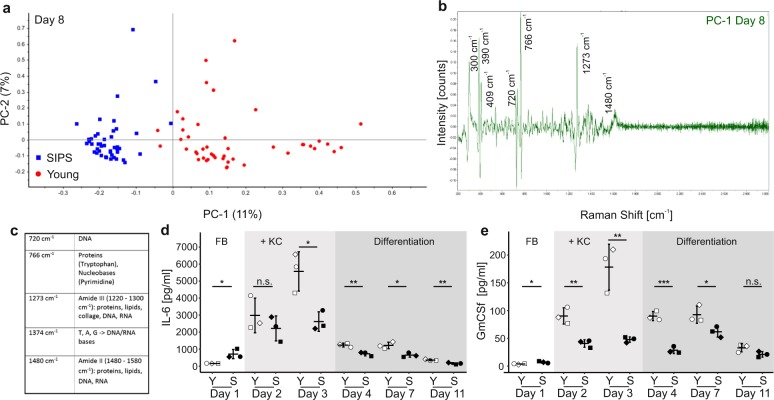
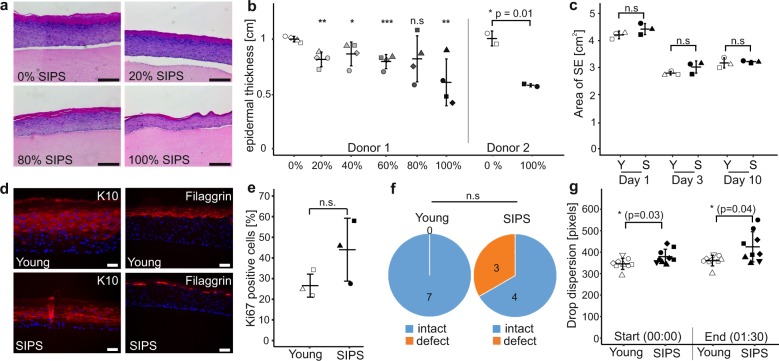
Skin aging is driven by intrinsic and extrinsic factors impacting on skin functionality with progressive age. One factor of this multifaceted process is cellular senescence, as it has recently been identified to contribute to a declining tissue functionality in old age. In the skin, senescent cells have been found to markedly accumulate with age, and thus might impact directly on skin characteristics. Especially the switch from young, extracellular matrix-building fibroblasts to a senescence-associated secretory phenotype (SASP) could alter the microenvironment in the skin drastically and therefore promote skin aging. In order to study the influence of senescence in human skin, 3D organotypic cultures are a well-suited model system. However, only few "aged" skin- equivalent (SE) models are available, requiring complex and long-term experimental setups. Here, we adapted a previously published full-thickness SE model by seeding increasing ratios of stress-induced premature senescent versus normal fibroblasts into the collagen matrix, terming these SE "senoskin". Immunohistochemistry stainings revealed a shift in the balance between proliferation (Ki67) and differentiation (Keratin 10 and Filaggrin) of keratinocytes within our senoskin equivalents, as well as partial impairment of skin barrier function and changed surface properties. Monitoring of cytokine levels of known SASP factors confirmedly showed an upregulation in 2D cultures of senescent cells and at the time of seeding into the skin equivalent. Surprisingly, we find a blunted response of cytokines in the senoskin equivalent over time during 3D differentiation.
皮肤老化是由随着年龄增长影响皮肤功能的内在和外在因素驱动的。这个多方面过程的一个因素是细胞衰老,因为最近已确定它会导致老年组织功能下降。在皮肤中,衰老细胞已被发现会随着年龄的增长而显著积累,因此可能直接影响皮肤特征。特别是从年轻的、构建细胞外基质的成纤维细胞转变为衰老相关分泌表型(SASP),可能会极大地改变皮肤中的微环境,从而促进皮肤老化。为了研究衰老对人类皮肤的影响,三维器官型培养是一个非常合适的模型系统。然而,只有少数“老化”的皮肤等效物(SE)模型可用,需要复杂且长期的实验设置。在这里,我们通过将应激诱导的早衰成纤维细胞与正常成纤维细胞以增加的比例接种到胶原蛋白基质中,改编了先前发表的全层SE模型,将这些SE称为“衰老皮肤”。免疫组织化学染色显示,在我们的衰老皮肤等效物中,角质形成细胞在增殖(Ki67)和分化(角蛋白10和丝聚蛋白)之间的平衡发生了变化,同时皮肤屏障功能部分受损,表面特性也发生了改变。对已知SASP因子细胞因子水平的监测证实,在衰老细胞的二维培养中以及接种到皮肤等效物时,细胞因子会上调。令人惊讶的是,我们发现在三维分化过程中,衰老皮肤等效物中细胞因子的反应随着时间的推移而减弱。