Benedetti Tânia Rosane Bertoldo, Rech Cassiano Ricardo, Konrad Lisandra Maria, Almeida Fabio Araujo, Brito Fabiana A, Chodzko-Zajko Wojtek, Schwingel Andiara
Sports Center, Federal University of Santa Catarina, Florianópolis, Brazil.
College of Public Health, University of Nebraska Medical Center, Omaha, NE, United States.
Front Public Health. 2020 Mar 5;8:48. doi: 10.3389/fpubh.2020.00048. eCollection 2020.
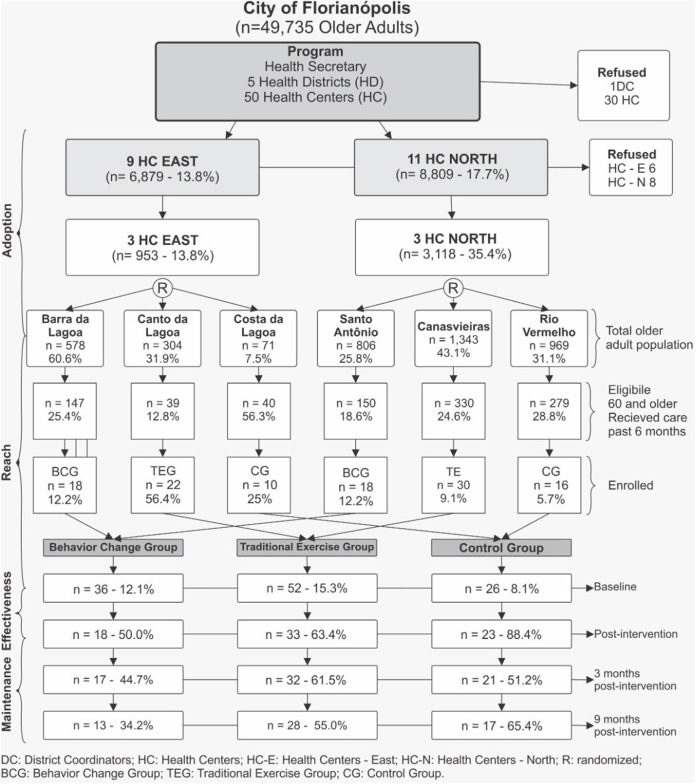
Explored the role of public health centers in the delivery of physical activity programs to older Brazilians. Total of 114 older adults (81% women) from public health centers across the city of Florianopolis, Brazil, were randomized into three groups: behavior change group ( = 36), traditional exercise group ( = 52), and control group ( = 26). The behavioral change group included 12 weekly meetings (2 h each). The traditional exercise group offered a 12-week exercise class. Individuals in the control group participated only in measurements. Program evaluation included a mixed-methods approach following the RE-AIM framework (reach, effectiveness, adoption, implementation, and maintenance). Trained interviewers conducted 12 focus groups and 32 interviews with participants in the program, professionals delivering the programs, community health workers, and local and city administrators overseeing public health centers. Participants completed health, quality of life, and fitness assessments at four time points. The study 11.5% of the eligible population in the community. Older adults' resistance to change and limited understanding of behavior change science by public health center staff hindered program reach. Physician encouraging patient participation and personal invitations by community health workers were perceived as favorable factors. Results of program suggest that behavior change strategies may be better suited than traditional exercise classes for decreasing sedentary time and increasing moderate-to-vigorous physical activity, as well as improving participants' quality of life. Only 14% of public health centers in the city adopted the programs. Heavy workload of health educators delivering the programs and limited physical space for program delivery were barriers for . The fidelity of program delivery was high and indicates that the programs are culturally-appropriate for the Brazilian context and feasible for implementation by local health educators. Our findings support the potential for dissemination of behavior change and traditional exercise programs to older adults through public health centers in Brazil. RBR-9pkxn2 (retrospectively registered) Register April 20, 2019.
探讨了公共卫生中心在为巴西老年人提供体育活动项目方面的作用。来自巴西弗洛里亚诺波利斯市各公共卫生中心的114名老年人(81%为女性)被随机分为三组:行为改变组(n = 36)、传统运动组(n = 52)和对照组(n = 26)。行为改变组包括每周12次会议(每次2小时)。传统运动组提供为期12周的健身课程。对照组的个体仅参与测量。项目评估采用了遵循RE-AIM框架(覆盖范围、有效性、采用情况、实施情况和维持情况)的混合方法。经过培训的访谈员对项目参与者、项目实施专业人员、社区卫生工作者以及监督公共卫生中心的地方和城市管理人员进行了12次焦点小组访谈和32次访谈。参与者在四个时间点完成了健康、生活质量和体能评估。该研究覆盖了社区中11.5%的符合条件人群。老年人对改变的抵触以及公共卫生中心工作人员对行为改变科学的理解有限阻碍了项目的覆盖范围。医生鼓励患者参与以及社区卫生工作者的个人邀请被视为有利因素。项目结果表明,与传统健身课程相比,行为改变策略可能更适合减少久坐时间、增加中度至剧烈身体活动以及改善参与者的生活质量。该市只有14%的公共卫生中心采用了这些项目。实施项目的健康教育工作者工作量大以及项目实施的物理空间有限是实施方面的障碍。项目实施的保真度很高,表明这些项目在文化上适合巴西的情况,并且当地健康教育工作者实施可行。我们的研究结果支持了通过巴西的公共卫生中心向老年人传播行为改变和传统运动项目的潜力。RBR-9pkxn2(回顾性注册)于2019年4月20日注册。