,.
Invest Ophthalmol Vis Sci. 2020 Mar 9;61(3):36. doi: 10.1167/iovs.61.3.36.
To test whether ganglion cell layer (GCL) and inner plexiform layer (IPL) topography is altered in albinism.
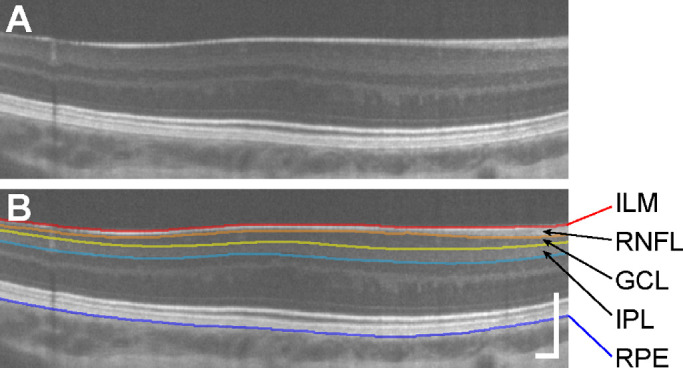
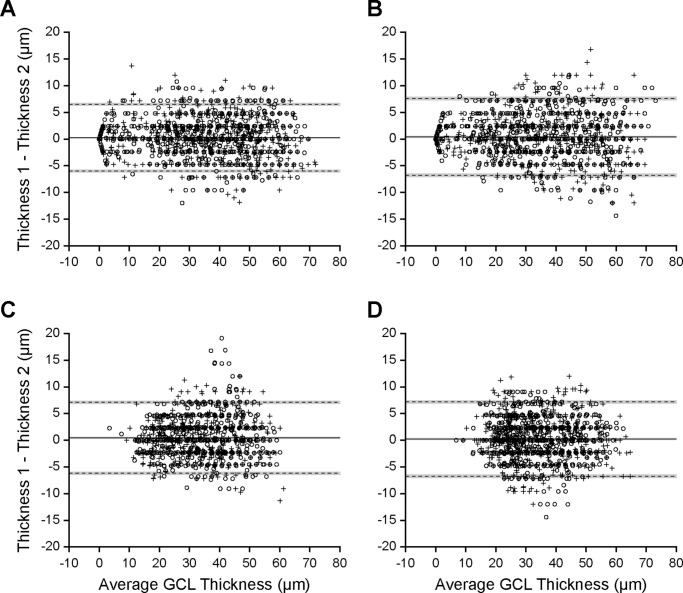
Optical coherence tomography scans were analyzed in 30 participants with albinism and 25 control participants. Horizontal and vertical line scans were acquired at the fovea, then strip registered and averaged. The Duke Optical Coherence Tomography Retinal Analysis Program was used to automatically segment the combined GCL and IPL and total retinal thickness, followed by program-assisted manual segmentation of the boundary between the GCL and IPL. Layer thickness and area under the curve (AUC) were calculated within 2.5 mm of the fovea. Nasal-temporal and superior-inferior asymmetry were calculated as an AUC ratio in each quadrant.
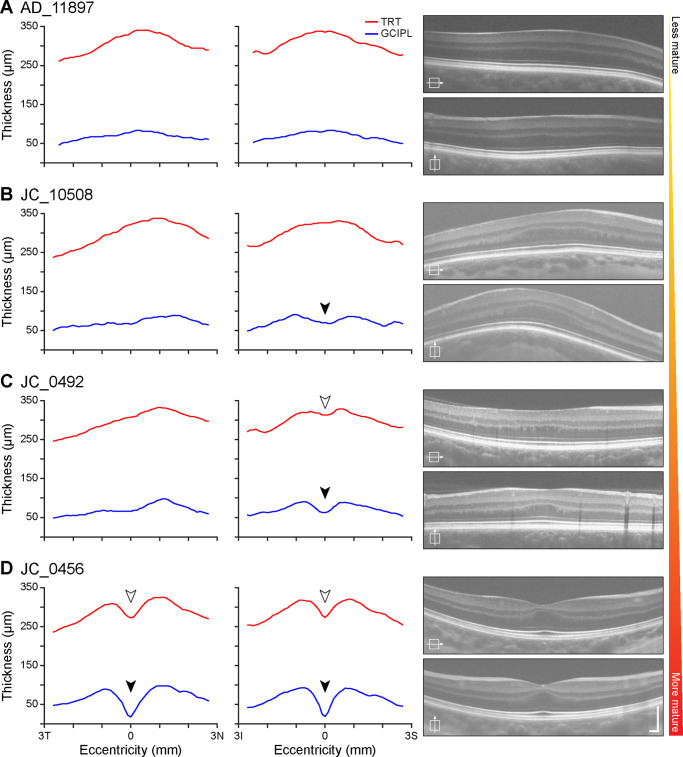
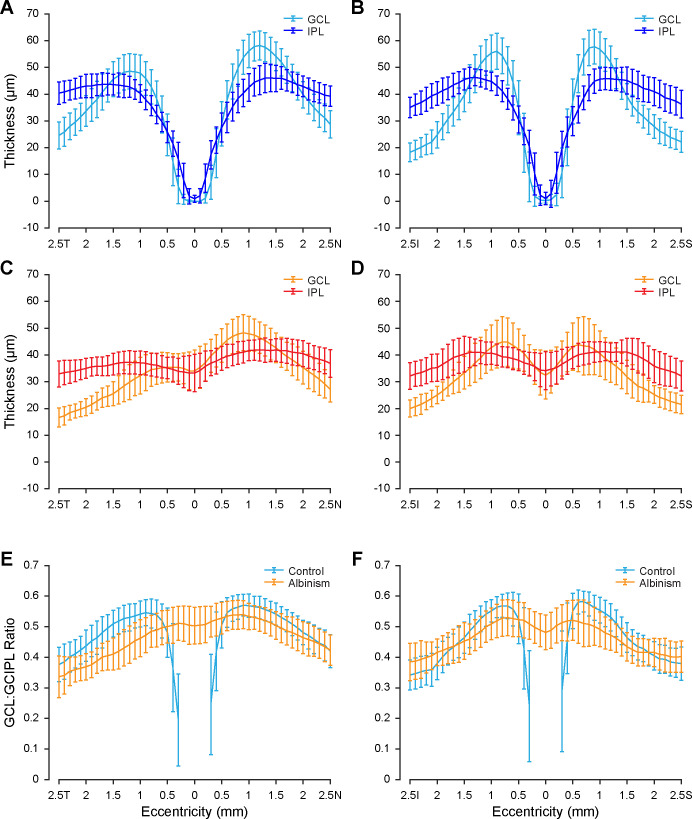
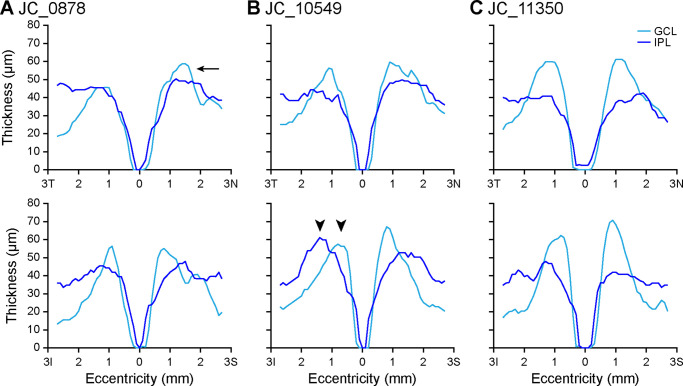
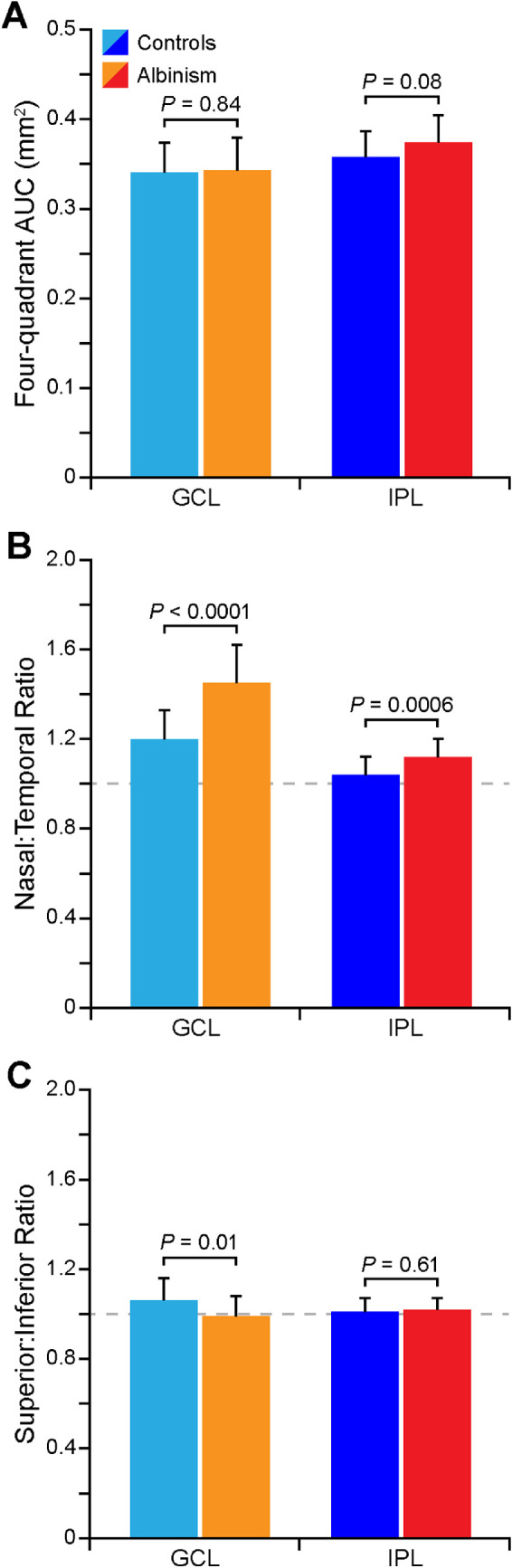
GCL and IPL topography varied between participants. The summed AUC in all quadrants was similar between groups for both the GCL (P = 0.84) and IPL (P = 0.08). Both groups showed nasal-temporal asymmetry in the GCL, but only participants with albinism had nasal-temporal asymmetry in the IPL. Nasal-temporal asymmetry was greater in albinism for both the GCL (P < 0.0001) and the IPL (P = 0.0006). The GCL usually comprised a greater percentage of the combined GCL and IPL in controls than in albinism.
The GCL and IPL have greater structural variability than previously reported. GCL and IPL topography are significantly altered in albinism, which suggests differences in the spatial distribution of retinal ganglion cells. This finding provides insight into foveal development and structure-function relationships in foveal hypoplasia.
检测在白化病中神经节细胞层(GCL)和内丛状层(IPL)的地形是否发生改变。
对 30 名白化病患者和 25 名对照者的光学相干断层扫描进行了分析。在黄斑区采集水平和垂直线扫描,然后进行条带配准和平均。使用 Duke 光学相干断层扫描视网膜分析程序自动分割 GCL 和 IPL 的总和以及总视网膜厚度,然后使用程序辅助手动分割 GCL 和 IPL 之间的边界。在距黄斑 2.5 毫米范围内计算层厚度和曲线下面积(AUC)。在每个象限中计算鼻颞侧和上-下侧的不对称性作为 AUC 比值。
GCL 和 IPL 的地形在参与者之间存在差异。两组的 GCL(P = 0.84)和 IPL(P = 0.08)在所有象限的总和 AUC 相似。两组 GCL 均存在鼻颞侧不对称性,但只有白化病患者的 IPL 存在鼻颞侧不对称性。白化病患者的 GCL(P < 0.0001)和 IPL(P = 0.0006)的鼻颞侧不对称性更大。GCL 在对照组中通常占 GCL 和 IPL 总和的比例大于白化病患者。
GCL 和 IPL 的结构变异性大于先前报道。GCL 和 IPL 在白化病中存在明显改变,这表明视网膜神经节细胞的空间分布存在差异。这一发现为黄斑发育和结构-功能关系提供了深入了解。