Institute of Diagnostic and Interventional Radiology, Faculty of Medicine and University Hospital of Cologne, University of Cologne, Cologne, Germany.
Department of Radiology and Nuclear Medicine, University Hospital of Magdeburg, Magdeburg, Germany.
PLoS One. 2020 Mar 20;15(3):e0230024. doi: 10.1371/journal.pone.0230024. eCollection 2020.
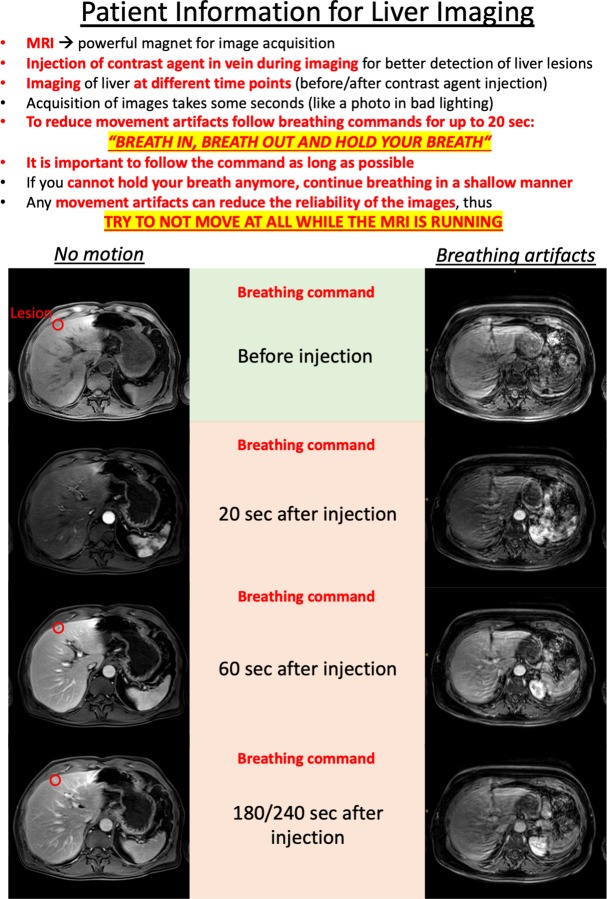
The objective of this study is to evaluate if intensified pre-scan patient preparation (IPPP) that comprises custom-made educational material on dynamic phase imaging and supervised pre-imaging breath-hold training in addition to standard informative conversation with verbal explanation of breath-hold commands (standard pre-scan patient preparation-SPPP) might reduce the incidence of gadoxetate disodium (Gd-EOB-DTPA)-related transient severe respiratory motion (TSM) and severity of respiratory motion (RM) during dynamic phase liver MRI.
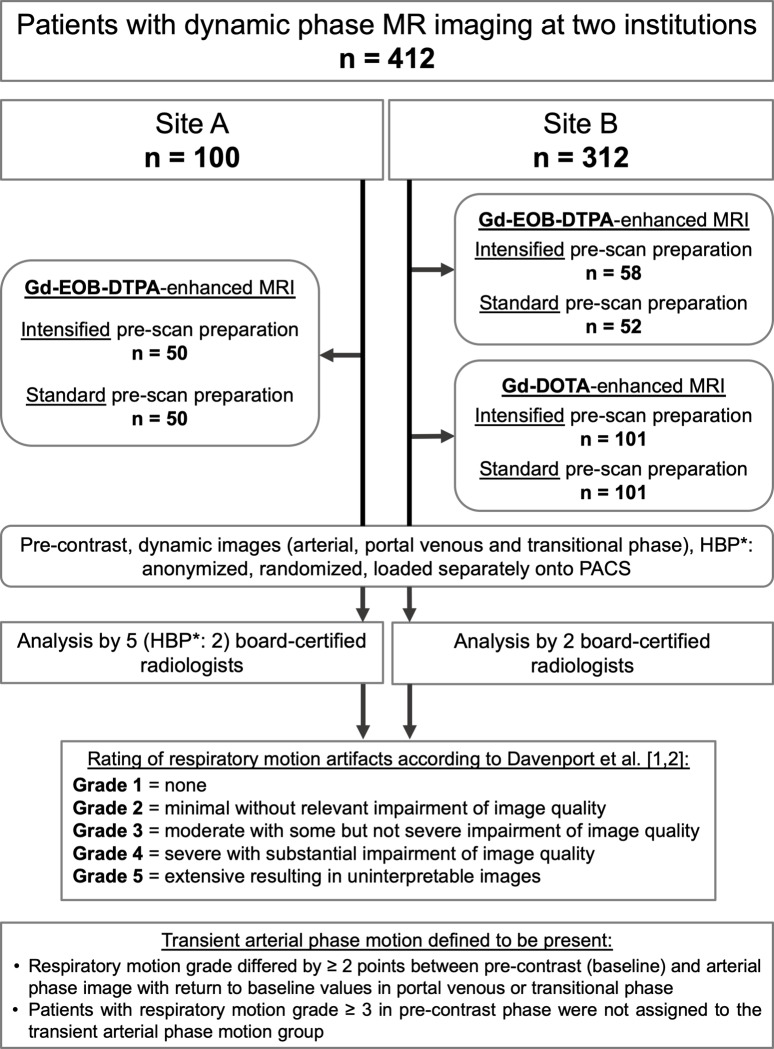
In this bi-institutional study 100 and 110 patients who received Gd-EOB-DTPA for dynamic phase liver MRI were allocated to either IPPP or SPPP at site A and B. The control group comprised 202 patients who received gadoterate meglumine (Gd-DOTA) of which each 101 patients were allocated to IPPP or SPPP at site B. RM artefacts were scored retrospectively in dynamic phase images (1: none- 5: extensive) by five and two blinded readers at site A and B, respectively, and in the hepatobiliary phase of the Gd-EOB-DTPA-enhanced scans by two blinded readers at either site.
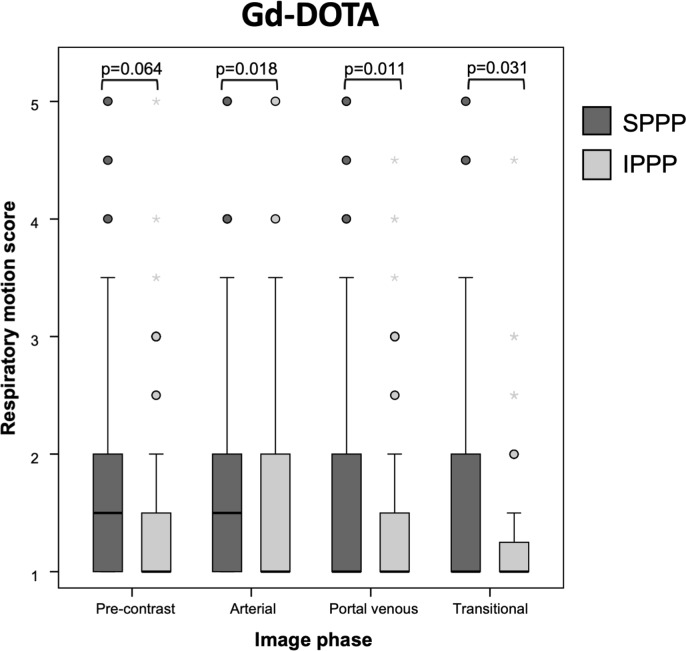
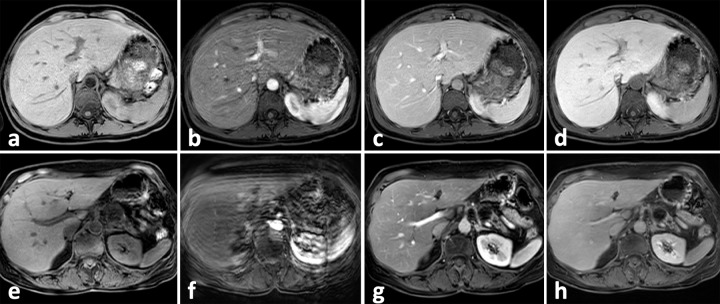
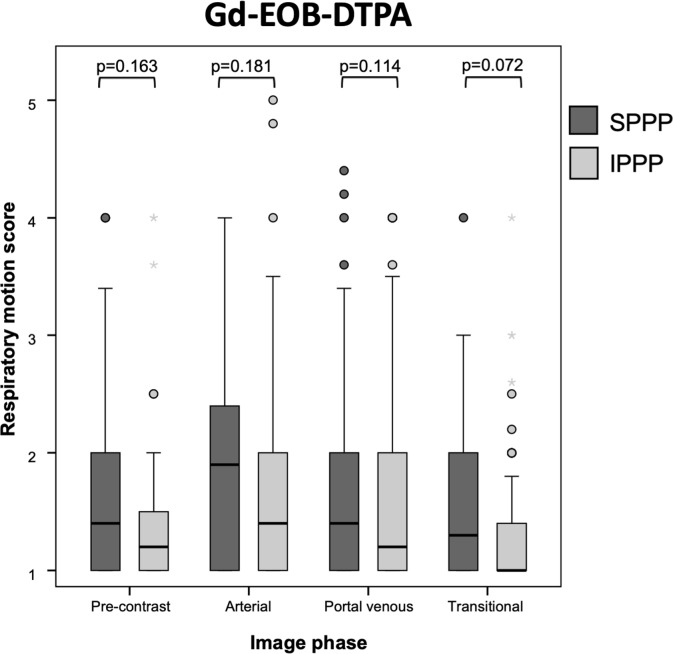
The incidence of TSM was 15% at site A and 22.7% at site B (p = 0.157). IPPP did not reduce the incidence of TSM in comparison to SPPP: 16.7% vs. 21.6% (p = 0.366). This finding was consistent at site A: 12% vs. 18% (p = 0.401) and site B: 20.6% vs. 25% (p = 0.590). The TSM incidence in patients with IPPP and SPPP did not differ significantly between both sites (p = 0.227; p = 0.390). IPPP did not significantly mitigate RM in comparison to SPPP in any of the Gd-EOB-DTPA-enhanced dynamic phases and the hepatobiliary phase in patients without TSM (all p≥0.072). In the Gd-DOTA control group on the other hand, IPPP significantly mitigated RM in all dynamic phases in comparison to SPPP (all p≤0.031).
We conclude that Gd-EOB-DTPA-related TSM cannot be mitigated by education and training and that Gd-EOB-DTPA-related breath-hold difficulty does not only affect the subgroup of patients with TSM or exclusively the arterial phase as previously proposed.
本研究旨在评估强化扫描前患者准备(IPPP)是否可以降低钆塞酸二钠(Gd-EOB-DTPA)相关的短暂性剧烈呼吸运动(TSM)的发生率和动态相肝 MRI 期间呼吸运动(RM)的严重程度,该方法包括针对动态相成像的定制教育材料以及监督预扫描屏气训练,此外还包括与口头解释屏气命令相结合的标准信息性对话(标准扫描前患者准备-SPPP)。
在这项双机构研究中,将在站点 A 和 B 接受 Gd-EOB-DTPA 进行动态相肝 MRI 的 100 名和 110 名患者分别分配至 IPPP 或 SPPP 组。对照组由 202 名接受钆特酸葡胺(Gd-DOTA)的患者组成,其中在站点 B 分别为 101 名患者分配至 IPPP 或 SPPP 组。由五位和两位在站点 A 和 B 分别进行盲法评估的读者对动态相图像(1:无-5:广泛)中的 RM 伪影进行回顾性评分,在 Gd-EOB-DTPA 增强扫描的肝胆相期由两位在任何站点的盲法读者进行评估。
在站点 A 和站点 B,TSM 的发生率分别为 15%和 22.7%(p = 0.157)。与 SPPP 相比,IPPP 并未降低 TSM 的发生率:16.7%对 21.6%(p = 0.366)。在站点 A:12%对 18%(p = 0.401)和站点 B:20.6%对 25%(p = 0.590),这一发现是一致的。在 IPPP 和 SPPP 组的患者中,TSM 的发生率在两个站点之间没有显著差异(p = 0.227;p = 0.390)。在没有 TSM 的患者中,与 SPPP 相比,IPPP 并未显著减轻任何 Gd-EOB-DTPA 增强动态相和肝胆相期的 RM(所有 p≥0.072)。另一方面,在 Gd-DOTA 对照组中,与 SPPP 相比,IPPP 显著减轻了所有动态相期的 RM(所有 p≤0.031)。
我们得出结论,不能通过教育和培训减轻 Gd-EOB-DTPA 相关的 TSM,并且 Gd-EOB-DTPA 相关的屏气困难不仅影响 TSM 患者亚组或如先前提出的仅影响动脉期。