Hindley Guy, Beck Katherine, Borgan Faith, Ginestet Cedric E, McCutcheon Robert, Kleinloog Daniel, Ganesh Suhas, Radhakrishnan Rajiv, D'Souza Deepak Cyril, Howes Oliver D
Department of Psychosis Studies, Institute of Psychiatry, Psychology and Neuroscience, King's College London, London, UK.
Department of Psychosis Studies, Institute of Psychiatry, Psychology and Neuroscience, King's College London, London, UK; South London and the Maudsley NHS Foundation Trust, London, UK; MRC London Institute of Medical Sciences, Hammersmith Hospital Campus, London, UK; Institute of Clinical Sciences, Faculty of Medicine, Imperial College London, London, UK.
Lancet Psychiatry. 2020 Apr;7(4):344-353. doi: 10.1016/S2215-0366(20)30074-2. Epub 2020 Mar 17.
Approximately 188 million people use cannabis yearly worldwide, and it has recently been legalised in 11 US states, Canada, and Uruguay for recreational use. The potential for increased cannabis use highlights the need to better understand its risks, including the acute induction of psychotic and other psychiatric symptoms. We aimed to investigate the effect of the cannabis constituent Δ-tetrahydrocannabinol (THC) alone and in combination with cannabidiol (CBD) compared with placebo on psychiatric symptoms in healthy people.
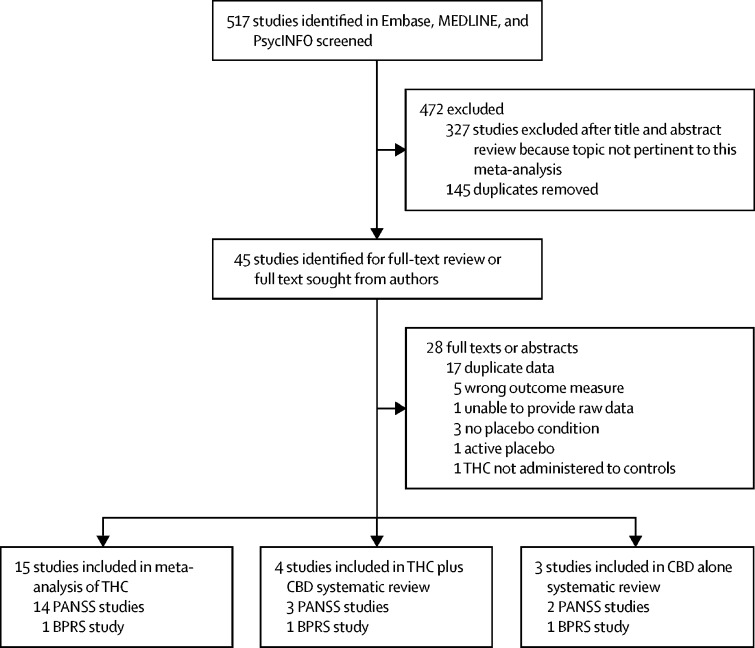
In this systematic review and meta-analysis, we searched MEDLINE, Embase, and PsycINFO for studies published in English between database inception and May 21, 2019, with a within-person, crossover design. Inclusion criteria were studies reporting symptoms using psychiatric scales (the Brief Psychiatric Rating Scale [BPRS] and the Positive and Negative Syndrome Scale [PANSS]) following the acute administration of intravenous, oral, or nasal THC, CBD, and placebo in healthy participants, and presenting data that allowed calculation of standardised mean change (SMC) scores for positive (including delusions and hallucinations), negative (such as blunted affect and amotivation), and general (including depression and anxiety) symptoms. We did a random-effects meta-analysis to assess the main outcomes of the effect sizes for total, positive, and negative PANSS and BPRS scores measured in healthy participants following THC administration versus placebo. Because the number of studies to do a meta-analysis on CBD's moderating effects was insufficient, this outcome was only systematically reviewed. This study is registered with PROSPERO, CRD42019136674.
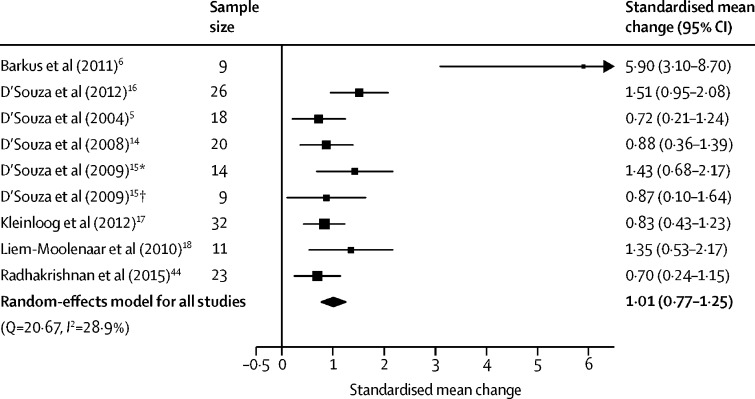
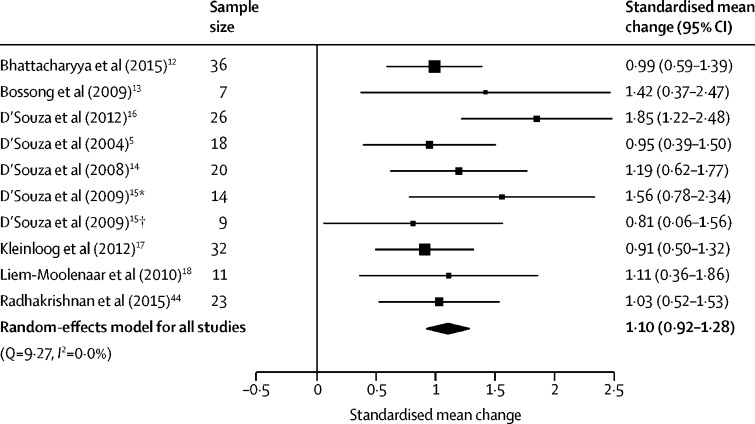
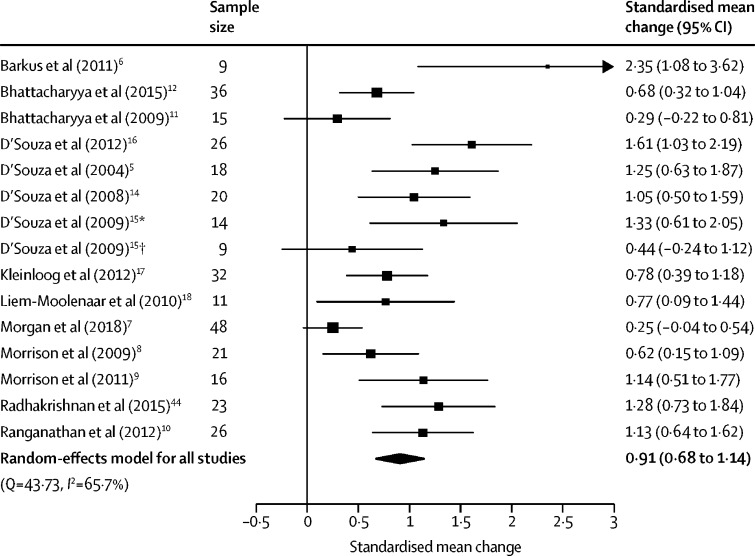
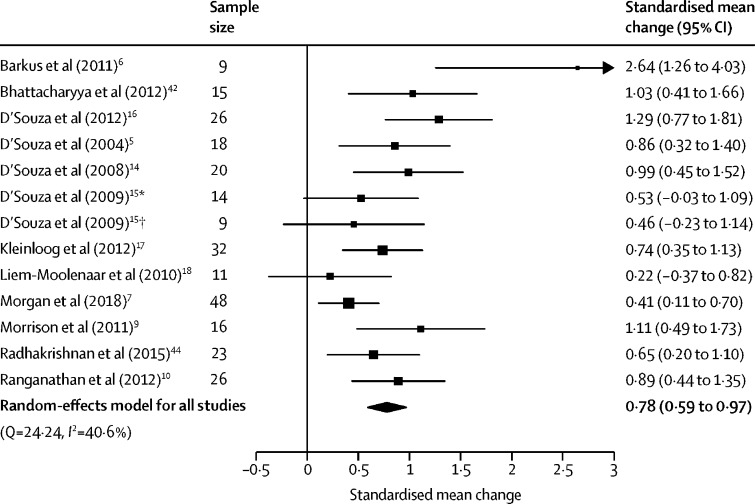
15 eligible studies involving the acute administration of THC and four studies on CBD plus THC administration were identified. Compared with placebo, THC significantly increased total symptom severity with a large effect size (assessed in nine studies, with ten independent samples, involving 196 participants: SMC 1·10 [95% CI 0·92-1·28], p<0·0001); positive symptom severity (assessed in 14 studies, with 15 independent samples, involving 324 participants: SMC 0·91 [95% CI 0·68-1·14], p<0·0001); and negative symptom severity with a large effect size (assessed in 12 studies, with 13 independent samples, involving 267 participants: SMC 0·78 [95% CI 0·59-0·97], p<0·0001). In the systematic review, of the four studies evaluating CBD's effects on THC-induced symptoms, only one identified a significant reduction in symptoms.
A single THC administration induces psychotic, negative, and other psychiatric symptoms with large effect sizes. There is no consistent evidence that CBD induces symptoms or moderates the effects of THC. These findings highlight the potential risks associated with the use of cannabis and other cannabinoids that contain THC for recreational or therapeutic purposes.
UK Medical Research Council, Maudsley Charity, Brain and Behavior Research Foundation, Wellcome Trust, and the UK National Institute for Health Research.
全球每年约有1.88亿人使用大麻,最近美国11个州、加拿大和乌拉圭已将其娱乐性使用合法化。大麻使用增加的可能性凸显了更好地了解其风险的必要性,包括急性诱发精神病性症状和其他精神症状。我们旨在研究大麻成分Δ-四氢大麻酚(THC)单独使用以及与大麻二酚(CBD)联合使用相比安慰剂对健康人精神症状的影响。
在这项系统评价和荟萃分析中,我们检索了MEDLINE、Embase和PsycINFO中从数据库建立至2019年5月21日期间以英文发表的采用自身交叉设计的研究。纳入标准为报告了在健康参与者中急性静脉注射、口服或鼻用THC、CBD和安慰剂后使用精神科量表(简明精神病评定量表[BPRS]和阳性与阴性症状量表[PANSS])评估症状的研究,且提供的数据能够计算阳性(包括妄想和幻觉)、阴性(如情感迟钝和意志缺乏)和一般(包括抑郁和焦虑)症状的标准化平均变化(SMC)分数。我们进行了随机效应荟萃分析,以评估在健康参与者中给予THC后与安慰剂相比,PANSS和BPRS总分、阳性分和阴性分效应量的主要结局。由于进行CBD调节作用荟萃分析的研究数量不足,该结局仅进行了系统评价。本研究已在国际前瞻性系统评价注册库(PROSPERO)注册,注册号为CRD42019136674。
确定了15项涉及急性给予THC的合格研究以及4项关于CBD加THC给药的研究。与安慰剂相比,THC显著增加了总症状严重程度,效应量较大(在9项研究中评估,有10个独立样本,涉及196名参与者:SMC 1.10[95%CI 0.92 - 1.28],p<0.0001);阳性症状严重程度(在14项研究中评估,有15个独立样本,涉及324名参与者:SMC 0.91[95%CI 0.68 - 1.14],p<0.0001);以及阴性症状严重程度,效应量较大(在12项研究中评估,有13个独立样本,涉及267名参与者:SMC 0.78[95%CI 0.59 - 0.97],p<0.0001)。在系统评价中,在评估CBD对THC诱发症状影响的4项研究中,只有1项发现症状有显著减轻。
单次给予THC会诱发精神病性、阴性及其他精神症状,且效应量较大。没有一致的证据表明CBD会诱发症状或调节THC的作用。这些发现凸显了使用大麻及其他含THC的大麻素用于娱乐或治疗目的所带来的潜在风险。
英国医学研究理事会、莫兹利慈善机构、大脑与行为研究基金会、惠康信托基金会以及英国国家卫生研究院。