Department of Microbiology and Molecular Genetics, Michigan State University, East Lansing, MI 48824, USA.
Department of Plant, Soil and Microbial Sciences, Michigan State University, East Lansing, MI 48824, USA.
Philos Trans R Soc Lond B Biol Sci. 2020 May 11;375(1798):20190255. doi: 10.1098/rstb.2019.0255. Epub 2020 Mar 23.
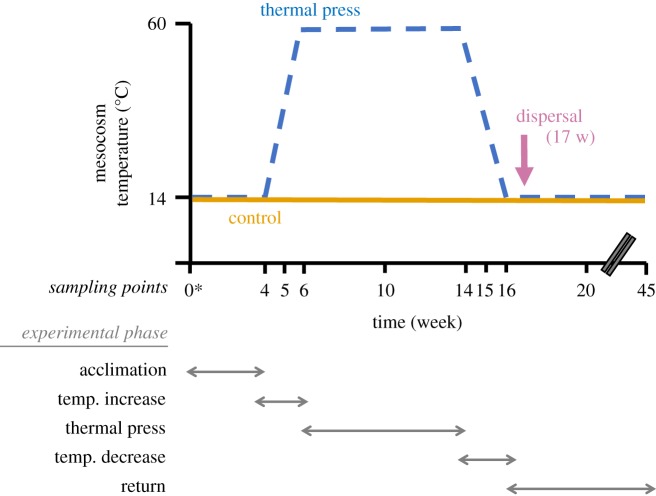
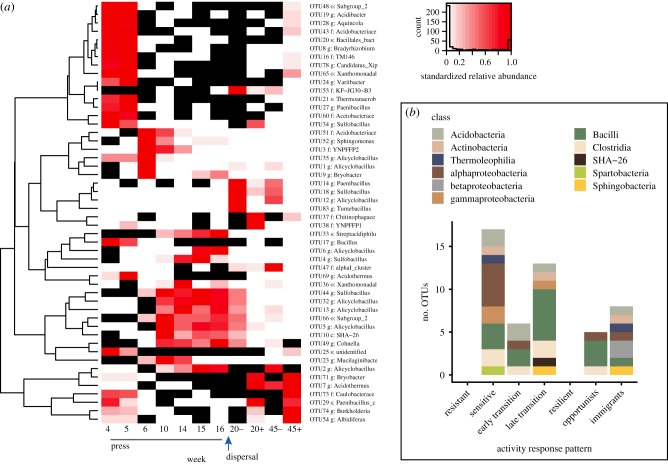
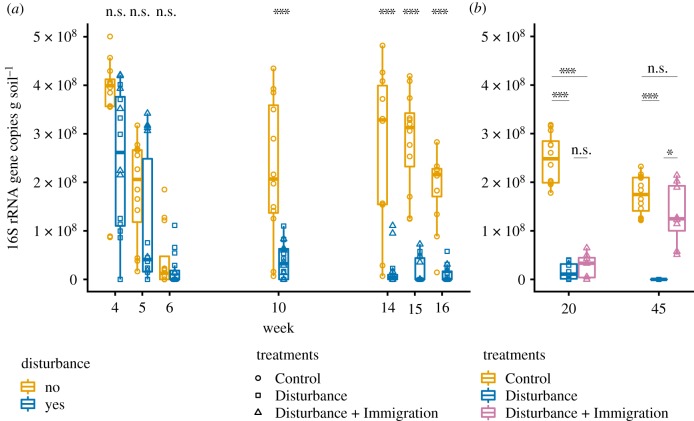
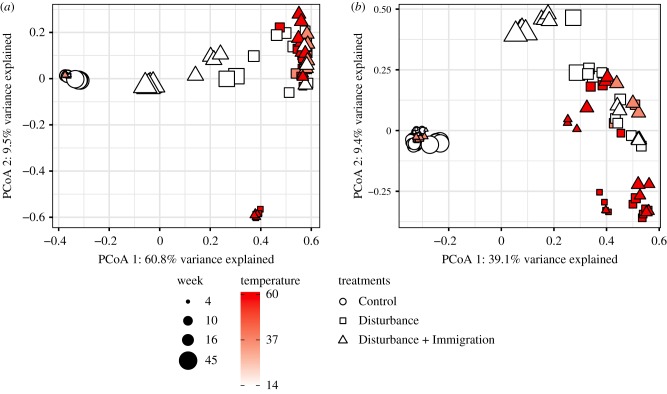
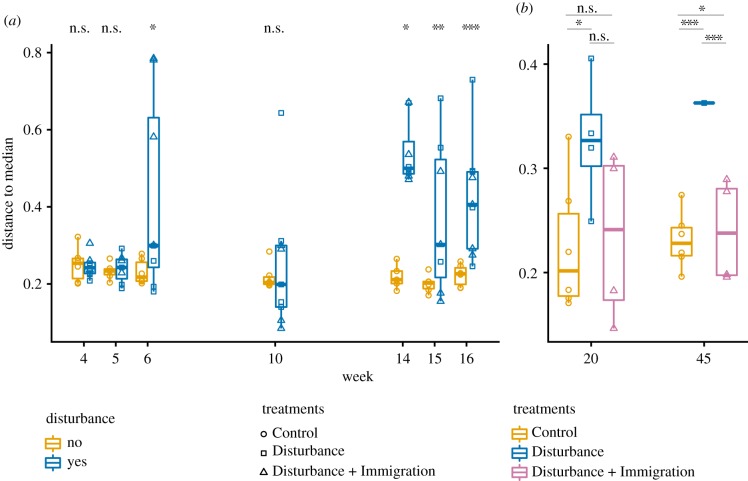
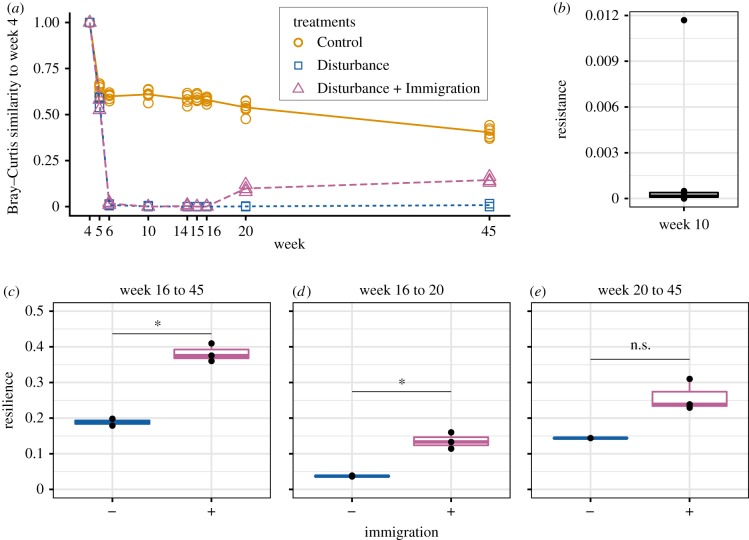
In disturbance ecology, stability is composed of resistance to change and resilience towards recovery after the disturbance subsides. Two key microbial mechanisms that can support microbiome stability include dormancy and dispersal. Specifically, microbial populations that are sensitive to disturbance can be re-seeded by local dormant pools of viable and reactivated cells, or by immigrants dispersed from regional metacommunities. However, it is difficult to quantify the contributions of these mechanisms to stability without, first, distinguishing the active from inactive membership, and, second, distinguishing the populations recovered by local resuscitation from those recovered by dispersed immigrants. Here, we investigate the contributions of dormancy dynamics (activation and inactivation), and dispersal to soil microbial community resistance and resilience. We designed a replicated, 45-week time-series experiment to quantify the responses of the active soil microbial community to a thermal press disturbance, including unwarmed control mesocosms, disturbed mesocosms without dispersal, and disturbed mesocosms with dispersal after the release of the stressor. Communities changed in structure within one week of warming. Though the disturbed mesocosms did not fully recover within 29 weeks, resuscitation of thermotolerant taxa was key for community transition during the press, and both resuscitation of opportunistic taxa and immigration contributed to community resilience. Also, mesocosms with dispersal were more resilient than mesocosms without. This work advances the mechanistic understanding of how microbiomes respond to disturbances in their environment. This article is part of the theme issue 'Conceptual challenges in microbial community ecology'.
在干扰生态学中,稳定性由对变化的抵抗力和干扰消退后恢复的弹性组成。支持微生物组稳定性的两个关键微生物机制包括休眠和分散。具体来说,对干扰敏感的微生物种群可以通过局部休眠的存活和可激活细胞池重新播种,或者通过来自区域宏群落的移民分散来重新播种。然而,如果不首先将活跃成员与非活跃成员区分开来,其次不将通过局部复苏恢复的种群与通过分散移民恢复的种群区分开来,就很难量化这些机制对稳定性的贡献。在这里,我们研究了休眠动力学(激活和失活)和分散对土壤微生物群落抵抗力和弹性的贡献。我们设计了一个重复的 45 周时间序列实验,以量化活性土壤微生物群落对热压力干扰的反应,包括未加热对照中体、没有分散的受干扰中体,以及在释放胁迫后有分散的受干扰中体。在升温后的一周内,群落结构发生了变化。虽然受干扰的中体在 29 周内没有完全恢复,但耐热类群的复苏是压力下群落转变的关键,机会类群的复苏和移民都有助于群落的恢复力。此外,有分散的中体比没有分散的中体更有弹性。这项工作推进了对微生物组如何响应其环境干扰的机制理解。本文是主题为“微生物群落生态学中的概念挑战”的一部分。