Department of Epidemiology and Preventive Medicine, Gifu University Graduate School of Medicine.
Department of Food Science and Nutrition, Nagoya Women's University.
J Epidemiol. 2021 Jan 5;31(1):37-42. doi: 10.2188/jea.JE20190176. Epub 2020 Mar 21.
Few studies have examined the association between seaweed intake and blood pressure in children. We conducted an intervention study to investigate whether seaweed intake affects blood pressure.
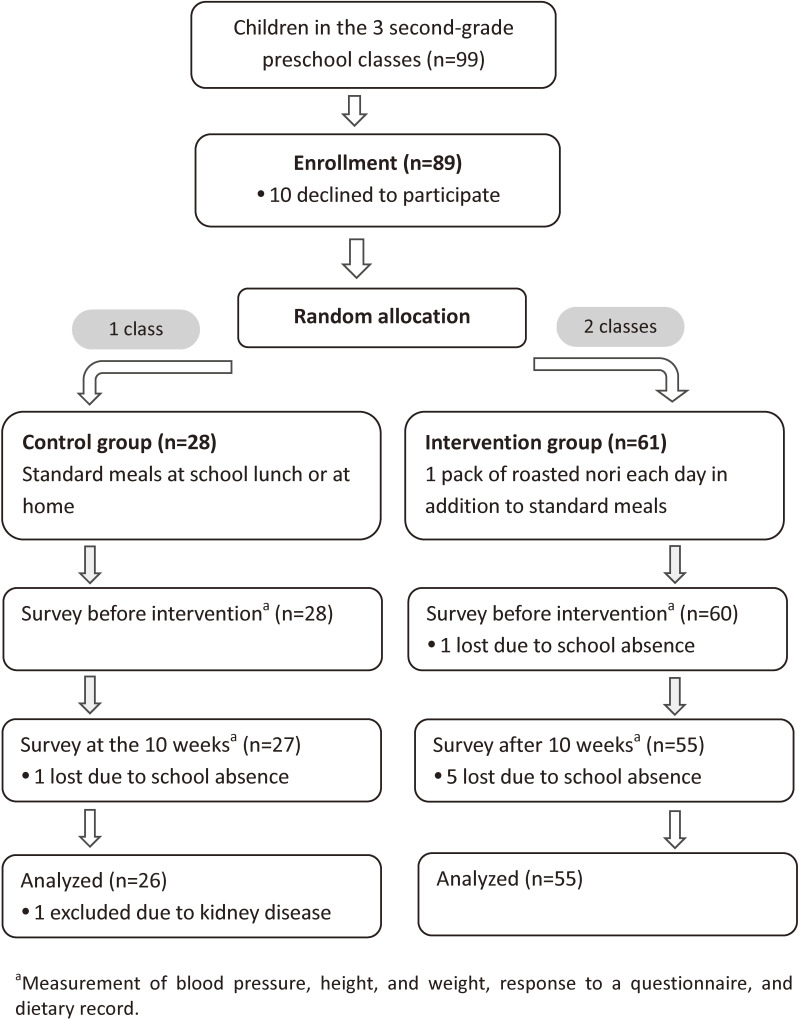
Subjects were children aged 4 to 5 years attending a preschool in Aichi Prefecture, Japan, in 2010. Among 99 students, 89 (89.9%) were enrolled in our study. Nori (dried laver), an edible seaweed widely consumed in Japan, was used as a dietary intervention. Children in the intervention group were asked to consume 1.76 grams per day of roasted nori in addition to standard meals for 10 weeks. Children in the control group consumed their usual diet. Before the intervention and at the 10th week of the intervention, children's blood pressure was measured three times successively using an automated sphygmomanometer with subjects in a sitting position. Changes in systolic (SBP) and diastolic blood pressure (DBP) were compared between 55 children in the intervention group and 26 in the control group after adjustment for SBP and DBP before the intervention.
Changes in SBP were -8.29 mm Hg in the intervention group and +0.50 mm Hg in the control group (P for difference in change = 0.051). Changes in DBP were -6.77 mm Hg in the intervention group and -0.05 mm Hg in the control group (P = 0.031). In girls, no difference in blood pressure changes was found between the intervention and control groups.
Nori intake lowered DBP level in boys. Seaweed intake might have preventive effects on elevated blood pressure in childhood.
很少有研究调查海藻摄入量与儿童血压之间的关系。我们进行了一项干预研究,以调查海藻摄入量是否会影响血压。
研究对象为 2010 年在日本爱知县上幼儿园的 4 至 5 岁儿童。在 99 名学生中,有 89 名(89.9%)参加了我们的研究。紫菜(干紫菜)是日本广泛食用的一种可食用海藻,被用作饮食干预。干预组的儿童被要求在 10 周内除了标准膳食外,每天额外食用 1.76 克烤紫菜。对照组的儿童则食用他们通常的饮食。在干预前和干预的第 10 周,让孩子们坐在座位上,使用自动血压计连续三次测量血压。对干预前的收缩压(SBP)和舒张压(DBP)进行调整后,比较了 55 名干预组儿童和 26 名对照组儿童的 SBP 和 DBP 变化。
干预组的 SBP 变化为-8.29mmHg,对照组为+0.50mmHg(差异变化 P 值=0.051)。干预组的 DBP 变化为-6.77mmHg,对照组为-0.05mmHg(P=0.031)。在女孩中,干预组和对照组之间的血压变化没有差异。
紫菜摄入量降低了男孩的 DBP 水平。海藻摄入可能对儿童高血压有预防作用。