Park Haeun, Lee Kyung Won, Shin Dayeon
Department of Food and Nutrition, Inha University, Incheon 22212, Korea.
Department of Home Economics Education, Korea National University of Education, Cheongju 28173, Korea.
Foods. 2022 Jun 1;11(11):1635. doi: 10.3390/foods11111635.
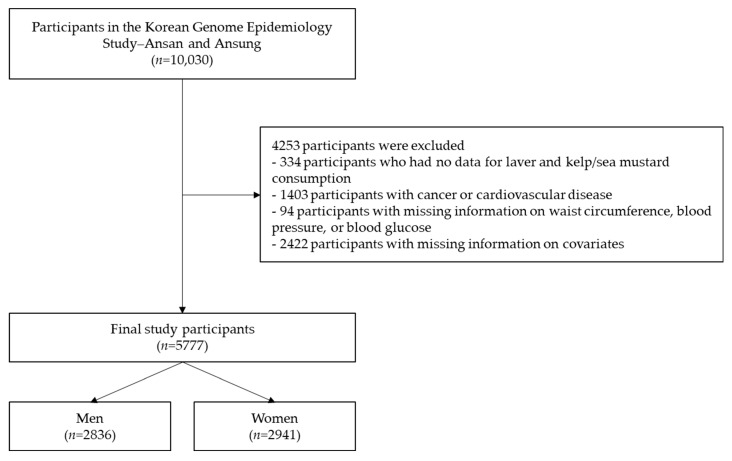
This study aimed to investigate the association between seaweed consumption and the odds of developing metabolic syndrome in middle-aged and elderly Koreans. The study included 5777 adults aged 40-69 years from 2001 to 2002 in the Ansan and Ansung cohorts of the Korean Genome and Epidemiology Study. Data on the consumption of seaweed, including laver and kelp/sea mustard, were obtained using a semiquantitative food frequency questionnaire. Multivariable logistic regression models were used to assess the association between seaweed consumption and the odds of developing metabolic syndrome and its components. Women in the highest tertile of laver consumption had lower odds of developing metabolic syndrome than those in the lowest tertile (adjusted odds ratio [AOR]: 0.70; 95% confidence interval [CI]: 0.54-0.92). Both men and women in the highest tertile of laver consumption had lower odds of abdominal obesity than those in the lowest tertile (AOR: 0.64, 95% CI: 0.42-0.98 for men; AOR: 0.53, 95% CI: 0.39-0.72 for women). These findings suggest that laver consumption is inversely associated with the odds of developing metabolic syndrome and abdominal obesity in Korean adults.
本研究旨在调查韩国中老年人食用海藻与患代谢综合征几率之间的关联。该研究纳入了2001年至2002年韩国基因组与流行病学研究安山和安城队列中的5777名40 - 69岁成年人。使用半定量食物频率问卷获取包括紫菜和海带/裙带菜在内的海藻食用数据。采用多变量逻辑回归模型评估海藻食用与患代谢综合征及其组分几率之间的关联。紫菜食用量处于最高三分位数的女性患代谢综合征的几率低于最低三分位数的女性(调整优势比[AOR]:0.70;95%置信区间[CI]:0.54 - 0.92)。紫菜食用量处于最高三分位数的男性和女性腹部肥胖的几率均低于最低三分位数的人群(男性AOR:0.64,95% CI:0.42 - 0.98;女性AOR:0.53,95% CI:0.39 - 0.72)。这些发现表明,食用紫菜与韩国成年人患代谢综合征和腹部肥胖的几率呈负相关。