School of Sport, Exercise and Rehabilitation Sciences, University of Birmingham, Birmingham, UK.
Department of Rheumatology, Russells Hall Hospital, Dudley Group NHS Foundation Trust, Dudley, UK.
Transl Behav Med. 2021 Mar 16;11(2):369-380. doi: 10.1093/tbm/ibaa022.
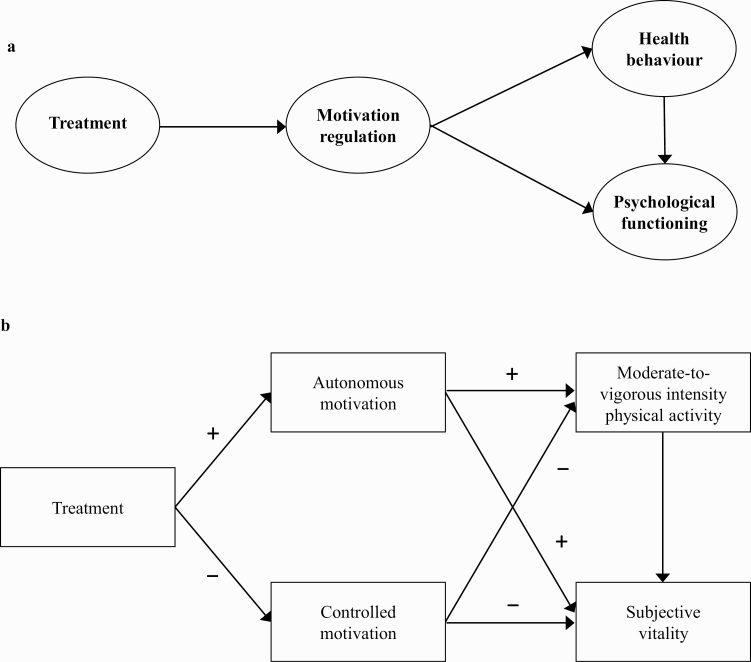
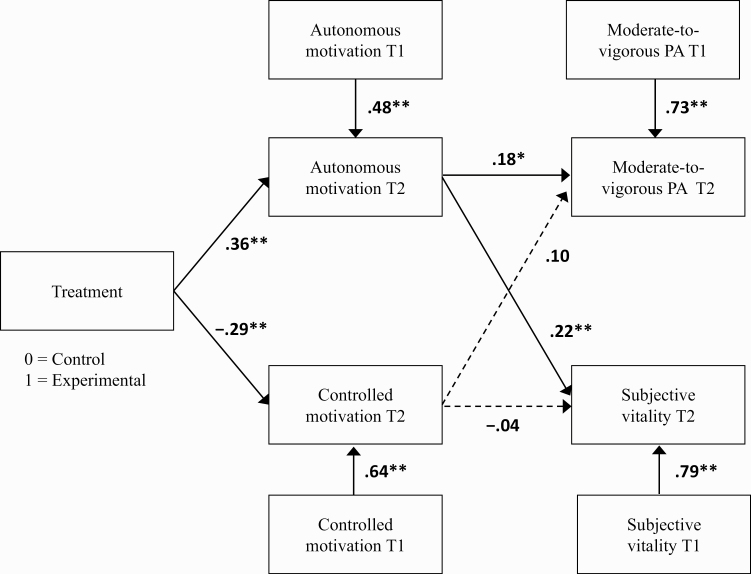
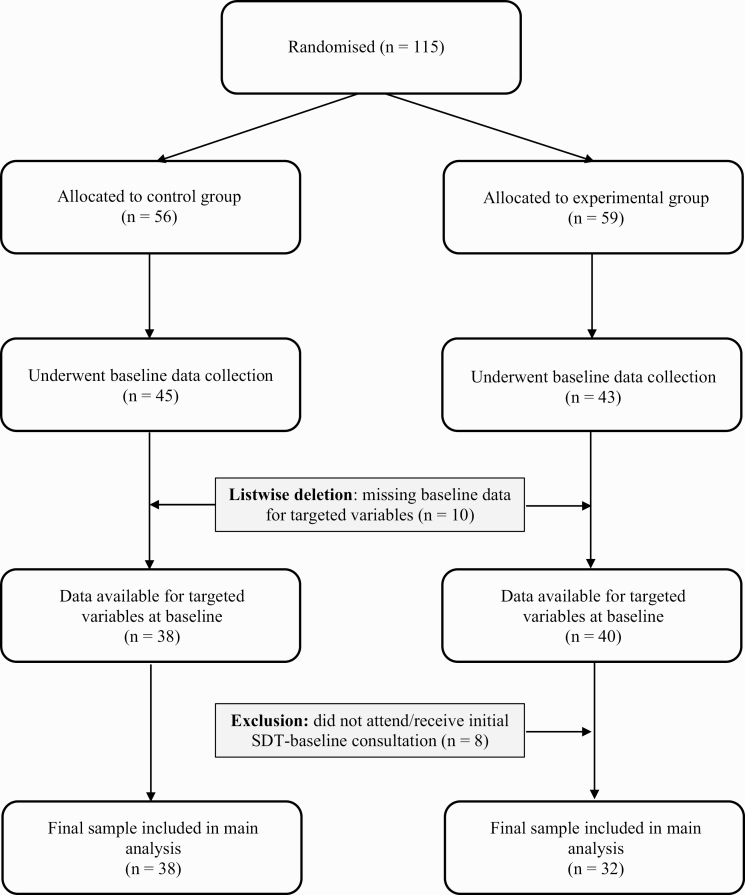
Physical inactivity is prevalent in rheumatoid arthritis (RA) patients, increasing the risk of poor physical health and compromised well-being. Interventions are therefore required to support physical activity (PA) behavior change in this population. This study examined whether a self-determination theory (SDT) based exercise intervention for people with RA, increased autonomous motivation for PA and in turn, moderate-to-vigorous PA (MVPA) and subjective vitality RA patients (n = 115) were randomized to a 3-month SDT-based psychological intervention + RA-tailored exercise program (experimental group, n = 59) or a RA-tailored exercise program only (control group, n = 56). During the program, the SDT-based intervention group received one-on-one consultations with a PA advisor trained in delivering strategies to promote autonomous motivation for PA. Well-established questionnaires assessed autonomous and controlled motivation for PA, MVPA (min/week), and subjective vitality at baseline (T1) and 3 months (T2). Path analysis examined the hypothesized theoretical process model. The model demonstrated an excellent fit to the data (n = 70, χ2 (26) = 28.69, p = .33, comparative fit index = 0.99, root square mean error of approximation = 0.04). The intervention corresponded to higher autonomous motivation and lower controlled motivation for PA at T2, after controlling for T1 autonomous and controlled motivation. In turn, changes in autonomous motivation from T1 to T2 significantly positively predicted changes in MVPA and subjective vitality. Results suggest an SDT based psychological intervention comprising autonomy-supportive strategies for PA predicted greater reported autonomous reasons for PA in RA patients participating in a tailored 3-month exercise program. Increased autonomous motivation linked to increased engagement in MVPA and feelings of vitality in these patients.
身体活动不足在类风湿关节炎 (RA) 患者中很常见,增加了身体不健康和幸福感受损的风险。因此,需要干预措施来支持这一人群的身体活动 (PA) 行为改变。本研究探讨了基于自我决定理论 (SDT) 的 RA 患者锻炼干预是否增加了 PA 的自主动机,进而适度到剧烈的 PA (MVPA) 和主观活力。115 名 RA 患者 (n = 115) 被随机分为 3 个月的基于 SDT 的心理干预+ RA 量身定制的锻炼计划 (实验组,n = 59) 或仅 RA 量身定制的锻炼计划 (对照组,n = 56)。在计划期间,基于 SDT 的干预组接受了经过培训以促进 PA 自主动机的 PA 顾问的一对一咨询。经过验证的问卷评估了 PA 的自主和控制动机、MVPA (分钟/周) 和主观活力,基线 (T1) 和 3 个月 (T2)。路径分析检验了假设的理论过程模型。该模型非常适合数据 (n = 70,χ2 (26) = 28.69,p =.33,比较拟合指数 = 0.99,根均方误差逼近 = 0.04)。在控制 T1 自主和控制动机后,干预对应于 T2 时更高的 PA 自主动机和更低的 PA 控制动机。相反,从 T1 到 T2 的自主动机变化与 MVPA 和主观活力的变化呈显著正相关。结果表明,基于 SDT 的心理干预包括支持 PA 的自主策略,可预测参与量身定制的 3 个月锻炼计划的 RA 患者报告的 PA 自主原因增加。自主动机的增加与这些患者中 MVPA 的增加和活力感的增加有关。