Cardoso Debora, Coelho Andreia, Fernandes Leonor, Matos Leonor Vasconcelos, Serrano Isabel, Miranda Helena, Martins Ana
Medical Oncology Department, Hospital São Francisco Xavier, Centro Hospitalar Lisboa Ocidental, Lisbon, Portugal.
Pathology Department, Hospital de Cascais Dr. José Almeida, Cascais, Portugal.
Eur J Case Rep Intern Med. 2020 Feb 7;7(3):001435. doi: 10.12890/2020_001435. eCollection 2020.
Breast cancer is the most commonly diagnosed cancer in women, mainly at an early stage, allowing treatment with curative intent. Aromatase inhibitors are widely used in the adjuvant treatment of oestrogen receptor-positive breast cancer, mainly in postmenopausal women. The most frequent adverse events associated with these therapies are musculoskeletal symptoms and an increased risk of bone fractures. Cutaneous adverse events have been rarely described. Sweet's syndrome can present as an idiopathic disorder in addition to being malignancy-associated or drug-induced.
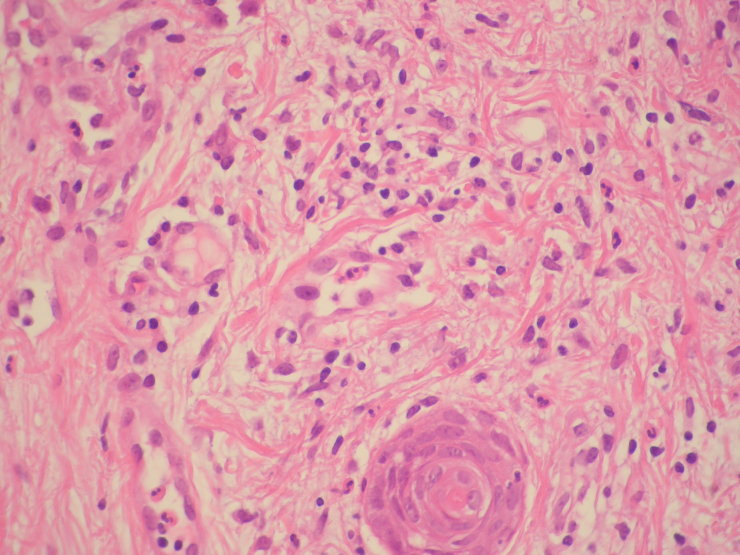
We report the case of a 69-year old woman, diagnosed with early stage breast cancer, who underwent breast-conserving surgery, followed by adjuvant radio and endocrine treatment with letrozole 2.5 mg daily, for a foreseeable duration of 5 years. Three months after starting letrozole, she presented with sudden fever and exuberant and painful erythematous skin papules and plaques on her upper body. After a full work-up and exclusion of other potential causes, a skin biopsy confirmed the presence of dermal oedema and a diffuse neutrophilic infiltrate, suggesting Sweet's syndrome. After discontinuation of letrozole and treatment with corticosteroids, the patient fully recovered. She resumed adjuvant treatment with tamoxifen, without symptom recurrence.
Sweet's syndrome is a rare condition and an association with aromatase inhibitors has not been previously reported. Although its occurrence has already been observed in the onset of malignancies such as breast cancer, aromatase inhibitors must be added to the list of potential causes of drug-induced Sweet's syndrome.
Aromatase inhibitors are widely used in the treatment of breast cancer and, though infrequent, it is important to recognize possible cutaneous adverse events.Sweet's syndrome is a rare but troublesome condition. Prompt recognition and management are crucial to alleviate symptoms.Drug-induced Sweet's syndrome associated with aromatase inhibitors has not been previously reported and should be considered when evaluating treatment toxicities.
乳腺癌是女性中最常被诊断出的癌症,主要处于早期阶段,可进行根治性治疗。芳香化酶抑制剂广泛用于雌激素受体阳性乳腺癌的辅助治疗,主要用于绝经后女性。与这些疗法相关的最常见不良事件是肌肉骨骼症状和骨折风险增加。皮肤不良事件很少被描述。Sweet综合征除了与恶性肿瘤相关或药物诱导外,还可表现为特发性疾病。
我们报告了一名69岁女性的病例,该患者被诊断为早期乳腺癌,接受了保乳手术,随后接受辅助放疗和内分泌治疗,每天服用2.5毫克来曲唑,预计持续5年。开始服用来曲唑三个月后,她突然发热,上半身出现大量疼痛性红斑丘疹和斑块。经过全面检查并排除其他潜在原因后,皮肤活检证实存在真皮水肿和弥漫性中性粒细胞浸润,提示Sweet综合征。停用 来曲唑并使用皮质类固醇治疗后,患者完全康复。她恢复了他莫昔芬辅助治疗,症状未复发。
Sweet综合征是一种罕见疾病,此前尚未报道其与芳香化酶抑制剂有关。虽然在乳腺癌等恶性肿瘤发病时已经观察到其发生,但芳香化酶抑制剂必须被列入药物性Sweet综合征的潜在病因清单。
芳香化酶抑制剂广泛用于乳腺癌治疗,虽然不常见,但认识到可能的皮肤不良事件很重要。Sweet综合征是一种罕见但麻烦的疾病。及时识别和处理对于缓解症状至关重要。此前尚未报道与芳香化酶抑制剂相关的药物性Sweet综合征,在评估治疗毒性时应予以考虑。