Research Institute Brainclinics, Brainclinics Foundation, Bijleveldsingel 34, 6524 AD, Nijmegen, The Netherlands.
Department of Experimental Psychology, Utrecht University, Utrecht, The Netherlands.
Appl Psychophysiol Biofeedback. 2020 Jun;45(2):39-48. doi: 10.1007/s10484-020-09455-2.
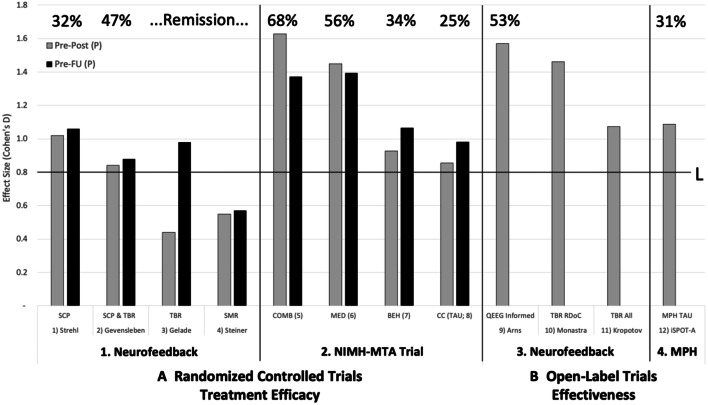
Stimulant medication and behaviour therapy are the most often applied and accepted treatments for Attention-Deficit/Hyperactivity-Disorder (ADHD). Here we explore where the non-pharmacological clinical intervention known as neurofeedback (NFB), fits on the continuum of empirically supported treatments, using standard protocols. In this quantitative review we utilized an updated and stricter version of the APA guidelines for rating 'well-established' treatments and focused on efficacy and effectiveness using effect-sizes (ES) and remission, with a focus on long-term effects. Efficacy and effectiveness are compared to medication and behaviour therapy using benchmark studies. Only recent systematic reviews and meta-analyses as well as multi-centre randomized controlled trials (RCT's) will be included. Two meta-analyses confirmed significant efficacy of standard neurofeedback protocols for parent and teacher rated symptoms with a medium effect size, and sustained effects after 6-12 months. Four multicenter RCT's demonstrated significant superiority to semi-active control groups, with medium-large effect sizes end of treatment or follow-up and remission rates of 32-47%. Effectiveness in open-label studies was confirmed, no signs of publication bias were found and no significant neurofeedback-specific side effects have been reported. Standard neurofeedback protocols in the treatment of ADHD can be concluded to be a well-established treatment with medium to large effect sizes and 32-47% remission rates and sustained effects as assessed after 6-12 months.
兴奋剂药物治疗和行为疗法是最常应用和被接受的治疗注意力缺陷多动障碍(ADHD)的方法。在这里,我们探讨了被称为神经反馈(NFB)的非药物临床干预措施在经过实证支持的治疗方法连续统中的位置,使用标准方案。在这项定量综述中,我们使用了更新和更严格的 APA 指南版本来评估“成熟”的治疗方法,并使用效果大小(ES)和缓解率来关注疗效和有效性,重点是长期效果。使用基准研究比较了药物治疗和行为疗法的疗效和有效性。只有最近的系统评价和荟萃分析以及多中心随机对照试验(RCT)才会被包括在内。两项荟萃分析证实了标准神经反馈方案对父母和教师评定症状的显著疗效,具有中等效果大小,并且在 6-12 个月后仍有持续效果。四项多中心 RCT 表明,与半主动对照组相比具有显著优势,治疗结束或随访时具有中到大的效果大小和 32-47%的缓解率。开放性研究证实了有效性,未发现发表偏倚的迹象,也未报告神经反馈特异性的不良反应。可以得出结论,标准神经反馈方案治疗 ADHD 是一种成熟的治疗方法,具有中等至大的效果大小和 32-47%的缓解率,并且在 6-12 个月后评估仍具有持续效果。