Ray Swapan K
Department of Pathology, Microbiology, and Immunology, University of South Carolina School of Medicine, Columbia, SC, USA.
Neural Regen Res. 2020 Sep;15(9):1601-1612. doi: 10.4103/1673-5374.276322.
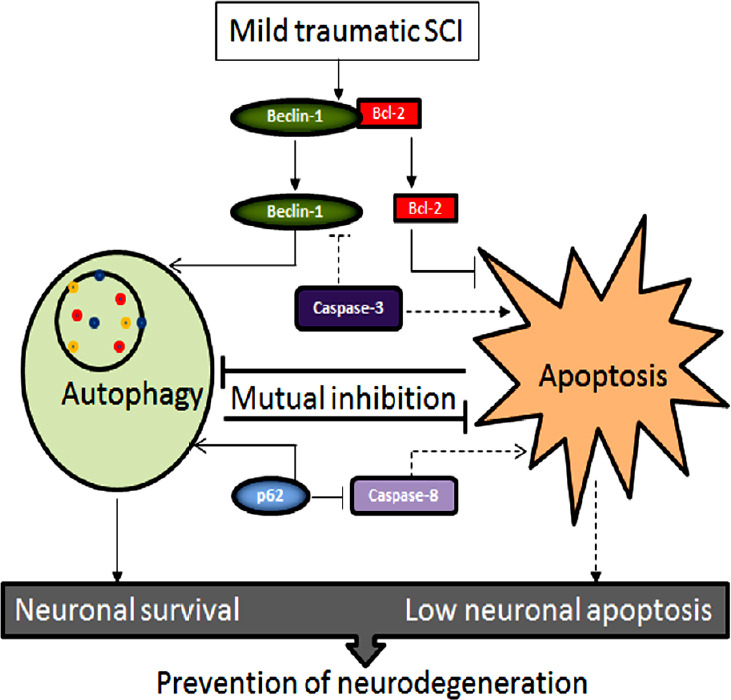
Spinal cord injury (SCI) is a serious central nervous system trauma that leads to loss of motor and sensory functions in the SCI patients. One of the cell death mechanisms is autophagy, which is 'self-eating' of the damaged and misfolded proteins and nucleic acids, damaged mitochondria, and other impaired organelles for recycling of cellular building blocks. Autophagy is different from all other cell death mechanisms in one important aspect that it gives the cells an opportunity to survive or demise depending on the circumstances. Autophagy is a therapeutic target for alleviation of pathogenesis in traumatic SCI. However, functions of autophagy in traumatic SCI remain controversial. Spatial and temporal patterns of activation of autophagy after traumatic SCI have been reported to be contradictory. Formation of autophagosomes following therapeutic activation or inhibition of autophagy flux is ambiguous in traumatic SCI studies. Both beneficial and harmful outcomes due to enhancement autophagy have been reported in traumatic SCI studies in preclinical models. Only further studies will make it clear whether therapeutic activation or inhibition of autophagy is beneficial in overall outcomes in preclinical models of traumatic SCI. Therapeutic enhancement of autophagy flux may digest the damaged components of the central nervous system cells for recycling and thereby facilitating functional recovery. Many studies demonstrated activation of autophagy flux and inhibition of apoptosis for neuroprotective effects in traumatic SCI. Therapeutic induction of autophagy in traumatic SCI promotes axonal regeneration, supporting another beneficial role of autophagy in traumatic SCI. In contrast, some other studies demonstrated that disruption of autophagy flux in traumatic SCI strongly correlated with neuronal death at remote location and impaired functional recovery. This article describes our current understanding of roles of autophagy in acute and chronic traumatic SCI, cross-talk between autophagy and apoptosis, therapeutic activation or inhibition of autophagy for promoting functional recovery, and future of autophagy in traumatic SCI.
脊髓损伤(SCI)是一种严重的中枢神经系统创伤,会导致脊髓损伤患者运动和感觉功能丧失。细胞死亡机制之一是自噬,即对受损和错误折叠的蛋白质、核酸、受损线粒体及其他受损细胞器进行“自我吞噬”,以实现细胞构建模块的循环利用。自噬在一个重要方面与所有其他细胞死亡机制不同,即它使细胞有机会根据具体情况存活或死亡。自噬是减轻创伤性脊髓损伤发病机制的治疗靶点。然而,自噬在创伤性脊髓损伤中的作用仍存在争议。据报道,创伤性脊髓损伤后自噬激活的时空模式相互矛盾。在创伤性脊髓损伤研究中,治疗性激活或抑制自噬通量后自噬体的形成尚不明确。在临床前模型的创伤性脊髓损伤研究中,既有自噬增强带来有益结果的报道,也有有害结果的报道。只有进一步的研究才能明确在创伤性脊髓损伤临床前模型中,治疗性激活或抑制自噬对总体结果是否有益。自噬通量的治疗性增强可能会消化中枢神经系统细胞的受损成分以进行循环利用,从而促进功能恢复。许多研究表明,在创伤性脊髓损伤中激活自噬通量并抑制细胞凋亡具有神经保护作用。创伤性脊髓损伤中自噬的治疗性诱导可促进轴突再生,这也支持了自噬在创伤性脊髓损伤中的另一个有益作用。相比之下,其他一些研究表明,创伤性脊髓损伤中自噬通量的破坏与远处神经元死亡及功能恢复受损密切相关。本文阐述了我们目前对自噬在急性和慢性创伤性脊髓损伤中的作用、自噬与细胞凋亡之间的相互作用、治疗性激活或抑制自噬以促进功能恢复以及自噬在创伤性脊髓损伤中的未来发展的理解。