Jeong Ji Seon, Wi Wongook, Chung Yoon Joo, Kim Jong Man, Choi Gyu-Seong, Kwon Choon Hyuck David, Han Sangbin, Gwak Mi Sook, Kim Gaab Soo, Ko Justin Sangwook
Department of Anesthesiology and Pain Medicine, Samsung Medical Center, Sungkyunkwan University School of Medicine, Seoul, Korea.
Surgery, Samsung Medical Center, Sungkyunkwan University School of Medicine, Seoul, Korea.
Sci Rep. 2020 Mar 24;10(1):5314. doi: 10.1038/s41598-020-62289-0.
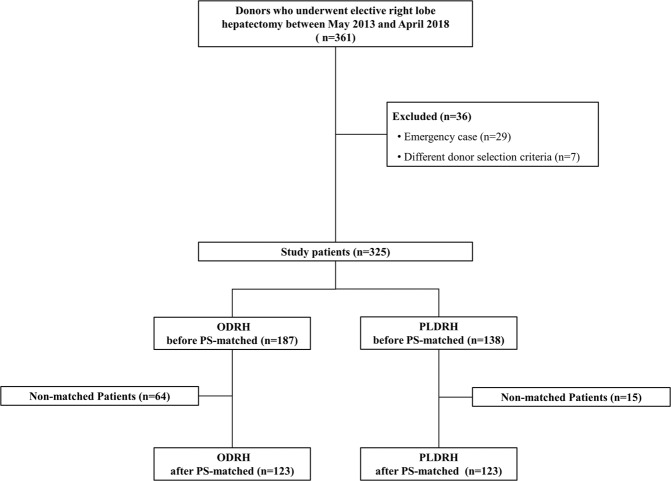
Pure laparoscopic donor right hepatectomy (PLDRH) is not a standard procedure for living donor liver transplantation but is safe and reproducible in the hands of experienced surgeons. However, the perioperative outcomes of PLDRH have not been fully evaluated yet. We used propensity score matching to compare the perioperative complications and postoperative short-term outcomes of donors undergoing PLDRH and open donor right hepatectomy (ODRH). A total of 325 consecutive donors who underwent elective, adult-to-adult right hepatectomy were initially screened. After propensity score matching, all patients were divided into two groups: PLDRH (n = 123) and ODRH (n = 123) groups. Perioperative complications and postoperative outcomes were compared between the two groups. Postoperative pulmonary complications were significantly more common in the ODRH than in the PLDRH group (54.5 vs. 31.7%, P < 0.001). The biliary complications (leak and stricture) were higher in PLDRH group than in the ODRH group (8% vs. 3%), but it failed to reach statistical significance (P = 0.167). Overall, surgical complication rates were similar between the two groups (P = 0.730). The opioid requirement during the first 7 postoperative days was higher in the ODRH group (686 vs. 568 mg, P < 0.001). The hospital stay and time to the first meal were shorter in the PLDRH than in the ODRH group (P = 0.003 and P < 0.001, respectively). PLDRH reduced the incidence of postoperative pulmonary complications and afforded better short-term postoperative outcomes compared to ODRH. However, surgical complication rates were similar in both groups.
单纯腹腔镜供体右半肝切除术(PLDRH)并非活体供肝移植的标准术式,但在经验丰富的外科医生手中是安全且可重复的。然而,PLDRH的围手术期结局尚未得到充分评估。我们采用倾向评分匹配法比较接受PLDRH和开放性供体右半肝切除术(ODRH)的供体的围手术期并发症及术后短期结局。最初筛选了325例连续接受择期成人对成人右半肝切除术的供体。经过倾向评分匹配后,所有患者被分为两组:PLDRH组(n = 123)和ODRH组(n = 123)。比较两组的围手术期并发症和术后结局。ODRH组术后肺部并发症明显比PLDRH组更常见(54.5%对31.7%,P < 0.001)。PLDRH组的胆道并发症(渗漏和狭窄)高于ODRH组(8%对3%),但未达到统计学意义(P = 0.167)。总体而言,两组的手术并发症发生率相似(P = 0.730)。ODRH组术后前7天的阿片类药物需求量更高(686对568 mg,P < 0.001)。PLDRH组的住院时间和首次进食时间比ODRH组短(分别为P = 0.003和P < 0.001)。与ODRH相比,PLDRH降低了术后肺部并发症的发生率,并提供了更好的术后短期结局。然而,两组的手术并发症发生率相似。