Maleki Dana Parisa, Mansournia Mohammad Ali, Mirhashemi Seyyed Mehdi
1Research Center for Biochemistry and Nutrition in Metabolic Diseases, Kashan University of Medical Sciences, Kashan, I.R. of Iran.
2Department of Epidemiology and Biostatistics, School of Public Health, Tehran University of Medical Sciences, Tehran, Iran.
Cell Biosci. 2020 Mar 23;10:44. doi: 10.1186/s13578-020-00403-5. eCollection 2020.
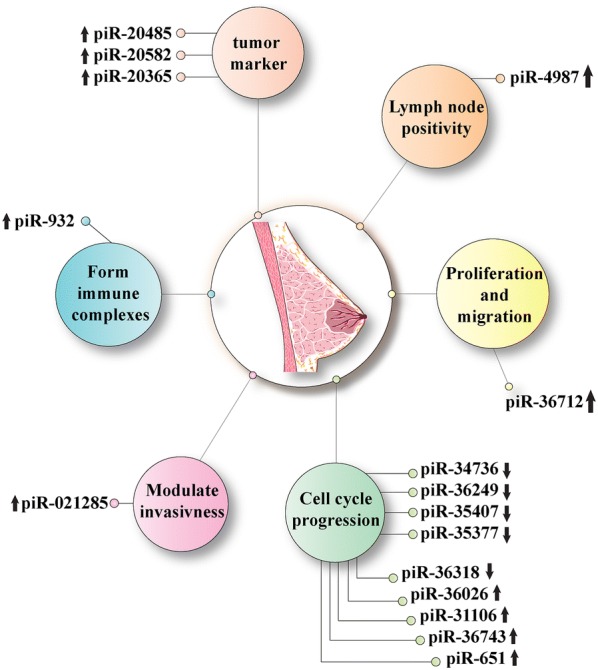
Cancer is one of the most important reasons of mortality in the world. However, there are several therapeutic platforms to treat patients who suffering from cancer common treatments such as surgery, chemotherapy and etc. The current therapeutic approaches are related to some limitations. Hence, more understanding about molecular mechanisms that involved in cancer particularly in breast cancer pathogenesis, could contribute to provide better therapeutic platforms. Recently, non-coding RNAs such as microRNAs have attracted researchers' attention in the field of cancer due to their functions in gene expression's regulation and functional interactions with other molecules. Interestingly, great advances in next-generation sequencing lead to considering other roles for another non-coding RNAs subgroup called PIWI-interacting RNAs (piRNAs) in addition to their functions in the germline. Novel studies investigated the role of piRNAs in several cancers including lung cancer, hepatocellular carcinoma, gastric cancer, multiple myeloma and colorectal cancer. Hopefully, based on new findings, piRNAs may be a potential biomarker which can be used as a tool to diagnose or treat breast cancer. Thus, this review aimed to discuss the role of piRNAs in breast cancer progression and metastasis as well as its molecular mechanisms.
癌症是全球最重要的死亡原因之一。然而,有多种治疗平台可用于治疗癌症患者,常见的治疗方法包括手术、化疗等。当前的治疗方法存在一些局限性。因此,更深入了解参与癌症尤其是乳腺癌发病机制的分子机制,有助于提供更好的治疗平台。最近,诸如微小RNA等非编码RNA因其在基因表达调控中的作用以及与其他分子的功能相互作用,在癌症领域引起了研究人员的关注。有趣的是,下一代测序技术的巨大进展使得另一种称为PIWI相互作用RNA(piRNA)的非编码RNA亚组除了在生殖系中的功能外,还被认为具有其他作用。新的研究调查了piRNA在多种癌症中的作用,包括肺癌、肝细胞癌、胃癌、多发性骨髓瘤和结直肠癌。有望基于新的发现,piRNA可能成为一种潜在的生物标志物,可作为诊断或治疗乳腺癌的工具。因此,本综述旨在讨论piRNA在乳腺癌进展和转移中的作用及其分子机制。