Institute for Genome Sciences, University of Maryland School of Medicine, Baltimore, MD, United States.
Department of Microbiology and Immunology, University of Maryland School of Medicine, Baltimore, MD, United States.
Front Cell Infect Microbiol. 2020 Mar 10;10:106. doi: 10.3389/fcimb.2020.00106. eCollection 2020.
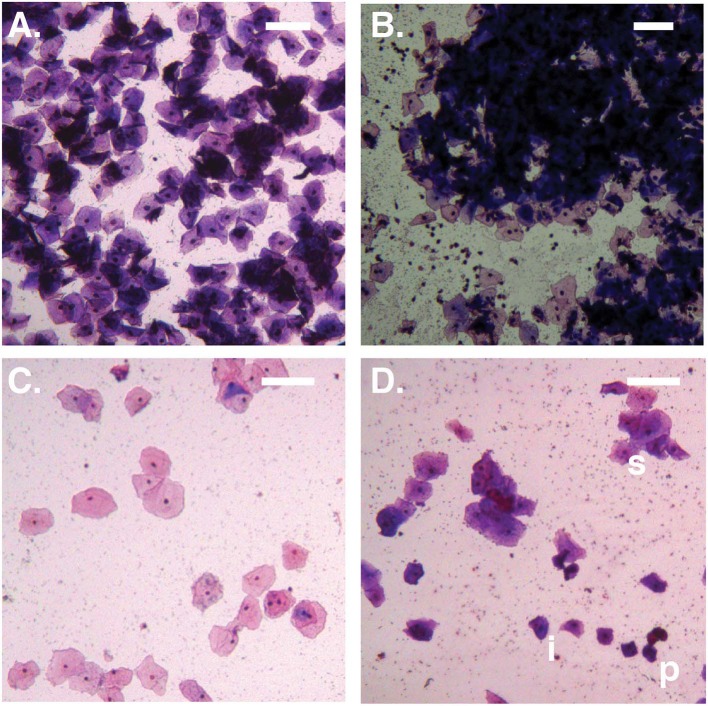
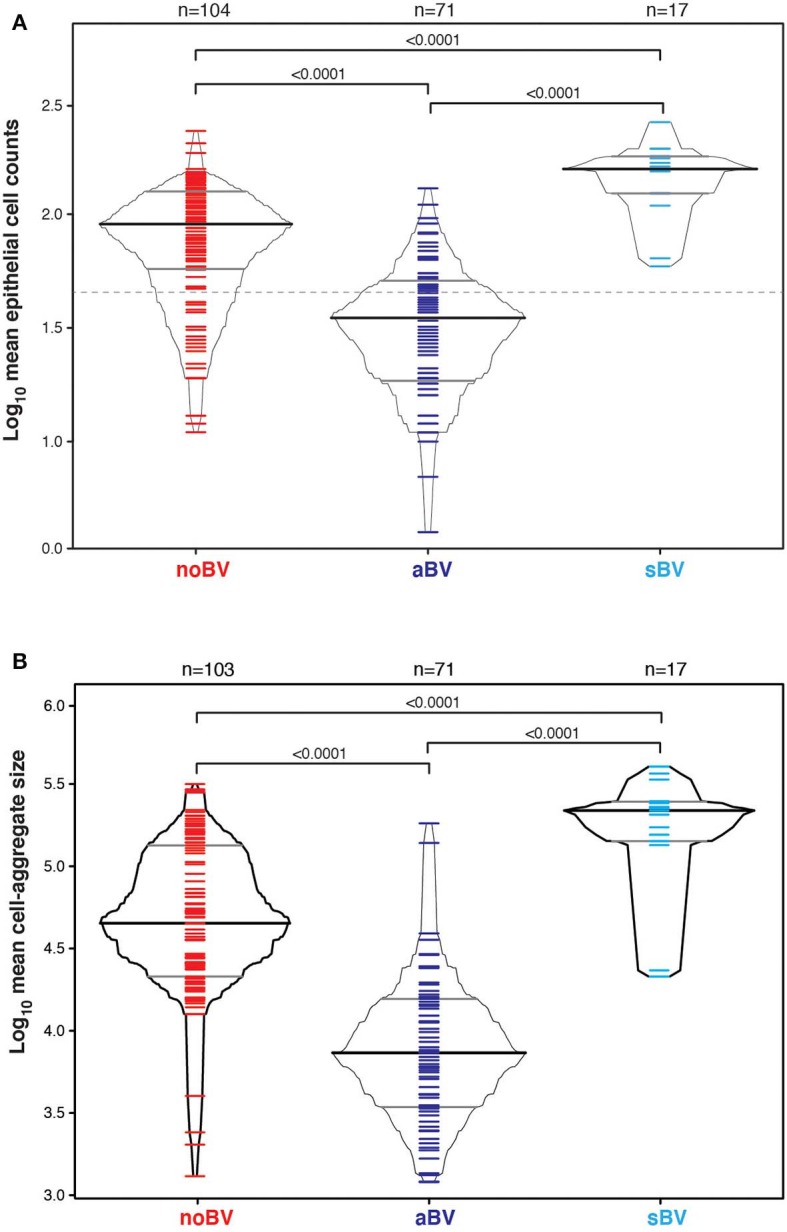
Previous studies have described bacterial vaginosis (BV) as associated with increased cell-shedding from the cervicovaginal epithelium. Cell-shedding in excess of cell-proliferation is thought to decrease epithelial barrier function and increase susceptibility to infection. This study evaluated the number of shed cells in mid-vaginal smears from women with a diagnosis of symptomatic BV (sBV, = 17), asymptomatic BV (aBV, = 71), or no BV ( = 104) by Amsel criteria. The sBV smears contained significantly more shed cells (median 158/100X field) than no BV smears (median 91/100X field), = 7.2e-9. However, we observed that aBV smears contained significantly fewer shed cells (median 35/100X field) than no BV smears, = 22.0e-16. The sizes of cell-aggregates (cells shed in sometimes multilayered sections with intact cell-cell attachments) followed the same pattern. Cell-aggregates in sBV smears were significantly larger (median ~220,000 μm) than those in no BV smears (median ~50,000 μm), = 1.8e-6, but cell-aggregates in aBV smears were significantly smaller (median ~7,000 μm) than those in no BV smears, = 0.0028. We also compared the superficial cell index (SCI), a measure of cervicovaginal epithelial cell maturity, in no BV and aBV smears with relatively low numbers of shed cells (≤50/100X field). The SCI of no BV smears was significantly higher (median 0.86) than that of aBV smears (median 0.35), = 4.3e-98, suggesting a depletion of mature cells with exposure and shedding of underlying immature cells in aBV with low number of shed cells. These results indicate that aBV may contribute disproportionately to the increased susceptibility to reproductive tract infections associated with BV. Our findings remained true when considering only those smears in which the microbiota comprised a diverse set of strict and facultative anaerobic bacteria [Community State Type IV ( = 162)], thus excluding those dominated by spp. This is consistent with our developing hypothesis that high-shedding sBV and low-shedding aBV could be temporally separated phases of the same condition, rather than two separate forms of BV. These findings might inform future work on clinical management of symptomatic and asymptomatic bacterial vaginosis.
先前的研究表明,细菌性阴道病(BV)与宫颈阴道上皮细胞过度脱落有关。过度的细胞脱落超过细胞增殖,被认为会降低上皮屏障功能并增加感染易感性。本研究通过 Amsel 标准评估了诊断为有症状细菌性阴道病(sBV,n=17)、无症状细菌性阴道病(aBV,n=71)或无细菌性阴道病(n=104)的女性的阴道中段涂片的脱落细胞数量。sBV 涂片的脱落细胞数量明显多于无 BV 涂片(中位数 158/100X 视野),=7.2e-9。然而,我们观察到 aBV 涂片的脱落细胞数量明显少于无 BV 涂片(中位数 35/100X 视野),=22.0e-16。细胞聚集物(有时以完整的细胞-细胞附着的多层切片形式脱落的细胞)的大小也遵循相同的模式。sBV 涂片的细胞聚集物明显大于无 BV 涂片(中位数约 220,000 μm),=1.8e-6,而 aBV 涂片的细胞聚集物明显小于无 BV 涂片(中位数约 7,000 μm),=0.0028。我们还比较了无 BV 和 aBV 涂片的浅层细胞指数(SCI),这是宫颈阴道上皮细胞成熟度的一种衡量标准,这些涂片的脱落细胞数量相对较低(≤50/100X 视野)。无 BV 涂片的 SCI 明显高于 aBV 涂片(中位数 0.86),=4.3e-98,这表明在脱落细胞数量较低的 aBV 中,成熟细胞的减少和底层未成熟细胞的暴露和脱落。这些结果表明,aBV 可能不成比例地导致与 BV 相关的生殖道感染易感性增加。当仅考虑微生物群由多种严格和兼性厌氧菌组成的涂片时,我们的发现仍然成立(社区状态类型 IV,n=162),因此排除了由 spp 主导的涂片。这与我们正在发展的假设一致,即高脱落 sBV 和低脱落 aBV 可能是同一疾病的不同阶段,而不是两种不同形式的 BV。这些发现可能为有症状和无症状细菌性阴道病的临床管理提供信息。