Max-Planck-Institute for Immunobiology und Epigenetics, Department of Chromatin Regulation, Stübeweg 51, 79108, Freiburg im Breisgau, Germany.
Gurdon Institute and Department of Pathology, University of Cambridge, Tennis Court Road, Cambridge, CB2 1QN, UK.
Mol Metab. 2020 Aug;38:100942. doi: 10.1016/j.molmet.2020.01.006. Epub 2020 Feb 15.
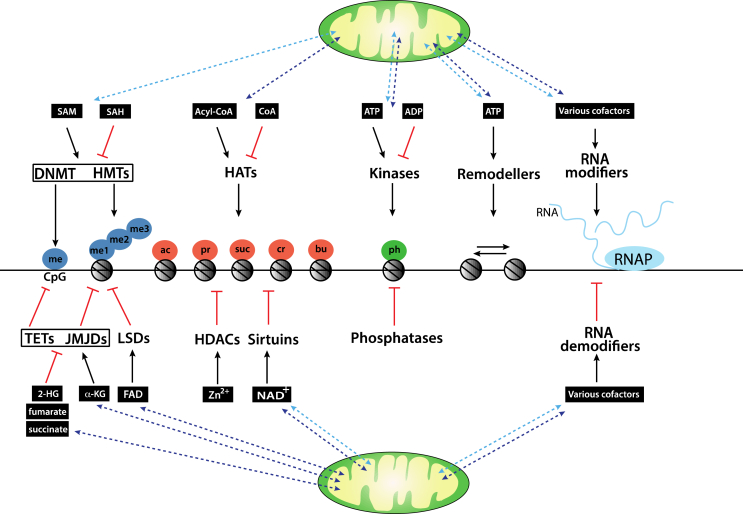
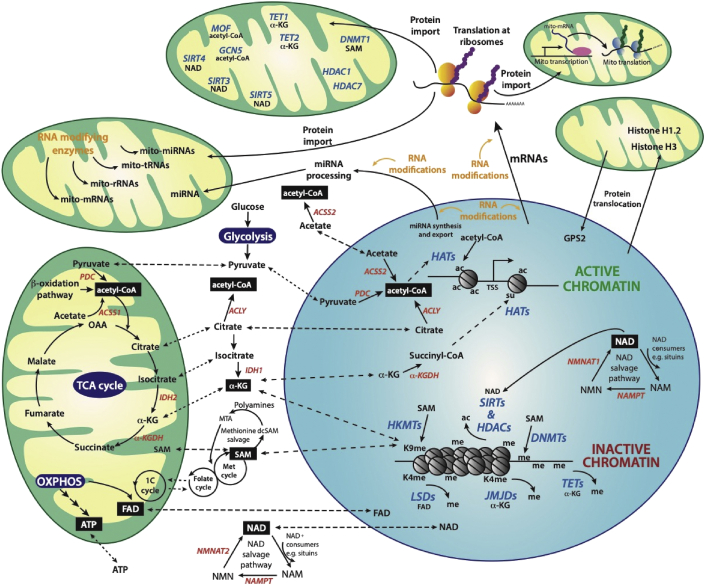
Virtually all eukaryotic cells contain spatially distinct genomes, a single nuclear genome that harbours the vast majority of genes and much smaller genomes found in mitochondria present at thousands of copies per cell. To generate a coordinated gene response to various environmental cues, the genomes must communicate with each another. Much of this bi-directional crosstalk relies on epigenetic processes, including DNA, RNA, and histone modification pathways. Crucially, these pathways, in turn depend on many metabolites generated in specific pools throughout the cell, including the mitochondria. They also involve the transport of metabolites as well as the enzymes that catalyse these modifications between nuclear and mitochondrial genomes.
This study examines some of the molecular mechanisms by which metabolites influence the activity of epigenetic enzymes, ultimately affecting gene regulation in response to metabolic cues. We particularly focus on the subcellular localisation of metabolite pools and the crosstalk between mitochondrial and nuclear proteins and RNAs. We consider aspects of mitochondrial-nuclear communication involving histone proteins, and potentially their epigenetic marks, and discuss how nuclear-encoded enzymes regulate mitochondrial function through epitranscriptomic pathways involving various classes of RNA molecules within mitochondria.
Epigenetic communication between nuclear and mitochondrial genomes occurs at multiple levels, ultimately ensuring a coordinated gene expression response between different genetic environments. Metabolic changes stimulated, for example, by environmental factors, such as diet or physical activity, alter the relative abundances of various metabolites, thereby directly affecting the epigenetic machinery. These pathways, coupled to regulated protein and RNA transport mechanisms, underpin the coordinated gene expression response. Their overall importance to the fitness of a cell is highlighted by the identification of many mutations in the pathways we discuss that have been linked to human disease including cancer.
几乎所有真核细胞都含有空间上不同的基因组,一个单一的核基因组包含了绝大多数的基因,而在线粒体中发现的较小基因组则存在于每个细胞数千个拷贝中。为了生成对各种环境线索的协调基因反应,基因组必须相互通信。这种双向串扰的大部分依赖于表观遗传过程,包括 DNA、RNA 和组蛋白修饰途径。至关重要的是,这些途径反过来又依赖于许多在细胞内特定区域产生的代谢物,包括线粒体。它们还涉及代谢物的运输以及在核和线粒体基因组之间催化这些修饰的酶的运输。
本研究考察了代谢物影响表观遗传酶活性的一些分子机制,最终影响了对代谢线索的基因调控。我们特别关注代谢物池的亚细胞定位以及线粒体和核蛋白和 RNA 之间的线粒体-核串扰。我们考虑了涉及组蛋白的线粒体-核通讯的各个方面,以及它们潜在的表观遗传标记,并讨论了核编码酶如何通过涉及线粒体中各种 RNA 分子的转录后途径来调节线粒体功能。
核和线粒体基因组之间的表观遗传通讯发生在多个层面,最终确保了不同遗传环境之间协调的基因表达反应。代谢变化,例如由环境因素如饮食或体育活动刺激,改变了各种代谢物的相对丰度,从而直接影响了表观遗传机制。这些途径与受调控的蛋白质和 RNA 运输机制相结合,为协调的基因表达反应提供了基础。我们讨论的途径中的许多突变已被确定与人类疾病(包括癌症)相关,这突显了它们对细胞适应性的重要性。