Southeast Asia Disaster Prevention Research Initiative (SEADPRI-UKM), Institute for Environment and Development (LESTARI), Universiti Kebangsaan Malaysia, Bangi 43600, Malaysia.
Department of Chemistry, Faculty of Mathematics and Science, Universitas Negeri Padang, Padang 25131, Indonesia.
Sensors (Basel). 2020 Mar 25;20(7):1820. doi: 10.3390/s20071820.
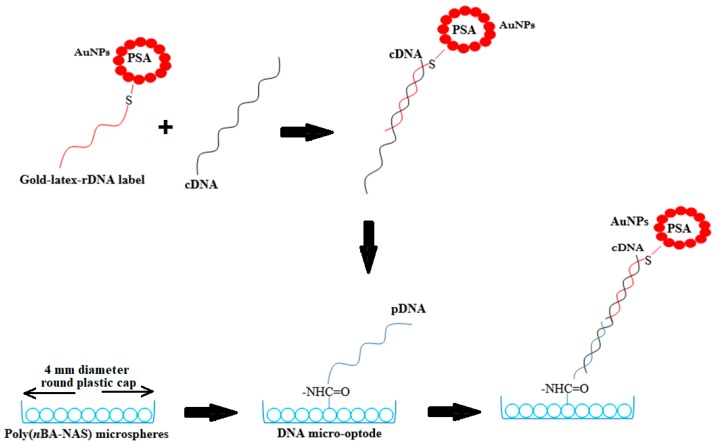
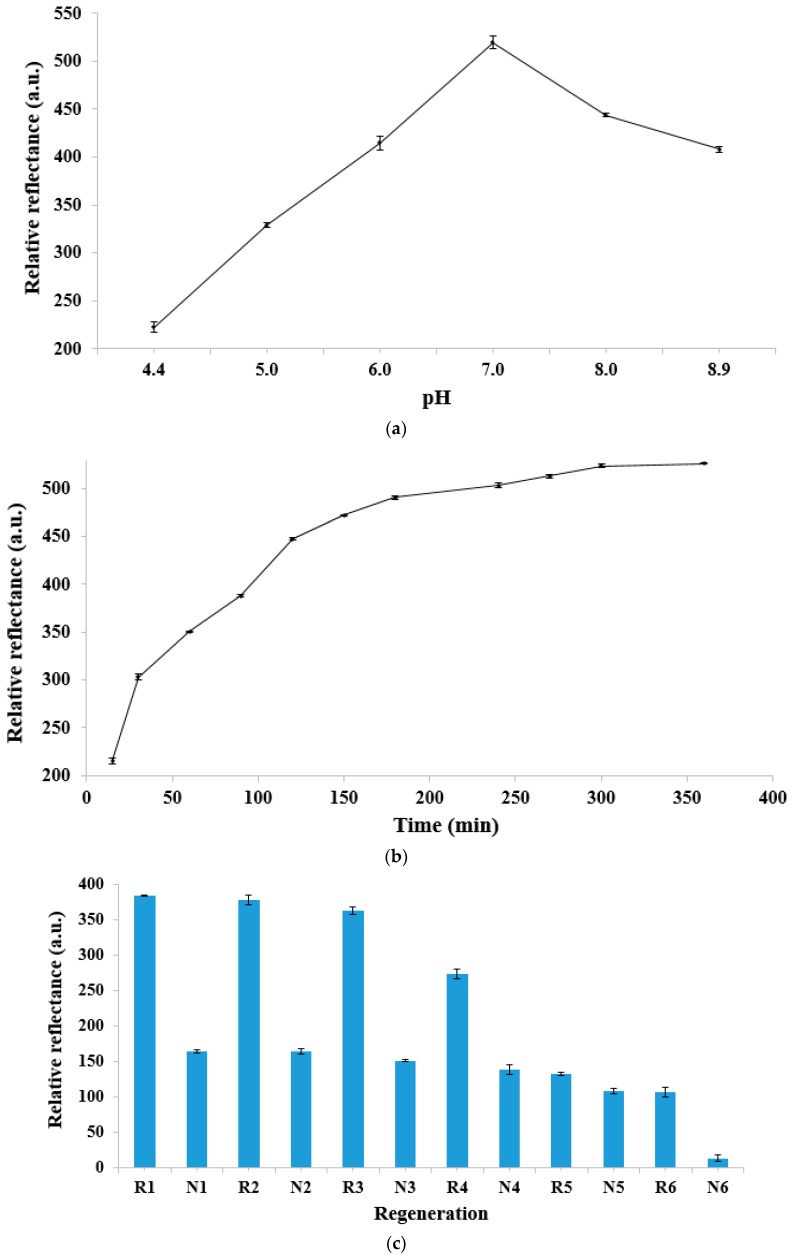
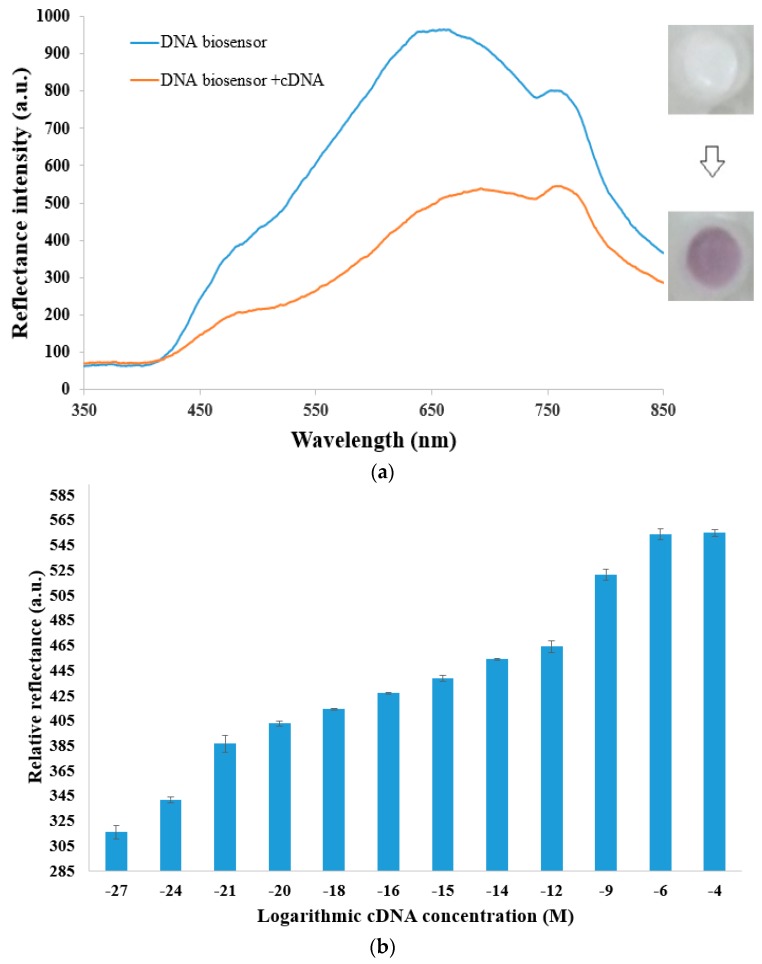
A DNA micro-optode for dengue virus detection was developed based on the sandwich hybridization strategy of DNAs on succinimide-functionalized poly(-butyl acrylate) (poly(BA-NAS)) microspheres. Gold nanoparticles (AuNPs) with an average diameter of ~20 nm were synthesized using a centrifugation-based method and adsorbed on the submicrometer-sized polyelectrolyte-coated poly(styrene--acrylic acid) (PSA) latex particles via an electrostatic method. The AuNP-latex spheres were attached to the thiolated reporter probe (rDNA) by Au-thiol binding to functionalize as an optical gold-latex-rDNA label. The one-step sandwich hybridization recognition involved a pair of a DNA probe, i.e., capture probe (pDNA), and AuNP-PSA reporter label that flanked the target DNA (complementary DNA (cDNA)). The concentration of dengue virus cDNA was optically transduced by immobilized AuNP-PSA-rDNA conjugates as the DNA micro-optode exhibited a violet hue upon the DNA sandwich hybridization reaction, which could be monitored by a fiber-optic reflectance spectrophotometer at 637 nm. The optical genosensor showed a linear reflectance response over a wide cDNA concentration range from 1.0 × 10 M to 1.0 × 10 M cDNA ( = 0.9807) with a limit of detection (LOD) of 1 × 10 M. The DNA biosensor was reusable for three consecutive applications after regeneration with mild sodium hydroxide. The sandwich-type optical biosensor was well validated with a molecular reverse transcription polymerase chain reaction (RT-PCR) technique for screening of dengue virus in clinical samples, e.g., serum, urine, and saliva from dengue virus-infected patients under informed consent.
基于聚(丁烯丙烯酰胺)(poly(BA-NAS))微球上的 DNA 的夹心杂交策略,开发了一种用于登革热病毒检测的 DNA 微光氧体。使用基于离心的方法合成了平均直径约为 20nm 的金纳米粒子(AuNPs),并通过静电方法吸附在亚微米级带正电荷的聚电解质涂覆的聚苯乙烯-丙烯酸(PSA)乳胶粒子上。将 AuNP-乳胶球通过 Au-硫键结合附着到巯基化报告探针(rDNA)上,用作光学金乳胶-rDNA 标记。一步夹心杂交识别涉及一对 DNA 探针,即捕获探针(pDNA)和 AuNP-PSA 报告标记,它们侧翼是目标 DNA(互补 DNA(cDNA))。通过固定的 AuNP-PSA-rDNA 缀合物光学转导登革热病毒 cDNA 的浓度,当 DNA 夹心杂交反应发生时,DNA 微光氧体呈现出紫罗兰色,这可以通过光纤反射分光光度计在 637nm 处监测到。光学基因传感器在从 1.0×10⁻¹²M 到 1.0×10⁻⁸M cDNA 的宽 cDNA 浓度范围内表现出线性反射响应(r=0.9807),检测限(LOD)为 1.0×10⁻¹²M。该 DNA 生物传感器在温和的氢氧化钠再生后可重复使用三次。该夹心型光学生物传感器通过分子逆转录聚合酶链反应(RT-PCR)技术进行了验证,用于筛查登革热病毒在临床样本中的存在,例如登革热病毒感染患者的血清、尿液和唾液,这些样本都是在知情同意的情况下采集的。