Grant Stephen D, Richford Kyle, Burdett Heidi L, McKee David, Patton Brian R
Department of Physics and SUPA, University of Strathclyde, Glasgow G4 0NG, UK.
Lyell Centre for Earth and Marine Science and Technology, Edinburgh EH14 4AS, UK.
R Soc Open Sci. 2020 Jan 29;7(1):191921. doi: 10.1098/rsos.191921. eCollection 2020 Jan.
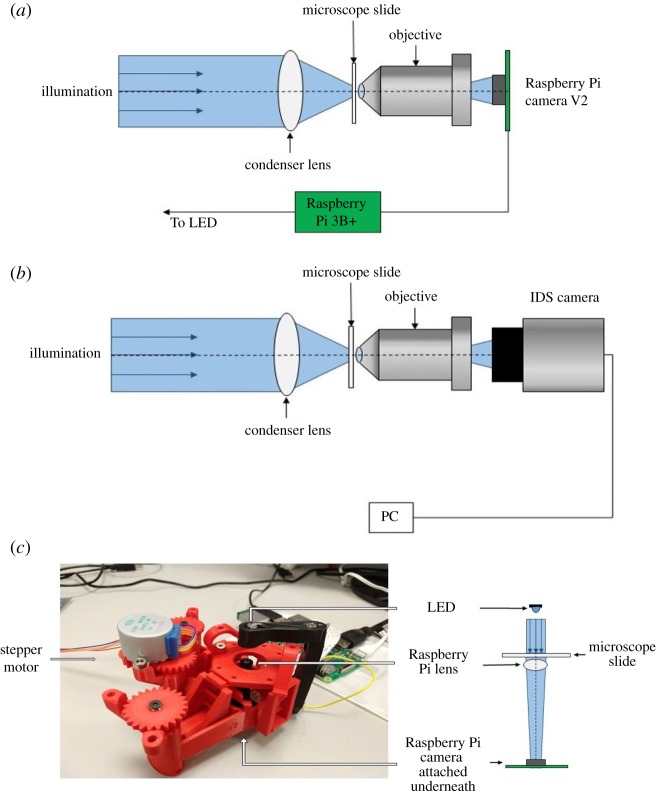
Phase microscopy allows stain-free imaging of transparent biological samples. One technique, using the transport of intensity equation (TIE), can be performed without dedicated hardware by simply processing pairs of images taken at known spacings within the sample. The resulting TIE images are quantitative phase maps of unstained biological samples. Therefore, spatially resolved optical path length (OPL) information can also be determined. Using low-cost, open-source hardware, we applied the TIE to living algal cells to measure their effect on OPL. We obtained OPL values that were repeatable within species and differed by distinct amounts depending on the species being measured. We suggest TIE imaging as a method of discrimination between different algal species and, potentially, non-biological materials, based on refractive index/OPL. Potential applications in biogeochemical modelling and climate sciences are suggested.
相显微镜术能够对透明生物样本进行无染色成像。一种利用强度传输方程(TIE)的技术,无需专用硬件,只需对在样本内已知间距处拍摄的成对图像进行简单处理即可。所得的TIE图像是未染色生物样本的定量相图。因此,还可以确定空间分辨的光程长度(OPL)信息。我们使用低成本的开源硬件,将TIE应用于活藻细胞,以测量它们对光程长度的影响。我们获得的光程长度值在物种内具有可重复性,并且根据所测量的物种不同而有明显差异。我们建议将TIE成像作为一种基于折射率/光程长度区分不同藻类物种以及潜在地区分非生物材料的方法。文中还提出了其在生物地球化学建模和气候科学中的潜在应用。