Graduate School of Peking Union Medical College, Chinese Academy of Medical Sciences, Beijing 100029, China.
Department of Spine Surgery, China-Japan Friendship Hospital, Beijing 100029, China.
Biomed Res Int. 2020 Mar 9;2020:7403034. doi: 10.1155/2020/7403034. eCollection 2020.
Tranexamic acid (TXA), an antifibrinolytic agent, interferes with fibrinolysis and has been used for many years to reduce blood loss during spine surgery. The purpose of our meta-analysis was to compare the effect of intravenous versus topical administration of TXA in patients undergoing nondeformity spine surgery.
We searched multiple databases, including PubMed, Embase, the Cochrane library, CNKI, WanFang database, and VIP to find studies that met the inclusion criteria. A meta-analysis was performed according to the guidelines of the Cochrane Reviewer's Handbook.
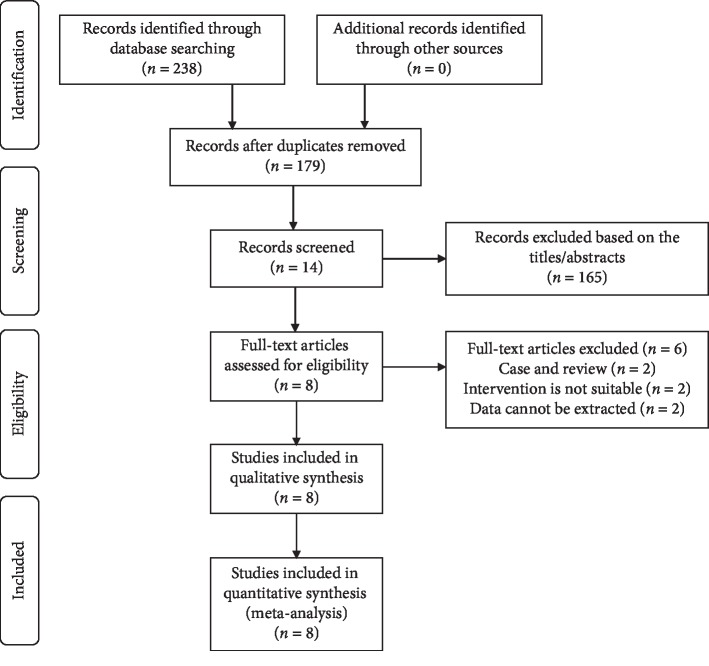
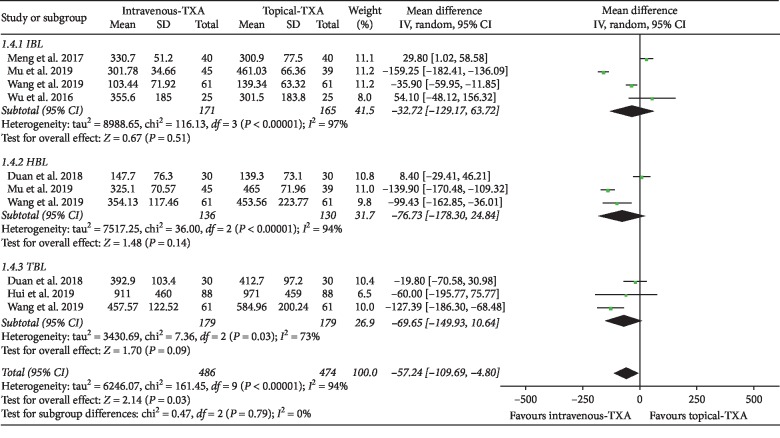
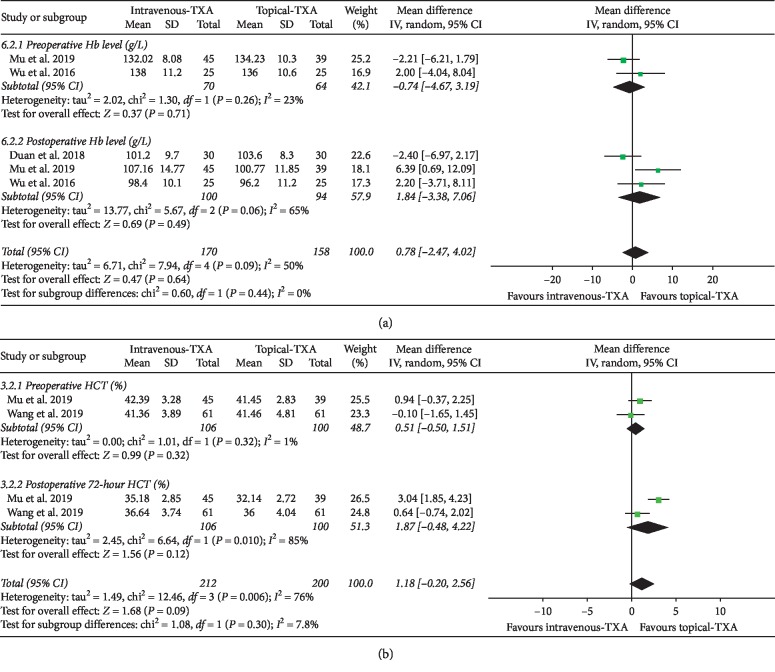
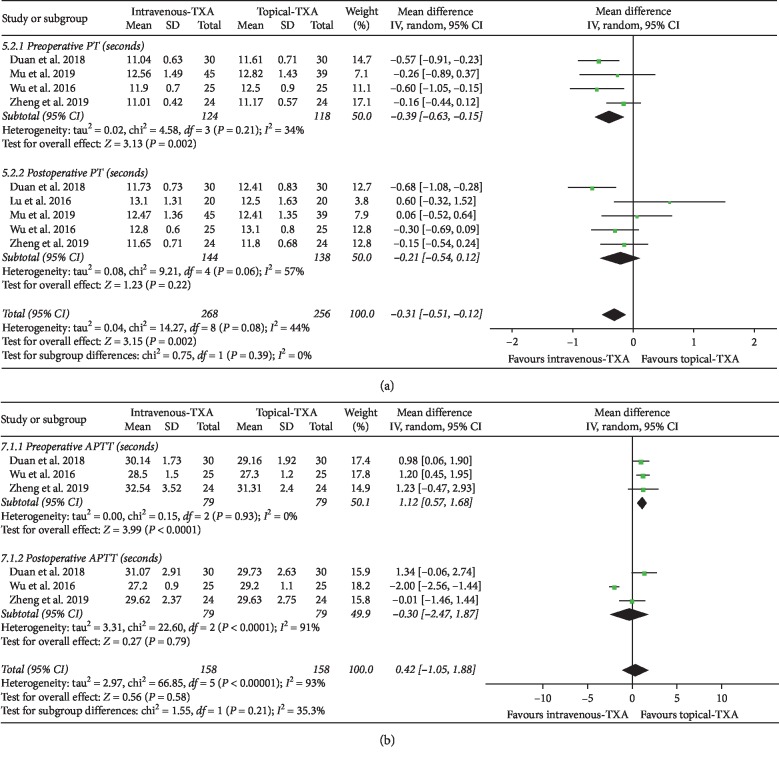
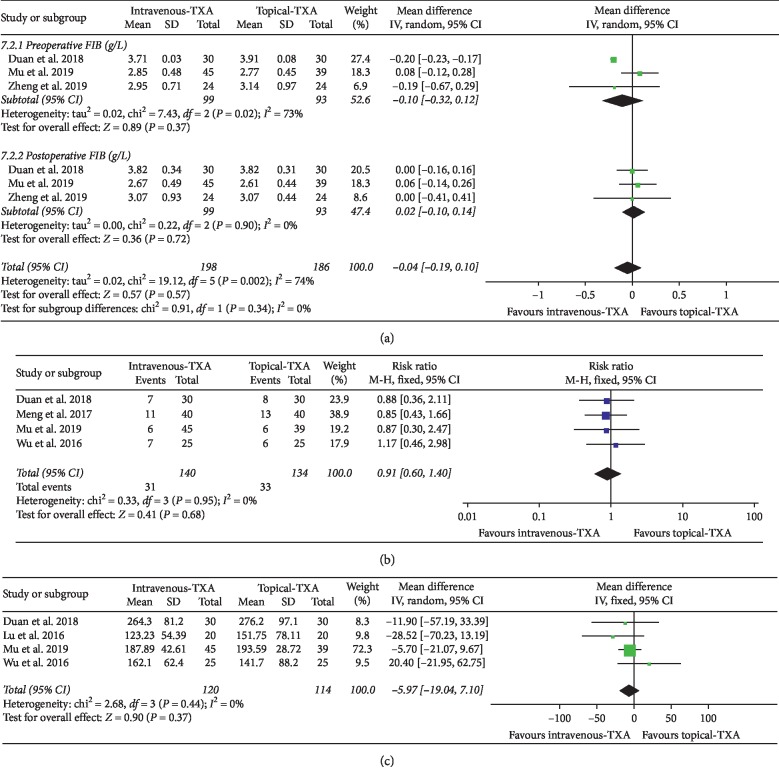
Eight randomized controlled trials (RCTs) were identified, including 660 patients. The surgical methods used in the included studies were nondeformity spine surgery. No significant differences were found in the two groups regarding total blood loss, intraoperative blood loss, hidden blood loss, hematocrit, hemoglobin, fibrinogen, postoperative prothrombin time (PT), postoperative activated partial thromboplastin time (APTT), drainage volume, and blood transfusion rate. There were statistically significant differences in the two groups in terms of preoperative PT (MD = -0.39, 95% CI: [-0.63, -0.15], =0.002) and preoperative APTT (MD = 1.12, 95% CI: [0.57, 1.68], =0.002) and preoperative APTT (MD = 1.12, 95% CI: [0.57, 1.68].
During nondeformity spine surgery, intravenous administration of TXA did not have a significant effect on the decrease of blood loss and blood transfusion rate compared with the topical group. According to the pooled analysis of PT and APTT, intravenous and topical application of TXA may have different effects on the coagulation pathway. More high-quality RCTs are needed to explore the optimal dosage, method, timing in the future in order to recommend TXA widespread use in spine surgery.
氨甲环酸(TXA)是一种抗纤维蛋白溶解剂,已用于减少脊柱手术中的出血量多年。本荟萃分析的目的是比较静脉内和局部应用 TXA 对非畸形脊柱手术患者的影响。
我们搜索了多个数据库,包括 PubMed、Embase、Cochrane 图书馆、CNKI、万方数据库和 VIP,以找到符合纳入标准的研究。根据 Cochrane 评论员手册的指南进行荟萃分析。
共纳入 8 项随机对照试验(RCT),共 660 例患者。纳入研究的手术方法为非畸形脊柱手术。两组在总失血量、术中失血量、隐性失血量、血细胞比容、血红蛋白、纤维蛋白原、术后凝血酶原时间(PT)、术后活化部分凝血活酶时间(APTT)、引流量和输血率方面无显著差异。两组在术前 PT(MD = -0.39,95%CI:[-0.63,-0.15],=0.002)和术前 APTT(MD = 1.12,95%CI:[0.57,1.68],=0.002)方面有统计学差异。
在非畸形脊柱手术中,与局部应用 TXA 相比,静脉内应用 TXA 对减少出血量和输血率没有显著影响。根据 PT 和 APTT 的汇总分析,静脉内和局部应用 TXA 可能对凝血途径有不同的影响。未来需要更多高质量的 RCT 来探讨最佳剂量、方法和时机,以便推荐 TXA 在脊柱手术中的广泛应用。