Sendak Mark P, Gao Michael, Brajer Nathan, Balu Suresh
1Duke Institute for Health Innovation, Durham, NC USA.
2Duke University School of Medicine, Durham, NC USA.
NPJ Digit Med. 2020 Mar 23;3:41. doi: 10.1038/s41746-020-0253-3. eCollection 2020.
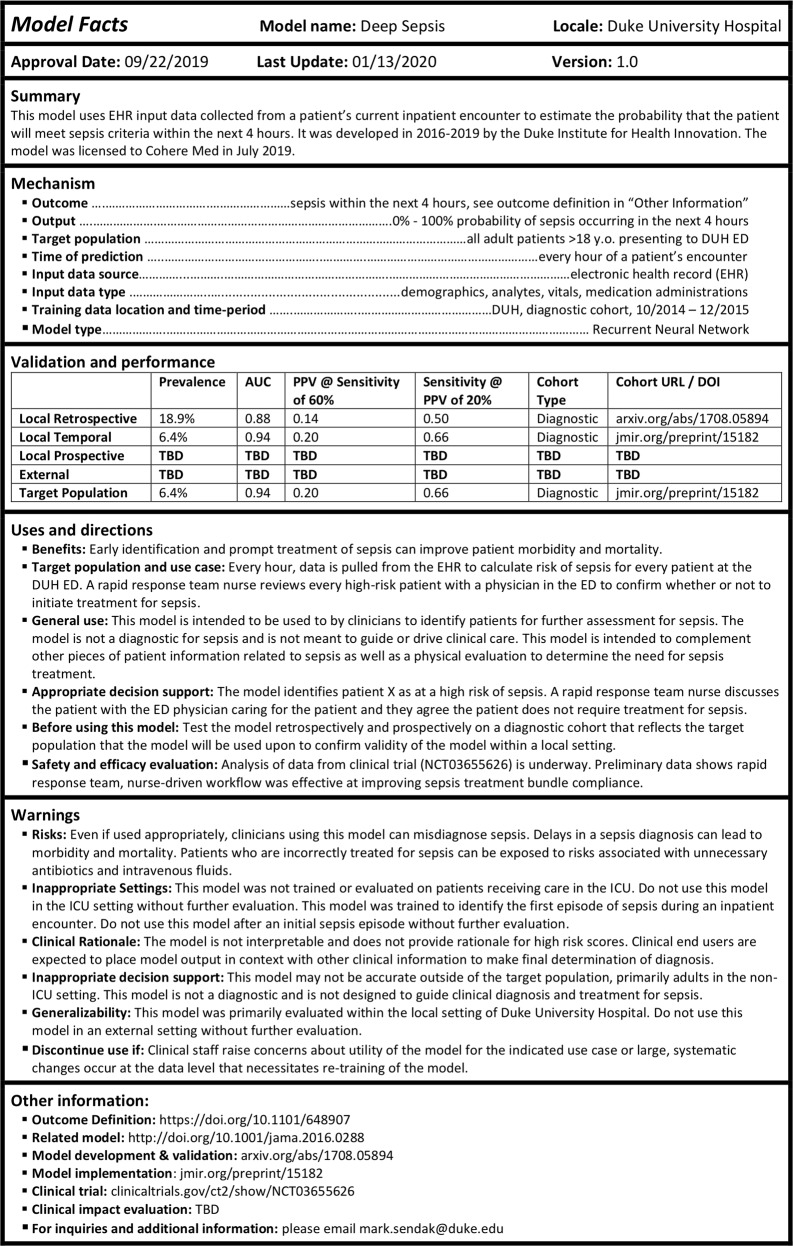
There is tremendous enthusiasm surrounding the potential for machine learning to improve medical prognosis and diagnosis. However, there are risks to translating a machine learning model into clinical care and clinical end users are often unaware of the potential harm to patients. This perspective presents the "Model Facts" label, a systematic effort to ensure that front-line clinicians actually know how, when, how not, and when not to incorporate model output into clinical decisions. The "Model Facts" label was designed for clinicians who make decisions supported by a machine learning model and its purpose is to collate relevant, actionable information in 1-page. Practitioners and regulators must work together to standardize presentation of machine learning model information to clinical end users in order to prevent harm to patients. Efforts to integrate a model into clinical practice should be accompanied by an effort to clearly communicate information about a machine learning model with a "Model Facts" label.
围绕机器学习改善医学预后和诊断的潜力,人们有着极大的热情。然而,将机器学习模型转化为临床护理存在风险,而临床终端用户往往并未意识到这可能对患者造成的危害。本文观点提出了“模型事实”标签,这是一项系统性的努力,旨在确保一线临床医生切实了解如何、何时、如何不以及何时不将模型输出纳入临床决策。“模型事实”标签是为那些依据机器学习模型做出决策的临床医生设计的,其目的是在1页纸内整理相关的、可操作的信息。从业者和监管机构必须共同努力,规范向临床终端用户呈现机器学习模型信息的方式,以防止对患者造成伤害。将模型整合到临床实践中的努力,应伴随着通过“模型事实”标签清晰传达有关机器学习模型信息的努力。