Mani Reeta S, Ravi V, Desai Anita, Madhusudana S N
Department of Neurovirology, National Institute of Mental Health and Neuro Sciences (NIMHANS), Bangalore, 560029 India.
Proc Natl Acad Sci India Sect B Biol Sci. 2012;82(1):5-21. doi: 10.1007/s40011-011-0001-1. Epub 2012 Jan 18.
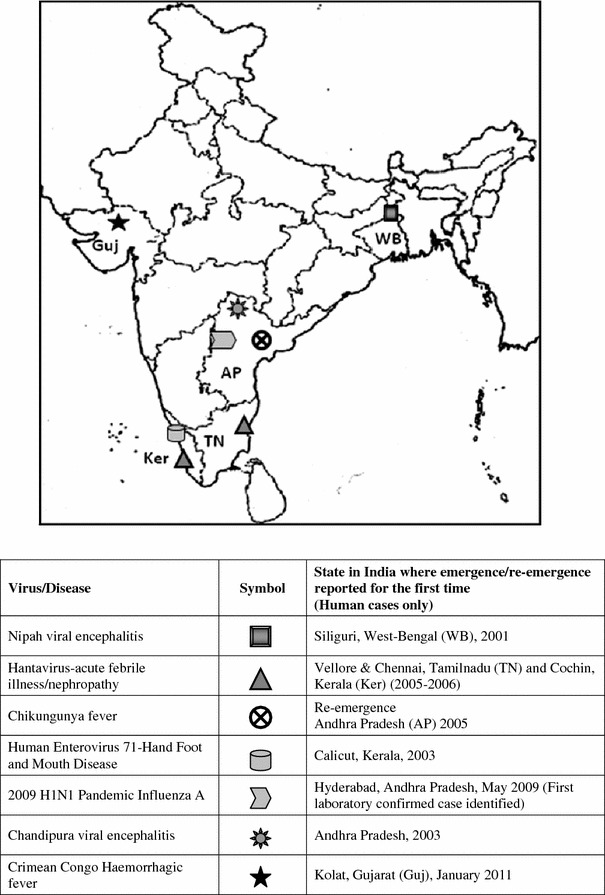
Despite an elaborate armamentarium to tackle microbes, emerging infectious diseases remain a crucial global challenge. Emerging infections can be defined as "infections that have newly appeared in a population or have existed previously but are rapidly increasing in incidence or geographic range." Several factors like increase in international travel and trade, human encroachment on wild-life habitats, changes in agricultural practices and wild-life trade have contributed to the emergence of pathogens. Emergence/re-emergence of several viral infections has been reported from India in the past few decades; some of the important emerging viral infections are discussed in this review. They include infection due to Nipah, Hantaviruses, Chikungunya, Human Enterovirus-71, Influenza, Chandipura, Crimean Congo, SARS Coronavirus, Buffalopox, Dengue and Japanese Encephalitis viruses. Creating increased awareness and training of clinical microbiologists/virologists for identification of new/emerging pathogens, and prompt reporting and management of outbreaks is essential to tackle the threat posed by emerging/re-emerging infections.
尽管有一套精心设计的应对微生物的手段,但新出现的传染病仍然是一项至关重要的全球挑战。新出现的感染可定义为“在人群中新出现的感染,或以前存在但发病率或地理范围正在迅速增加的感染”。国际旅行和贸易的增加、人类对野生动物栖息地的侵占、农业实践的变化以及野生动物贸易等几个因素促成了病原体的出现。在过去几十年里,印度报告了几种病毒感染的出现/再次出现;本综述讨论了一些重要的新出现的病毒感染。它们包括尼帕病毒、汉坦病毒、基孔肯雅病毒、人类肠道病毒71型、流感病毒、钱迪普拉病毒、克里米亚刚果病毒、SARS冠状病毒、水牛痘病毒、登革热病毒和日本脑炎病毒引起的感染。提高临床微生物学家/病毒学家对新出现病原体的识别意识并对其进行培训,以及对疫情进行及时报告和管理,对于应对新出现/再次出现的感染所构成的威胁至关重要。