Vanderbilt Brain Institute, Department of Psychology, Vanderbilt University, Nashville, Tennessee.
Department of Neurology, Vanderbilt University Medical Center, Nashville, Tennessee.
Ann Clin Transl Neurol. 2020 Apr;7(4):437-448. doi: 10.1002/acn3.51016. Epub 2020 Mar 29.
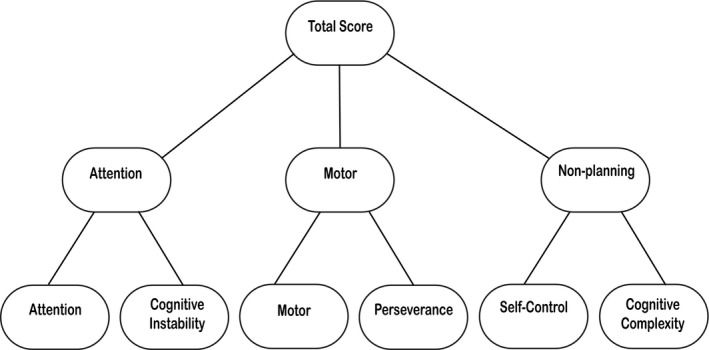
Impulsive decision-making is characterized by actions taken without considering consequences. Patients with Parkinson's disease (PD) who receive dopaminergic treatment, especially dopamine agonists, are at risk of developing impulsive-compulsive behaviors (ICBs). We assessed impulse-related changes across a large heterogeneous PD population using the Barratt impulsivity scale (BIS-11) by evaluating BIS-11 first- and second-order factors.
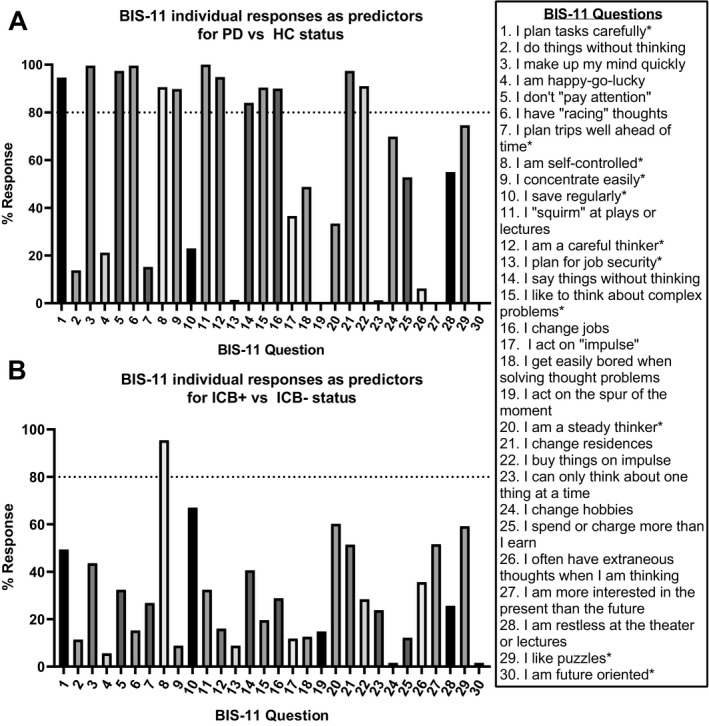
We assessed a total of 204 subjects: 93 healthy controls (HCs), and 68 ICB- and 43 ICB + PD patients who completed the BIS-11. Using a general linear model and a least absolute shrinkage and selection operation regression, we compared BIS-11 scores between the HC, ICB- PD, and ICB + PD groups.
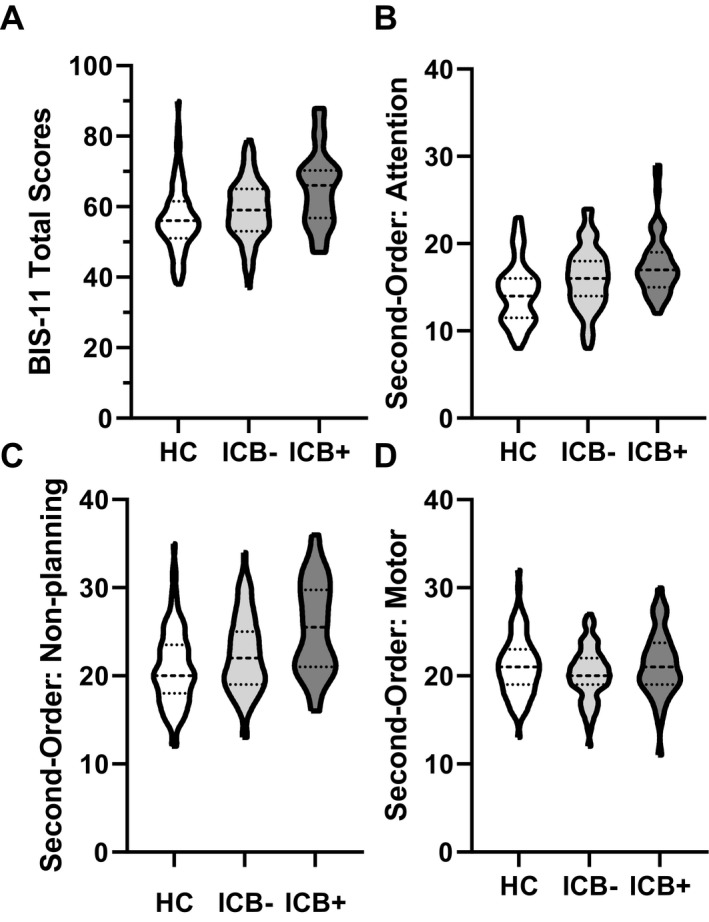
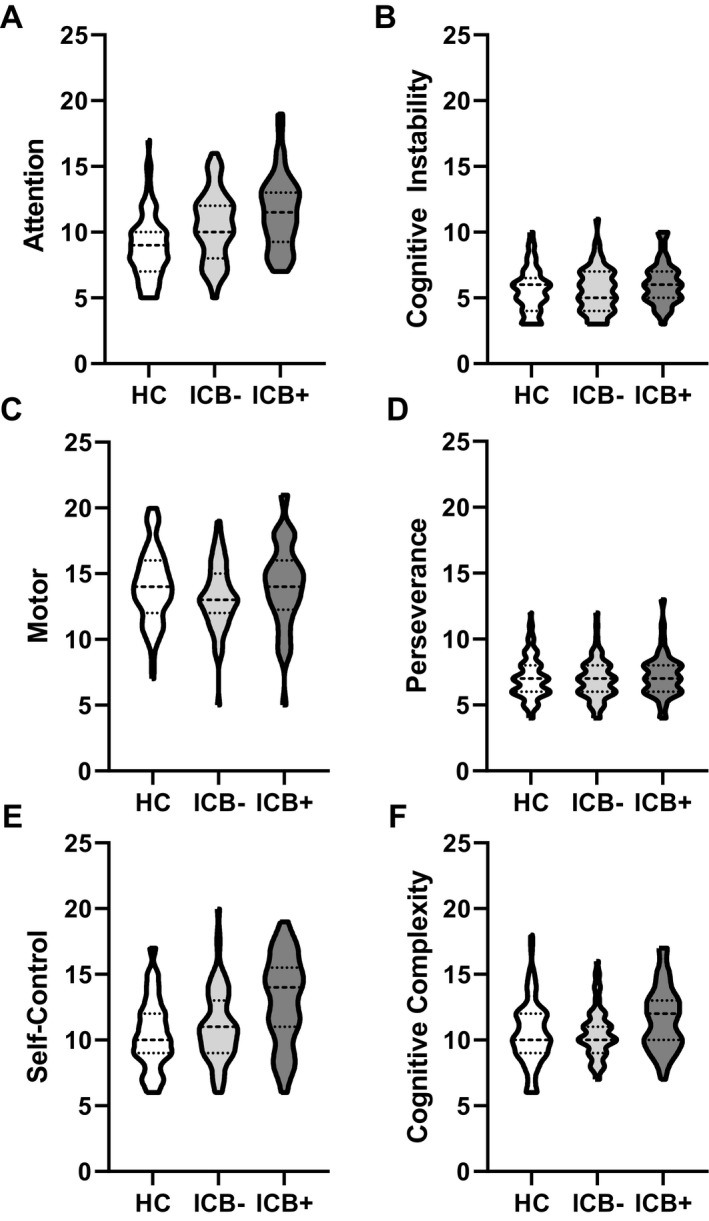
Patients with PD rated themselves as more impulsive than HCs in the BIS-11 total score, second-order attention domain, and first-order attention and self-control domains. ICB + patients recorded higher total scores as well as higher scores in the second-order non-planning domain and in self-control and cognitive complexity than ICB- patients.
These results indicate that the patients with PD show particular problems with attentional control, whereas ICB + patients show a distinct problem in cognitive control and complexity. Additionally, it appears that all patients with PD are more impulsive than their age- and sex-matched healthy peers. Increased impulsivity may be a result of the disease course, or attributed to dopaminergic medication use, but these results emphasize the importance of the cognitive components of impulsivity in patients with PD.
冲动决策的特点是在不考虑后果的情况下采取行动。接受多巴胺能治疗的帕金森病(PD)患者,尤其是多巴胺激动剂,有发展冲动-强迫行为(ICBs)的风险。我们使用巴雷特冲动量表(BIS-11)评估了一个大型异质 PD 人群的冲动相关变化,通过评估 BIS-11 的一阶和二阶因素来评估。
我们共评估了 204 名受试者:93 名健康对照者(HCs),68 名 ICB-和 43 名 ICB+PD 患者完成了 BIS-11。使用一般线性模型和最小绝对收缩和选择操作回归,我们比较了 HC、ICB-PD 和 ICB+PD 组之间的 BIS-11 评分。
PD 患者在 BIS-11 总分、二阶注意域和一阶注意和自我控制域中自我评估比 HCs 更冲动。ICB+患者的总评分以及二阶非计划域和自我控制和认知复杂性的评分均高于 ICB-患者。
这些结果表明,PD 患者表现出注意力控制方面的特殊问题,而 ICB+患者表现出认知控制和复杂性方面的明显问题。此外,似乎所有 PD 患者都比年龄和性别匹配的健康同龄人更冲动。冲动增加可能是疾病过程的结果,或者归因于多巴胺能药物的使用,但这些结果强调了认知成分在 PD 患者中冲动的重要性。