Neurosciences Research Centre, Molecular and Clinical Sciences Research Institute, St George's University of London, London, United Kingdom.
Medical Research Council Brain Network Dynamics Unit, Nuffield Department of Clinical Neurosciences, Oxford, United Kingdom.
Mov Disord. 2021 Sep;36(9):2126-2135. doi: 10.1002/mds.28625. Epub 2021 May 13.
Impulsivity is common in people with Parkinson's disease (PD), with many developing impulsive compulsive behavior disorders (ICB). Its pathophysiological basis remains unclear.
We aimed to investigate local field potential (LFP) markers of trait impulsivity in PD and their relationship to ICB.
We recorded subthalamic nucleus (STN) LFPs in 23 PD patients undergoing deep brain stimulation implantation. Presence and severity of ICB were assessed by clinical interview and the Questionnaire for Impulsive-Compulsive Disorders in PD-Rating Scale (QUIP-RS), whereas trait impulsivity was estimated with the Barratt Impulsivity Scale (BIS-11). Recordings were obtained during the off dopaminergic states and the power spectrum of the subthalamic activity was analyzed using Fourier transform-based techniques. Assessment of each electrode contact localization was done to determine the topography of the oscillatory activity recorded.
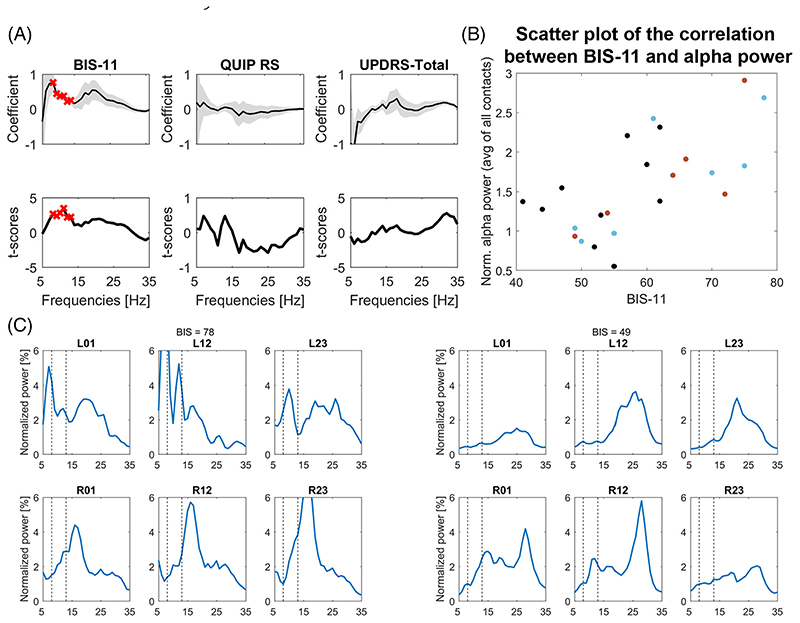
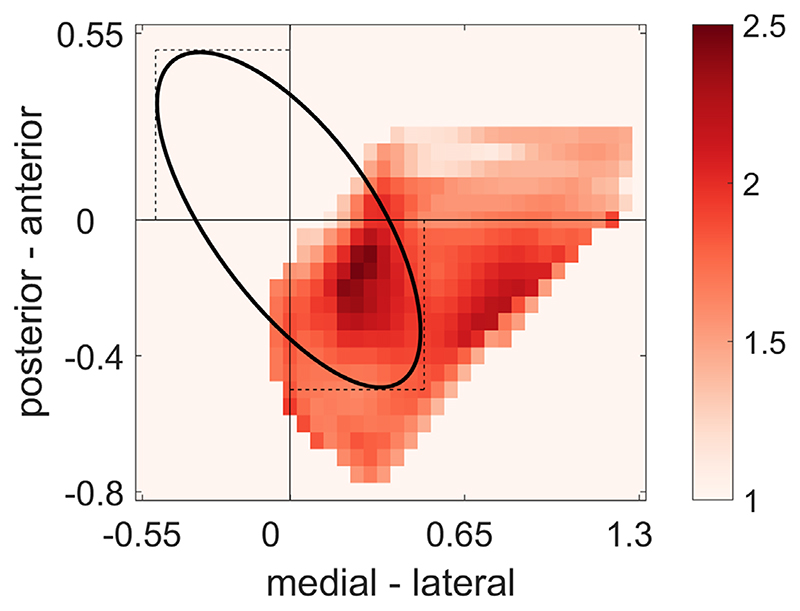
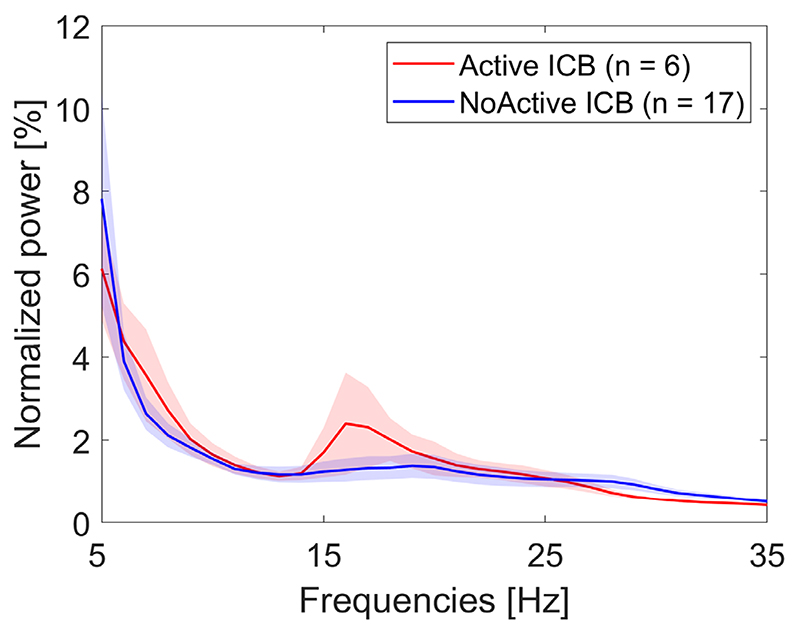
Patients with (n = 6) and without (n = 17) ICB had similar LFP spectra. A multiple regression model including QUIP-RS, BIS-11, and Unified PD Rating Scale-III scores as regressors showed a significant positive correlation between 8-13 Hz power and BIS-11 score. The correlation was mainly driven by the motor factor of the BIS-11, and was irrespective of the presence or absence of active ICB. Electrode contact pairs with the highest α power, which also correlated most strongly with BIS-11, tended to be more ventral than contact pairs with the highest beta power, which localize to the dorsolateral motor STN.
Our data suggest a link between α power and trait impulsivity in PD, irrespective of the presence and severity of ICB. © 2021 The Authors. Movement Disorders published by Wiley Periodicals LLC on behalf of International Parkinson and Movement Disorder Society.
冲动在帕金森病(PD)患者中很常见,许多患者会发展为冲动强迫行为障碍(ICB)。其病理生理学基础仍不清楚。
我们旨在研究 PD 中特质冲动的局部场电位(LFP)标志物及其与 ICB 的关系。
我们记录了 23 名接受深部脑刺激植入术的 PD 患者的丘脑底核(STN)LFP。通过临床访谈和 PD 冲动-强迫障碍评定量表(QUIP-RS)评估 ICB 的存在和严重程度,而特质冲动则用巴瑞特冲动量表(BIS-11)来估计。在不使用多巴胺能药物的状态下进行记录,并使用基于傅立叶变换的技术对 STN 活动的功率谱进行分析。评估每个电极接触的定位,以确定记录的振荡活动的拓扑结构。
有(n=6)和无(n=17)ICB 的患者的 LFP 频谱相似。一个包含 QUIP-RS、BIS-11 和统一 PD 评定量表-III 评分作为回归因子的多元回归模型显示,8-13 Hz 功率与 BIS-11 评分之间存在显著的正相关。这种相关性主要是由 BIS-11 的运动因子驱动的,与是否存在活跃的 ICB 无关。与 BIS-11 相关性最强的、具有最高 α 功率的电极接触对往往比具有最高 β 功率的电极接触对更偏向腹侧,后者定位于 STN 的背外侧运动区。
我们的数据表明,PD 中 α 功率与特质冲动之间存在联系,与 ICB 的存在和严重程度无关。© 2021 作者。运动障碍由 Wiley 期刊公司代表国际帕金森病和运动障碍协会出版。