Dixon Brian E, Wen Chen, French Tony, Williams Jennifer L, Duke Jon D, Grannis Shaun J
Department of Epidemiology, Indiana University Richard M Fairbanks School of Public Health, Indianapolis, Indiana, USA
Center for Biomedical Informatics, Regenstrief Institute Inc, Indianapolis, Indiana, USA.
BMJ Health Care Inform. 2020 Mar;27(1). doi: 10.1136/bmjhci-2019-100054.
As the health system seeks to leverage large-scale data to inform population outcomes, the informatics community is developing tools for analysing these data. To support data quality assessment within such a tool, we extended the open-source software Observational Health Data Sciences and Informatics (OHDSI) to incorporate new functions useful for population health.
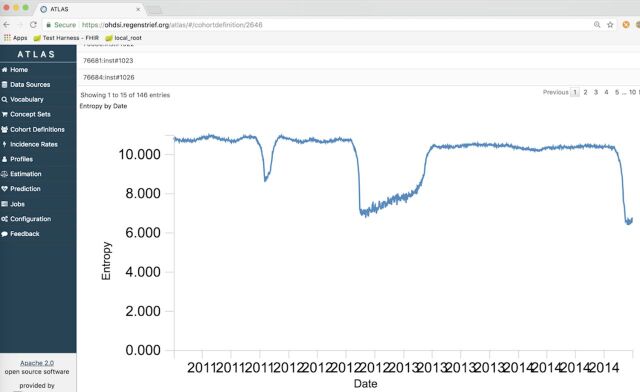
We developed and tested methods to measure the completeness, timeliness and entropy of information. The new data quality methods were applied to over 100 million clinical messages received from emergency department information systems for use in public health syndromic surveillance systems.
While completeness and entropy methods were implemented by the OHDSI community, timeliness was not adopted as its context did not fit with the existing OHDSI domains. The case report examines the process and reasons for acceptance and rejection of ideas proposed to an open-source community like OHDSI.
随着卫生系统寻求利用大规模数据来了解人群健康结果,信息学领域正在开发用于分析这些数据的工具。为了在这样的工具中支持数据质量评估,我们扩展了开源软件观察性健康数据科学与信息学(OHDSI),以纳入对人群健康有用的新功能。
我们开发并测试了用于衡量信息完整性、及时性和熵的方法。这些新的数据质量方法应用于从急诊科信息系统接收的超过1亿条临床信息,用于公共卫生症状监测系统。
虽然完整性和熵方法由OHDSI社区实施,但及时性未被采用,因为其背景与现有的OHDSI领域不匹配。该案例报告探讨了向OHDSI这样的开源社区提出的想法被接受和拒绝的过程及原因。