Emerging Pathogens Institute, University of Florida, Gainesville, FL 32610;
Department of Pathology, Immunology and Laboratory Medicine, College of Medicine, University of Florida, Gainesville, FL 32610.
Proc Natl Acad Sci U S A. 2020 Apr 7;117(14):7897-7904. doi: 10.1073/pnas.1918763117. Epub 2020 Mar 30.
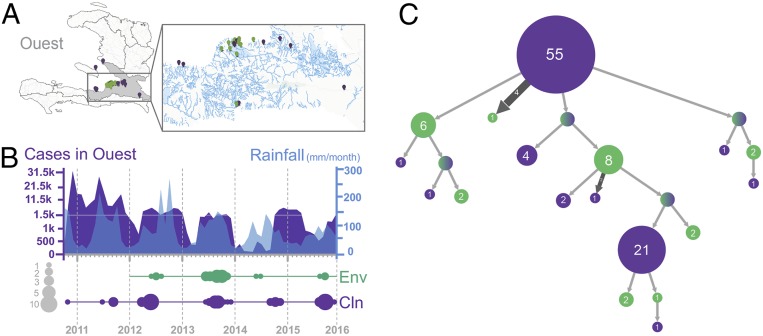
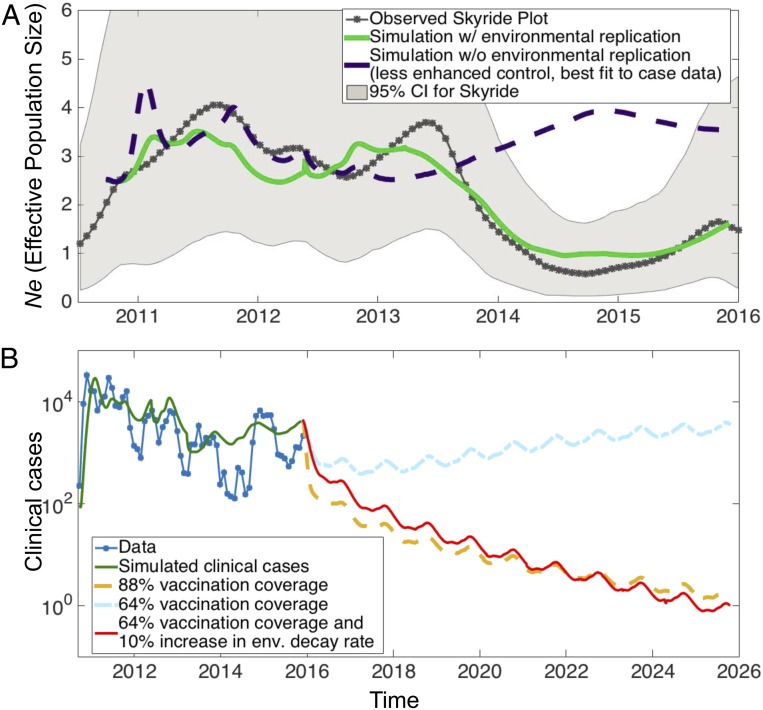
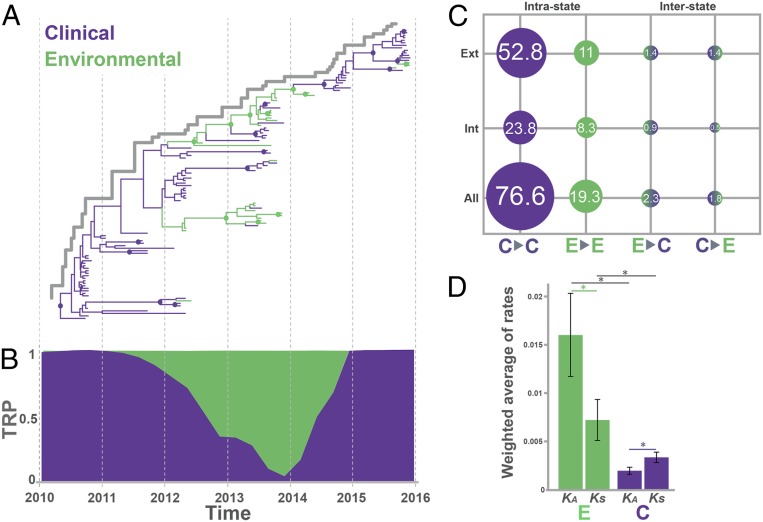
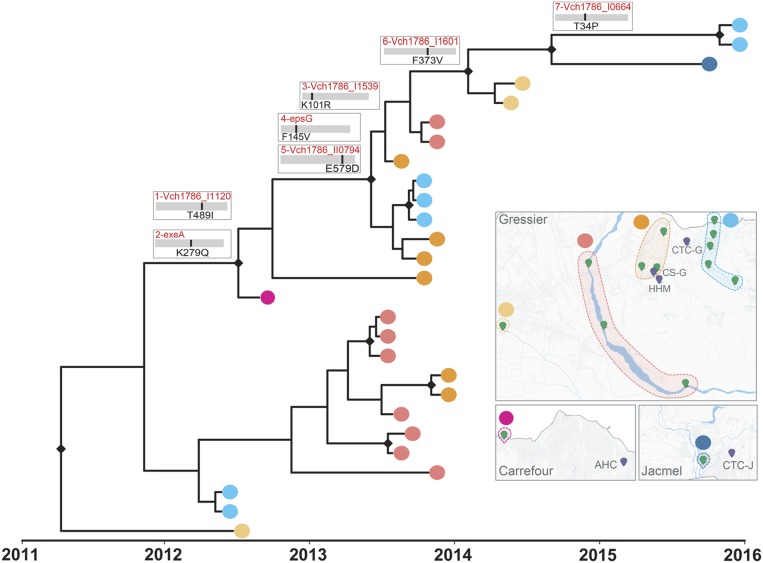
The spread of cholera in the midst of an epidemic is largely driven by direct transmission from person to person, although it is well-recognized that is also capable of growth and long-term survival in aquatic ecosystems. While prior studies have shown that aquatic reservoirs are important in the persistence of the disease on the Indian subcontinent, an epidemiological view postulating that locally evolving environmental contributes to outbreaks outside Asia remains debated. The single-source introduction of toxigenic O1 in Haiti, one of the largest outbreaks occurring this century, with 812,586 suspected cases and 9,606 deaths reported through July 2018, provided a unique opportunity to evaluate the role of aquatic reservoirs and assess bacterial transmission dynamics across environmental boundaries. To this end, we investigated the phylogeography of both clinical and aquatic toxigenic O1 isolates and show robust evidence of the establishment of aquatic reservoirs as well as ongoing evolution of isolates from aquatic sites. Novel environmental lineages emerged from sequential population bottlenecks, carrying mutations potentially involved in adaptation to the aquatic ecosystem. Based on such empirical data, we developed a mixed-transmission dynamic model of , where aquatic reservoirs actively contribute to genetic diversification and epidemic emergence, which underscores the complexity of transmission pathways in epidemics and endemic settings and the need for long-term investments in cholera control at both human and environmental levels.
在疫情期间,霍乱的传播在很大程度上是人与人之间的直接传播驱动的,尽管人们已经认识到它也能够在水生生态系统中生长和长期生存。虽然先前的研究表明,水生水库在疾病在印度次大陆的持续存在中很重要,但有一种流行病学观点认为,当地进化的环境 有助于亚洲以外的爆发,这一观点仍存在争议。海地发生了本世纪最大的霍乱疫情之一,单一来源的产毒 O1 霍乱弧菌的引入,提供了一个独特的机会来评估水生水库的作用,并评估细菌跨越环境边界的传播动态。为此,我们调查了临床和水生产毒 O1 分离株的系统地理学,并有力地证明了水生水库的建立以及来自水生地点的 分离株的持续进化。新的环境谱系从连续的种群瓶颈中出现,携带潜在参与适应水生生态系统的突变。基于这些经验数据,我们开发了一个 的混合传播动态模型,其中水生水库积极促进遗传多样化和流行病的出现,这凸显了传染病和地方病传播途径的复杂性,以及在人类和环境层面上长期投资霍乱控制的必要性。