Barcellos Lins Sergio Augusto, Ridolfi Stefano, Gigante Giovanni Ettore, Cesareo Roberto, Albini Monica, Riccucci Cristina, di Carlo Gabriella, Fabbri Andrea, Branchini Paolo, Tortora Luca
Department of Basic and Applied Sciences for Engineering, Sapienza University of Rome, Rome, Italy.
Surface Analysis Laboratory, Istituto Nazionale di Fisica Nucleare Sezione di Roma Tre, Rome, Italy.
Front Chem. 2020 Mar 13;8:175. doi: 10.3389/fchem.2020.00175. eCollection 2020.
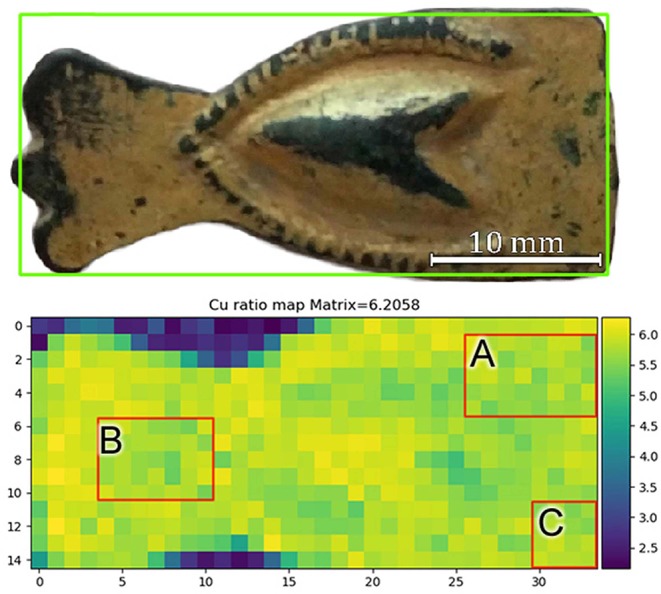
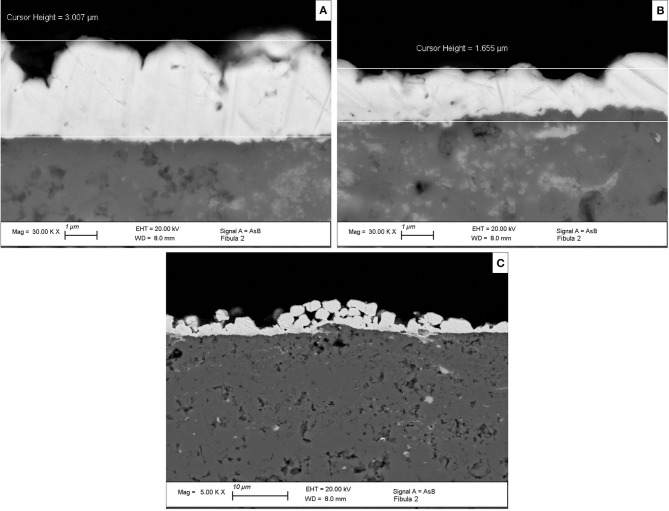
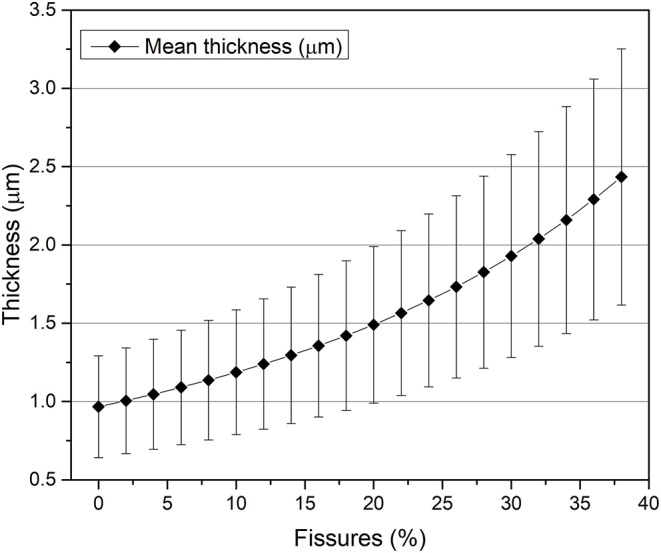
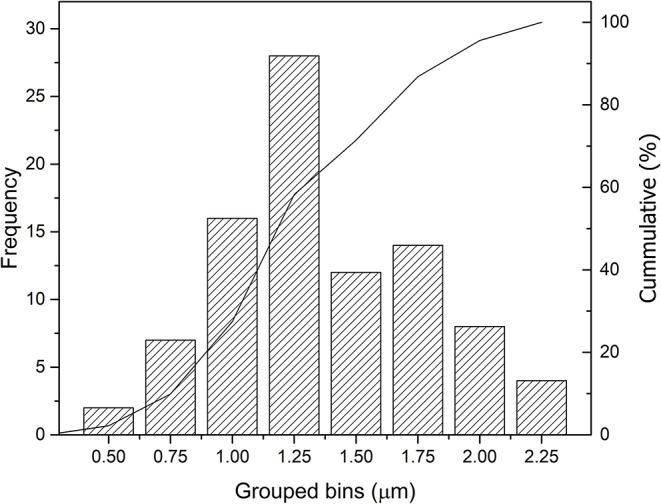
When investigating gilded artifacts or works of art, the determination of the gilding thickness plays a significant role in establishing restoration protocols or conservation strategies. Unfortunately, this is done by cross-sectioning the object, a destructive approach not always feasible. A non-destructive alternative, based on the differential attenuation of fluorescence radiation from the sample, has been developed in the past years, but due to the intrinsic random nature of X-rays, the study of single or few spots of an objects surface may yield biased information. Furthermore, considering the effects of both porosity and sample inhomogeneities is a practice commonly overlooked, which may introduce systematic errors. In order to overcome these matters, here we propose the extrapolation of the differential-attenuation method from single-spot X-ray fluorescence (XRF) measurements to macro-XRF (MA-XRF) scanning. In this work, an innovative algorithm was developed for evaluating the large amount of data coming from MA-XRF datasets and evaluate the thickness of a given overlapping layer over an area. This approach was adopted to study a gilded copper-based buckle from the sixteenth to seventeenth century found in Rome. The gilded object under investigation was also studied by other analytical techniques including scanning electron microscopy coupled with energy dispersive spectroscopy (SEM-EDS). Previous results obtained from SEM-EDS were used to confront the data obtained with the proposed methodology and validate it. MA-XRF elemental distribution maps were fundamental in identifying and choosing sampling areas to calculate the thickness of the gilding layer, avoiding lead islands present in the sample that could negatively influence the results. Albeit the large relative standard deviation, the mean thickness values fell within those found in literature and those obtained from previous studies with SEM-EDS. Surface fissure has been found to deeply affect the results obtained, an aspect that is often disregarded.
在研究镀金文物或艺术品时,镀金厚度的测定对于制定修复方案或保护策略起着重要作用。不幸的是,这通常是通过对物体进行切片来完成的,这种破坏性方法并非总是可行。过去几年开发了一种基于样品荧光辐射的差分衰减的非破坏性替代方法,但由于X射线固有的随机性质,对物体表面单个或少数几个点的研究可能会产生有偏差的信息。此外,通常会忽略孔隙率和样品不均匀性的影响,这可能会引入系统误差。为了克服这些问题,我们在此提出将差分衰减方法从单点X射线荧光(XRF)测量外推到宏观XRF(MA-XRF)扫描。在这项工作中,开发了一种创新算法,用于评估来自MA-XRF数据集的大量数据,并评估给定重叠区域上一层的厚度。采用这种方法研究了在罗马发现的一件16至17世纪的镀金铜质带扣。还通过其他分析技术对所研究的镀金物体进行了研究,包括扫描电子显微镜与能量色散光谱联用(SEM-EDS)。将SEM-EDS先前获得的结果与用所提出的方法获得的数据进行对比并验证。MA-XRF元素分布图对于识别和选择采样区域以计算镀金层的厚度至关重要,避免样品中存在的铅岛对结果产生负面影响。尽管相对标准偏差较大,但平均厚度值落在文献中以及先前用SEM-EDS研究获得的值范围内。已发现表面裂缝会严重影响所获得的结果,而这一方面常常被忽视。