Brandt Emma B, Bashar S Janna, Mahmoud Ahmed I
Department of Cell and Regenerative Biology, University of Wisconsin-Madison School of Medicine and Public Health, 1111 Highland Ave, Room 4557, Madison, WI 53705 USA.
Bioelectron Med. 2019 Jun 26;5:8. doi: 10.1186/s42234-019-0024-0. eCollection 2019.
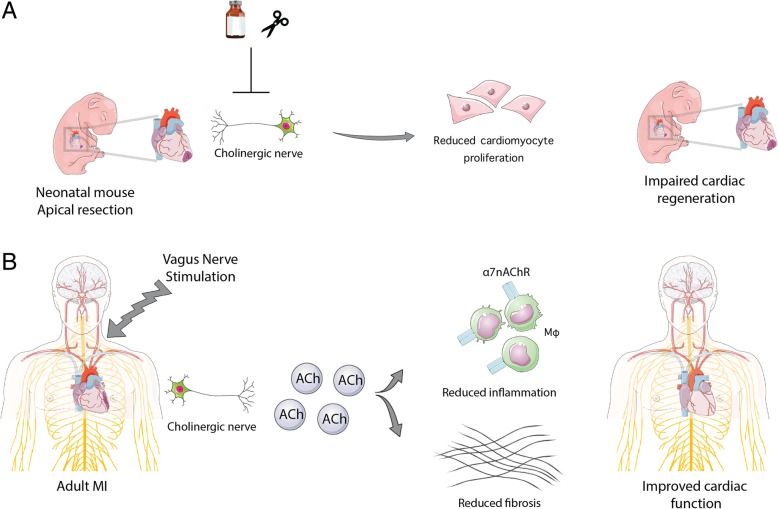
Ischemic heart disease is the leading cause of death worldwide. The blockade of coronary arteries limits oxygen-rich blood to the heart and consequently there is cardiomyocyte (CM) cell death, inflammation, fibrotic scarring, and myocardial remodeling. Unfortunately, current therapeutics fail to effectively replace the lost cardiomyocytes or prevent fibrotic scarring, which results in reduced cardiac function and the development of heart failure (HF) in the adult mammalian heart. In contrast, neonatal mice are capable of regenerating their hearts following injury. However, this regenerative response is restricted to the first week of post-natal development. Recently, we identified that cholinergic nerve signaling is necessary for the neonatal mouse cardiac regenerative response. This demonstrates that cholinergic nerve stimulation holds significant potential as a bioelectronic therapeutic tool for heart disease. However, the mechanisms of nerve directed regeneration in the heart remain undetermined. In this review, we will describe the historical evidence of nerve function during regeneration across species. Specifically, we will focus on the emerging role of cholinergic innervation in modulating cardiomyocyte proliferation and inflammation during heart regeneration. Understanding the role of nerves in mammalian heart regeneration and adult cardiac remodeling can provide us with innovative bioelectronic-based therapeutic approaches for treatment of human heart disease.
缺血性心脏病是全球主要的死亡原因。冠状动脉阻塞限制了富含氧气的血液流向心脏,进而导致心肌细胞(CM)死亡、炎症、纤维化瘢痕形成和心肌重塑。不幸的是,目前的治疗方法无法有效替代丢失的心肌细胞或预防纤维化瘢痕形成,这导致成年哺乳动物心脏的心脏功能下降和心力衰竭(HF)的发展。相比之下,新生小鼠在受伤后能够再生其心脏。然而,这种再生反应仅限于出生后发育的第一周。最近,我们发现胆碱能神经信号传导是新生小鼠心脏再生反应所必需的。这表明胆碱能神经刺激作为一种治疗心脏病的生物电子治疗工具具有巨大潜力。然而,心脏中神经定向再生的机制仍未确定。在这篇综述中,我们将描述跨物种再生过程中神经功能的历史证据。具体而言,我们将重点关注胆碱能神经支配在心脏再生过程中调节心肌细胞增殖和炎症方面的新作用。了解神经在哺乳动物心脏再生和成年心脏重塑中的作用可以为我们提供基于生物电子学的创新治疗方法来治疗人类心脏病。