Frejo Lidia, Grande Daniel A
Orthopaedic Research Laboratory, The Feinstein Institutes for Medical Research, 350 Community Drive, Manhasset, NY 11030 USA.
2Division of Otolaryngology and Communicative Disorders-Pediatric Otolaryngology, Long Island Jewish Medical Center New Hyde Park, New York, USA.
Bioelectron Med. 2019 Sep 17;5:15. doi: 10.1186/s42234-019-0031-1. eCollection 2019.
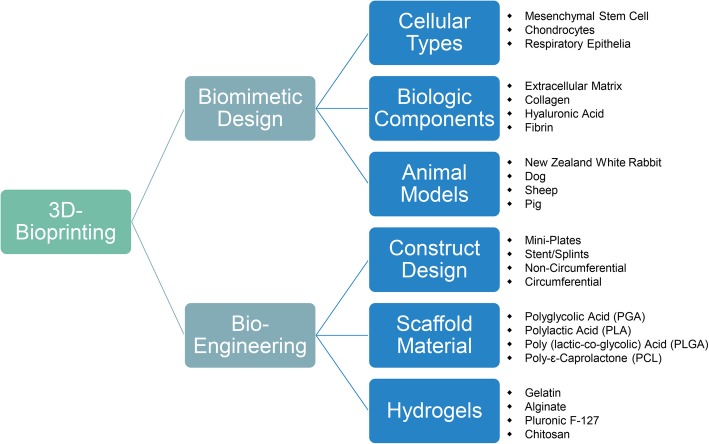
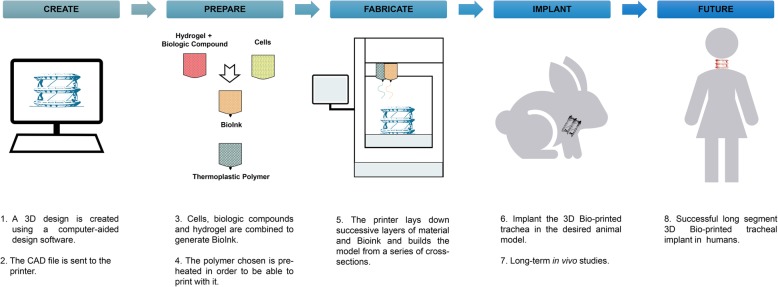
Congenital tracheomalacia and tracheal stenosis are commonly seen in premature infants. In adulthood, are typically related with chronic obstructive pulmonary disease, and can occur secondarily from tracheostomy, prolong intubation, trauma, infection and tumors. Both conditions are life-threatening when not managed properly. There are still some surgical limitations for certain pathologies, however tissue engineering is a promising approach to treat massive airway dysfunctions. 3D-bioprinting have contributed to current preclinical and clinical efforts in airway reconstruction. Several strategies have been used to overcome the difficulty of airway reconstruction such as scaffold materials, construct designs, cellular types, biologic components, hydrogels and animal models used in tracheal reconstruction. Nevertheless, additional long-term in vivo studies need to be performed to assess the efficacy and safety of tissue-engineered tracheal grafts in terms of mechanical properties, behavior and, the possibility of further stenosis development.
先天性气管软化和气管狭窄在早产儿中很常见。在成年人中,通常与慢性阻塞性肺疾病有关,并且可继发于气管切开术、长期插管、创伤、感染和肿瘤。如果处理不当,这两种情况都危及生命。对于某些病理情况,仍然存在一些手术限制,然而组织工程是治疗大面积气道功能障碍的一种有前景的方法。3D生物打印有助于当前气道重建的临床前和临床研究。已经使用了几种策略来克服气道重建的困难,例如支架材料、构建设计、细胞类型、生物成分、水凝胶以及气管重建中使用的动物模型。然而,需要进行更多的长期体内研究,以评估组织工程气管移植物在机械性能、行为以及进一步狭窄发展可能性方面的有效性和安全性。