Drobin Kimi, Marczyk Michal, Halle Martin, Danielsson Daniel, Papiez Anna, Sangsuwan Traimate, Bendes Annika, Hong Mun-Gwan, Qundos Ulrika, Harms-Ringdahl Mats, Wersäll Peter, Polanska Joanna, Schwenk Jochen M, Haghdoost Siamak
Affinity Proteomics, Science for Life Laboratory, Department of Protein Science, School of Engineering Sciences in Chemistry, Biotechnology and Health, KTH - Royal Institute of Technology, Tomtebodavägen 23, 171 65 Stockholm, Sweden.
Yale Cancer Center, Department of Internal Medicine, Yale University School of Medicine, 06511 New Haven, CT, USA.
Cancers (Basel). 2020 Mar 22;12(3):753. doi: 10.3390/cancers12030753.
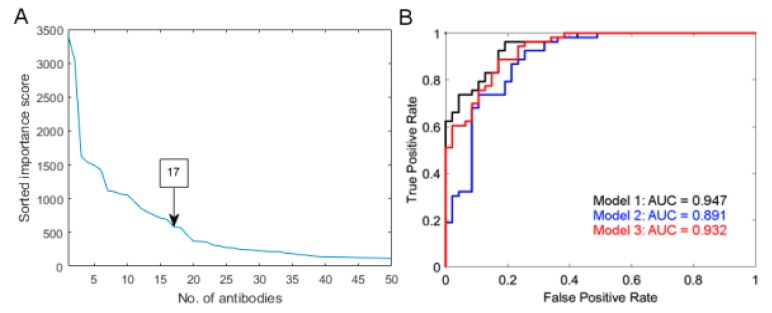
Nearly half of all cancers are treated with radiotherapy alone or in combination with other treatments, where damage to normal tissues is a limiting factor for the treatment. Radiotherapy-induced adverse health effects, mostly of importance for cancer patients with long-term survival, may appear during or long time after finishing radiotherapy and depend on the patient's radiosensitivity. Currently, there is no assay available that can reliably predict the individual's response to radiotherapy. We profiled two study sets from breast ( = 29) and head-and-neck cancer patients ( = 74) that included radiosensitive patients and matched radioresistant controls.. We studied 55 single nucleotide polymorphisms (SNPs) in 33 genes by DNA genotyping and 130 circulating proteins by affinity-based plasma proteomics. In both study sets, we discovered several plasma proteins with the predictive power to find radiosensitive patients (adjusted < 0.05) and validated the two most predictive proteins (THPO and STIM1) by sandwich immunoassays. By integrating genotypic and proteomic data into an analysis model, it was found that the proteins CHIT1, PDGFB, PNKD, RP2, SERPINC1, SLC4A, STIM1, and THPO, as well as the gene variant rs69947, predicted radiosensitivity of our breast cancer (AUC = 0.76) and head-and-neck cancer (AUC = 0.89) patients. In conclusion, circulating proteins and a SNP variant of suggest that processes such as vascular growth capacity, immune response, DNA repair and oxidative stress/hypoxia may be involved in an individual's risk of experiencing radiation-induced toxicity.
几乎一半的癌症患者接受单独放疗或与其他治疗联合使用的放疗,其中对正常组织的损伤是治疗的限制因素。放疗引起的不良健康影响,对长期存活的癌症患者最为重要,可能在放疗期间或结束后很长时间出现,并取决于患者的放射敏感性。目前,尚无可用的检测方法能够可靠地预测个体对放疗的反应。我们对来自乳腺癌患者(n = 29)和头颈癌患者(n = 74)的两个研究组进行了分析,其中包括放射敏感患者和匹配的放射抗性对照。我们通过DNA基因分型研究了33个基因中的55个单核苷酸多态性(SNP),并通过基于亲和的血浆蛋白质组学研究了130种循环蛋白。在两个研究组中,我们发现了几种具有预测放射敏感患者能力的血浆蛋白(校正P < 0.05),并通过夹心免疫测定法验证了两种最具预测性的蛋白(THPO和STIM1)。通过将基因型和蛋白质组学数据整合到一个分析模型中,发现蛋白CHIT1、PDGFB、PNKD、RP2、SERPINC1、SLC4A、STIM1和THPO,以及基因变体rs69947,可预测我们乳腺癌患者(AUC = 0.76)和头颈癌患者(AUC = 0.89)的放射敏感性。总之,循环蛋白和一个SNP变体表明,血管生长能力、免疫反应、DNA修复和氧化应激/缺氧等过程可能与个体发生辐射诱导毒性的风险有关。