Department of Nutrition and Health Sciences, University of Nebraska-Lincoln, Lincoln, NE, USA.
Department of Sport and Health Sciences, Technical University of Munich, Uptown München-Campus D, Georg-Brauchle-Ring 60/62, 80992, München, Germany.
Eur J Appl Physiol. 2020 May;120(5):1155-1164. doi: 10.1007/s00421-020-04354-0. Epub 2020 Mar 31.
Weight loss can result in the loss of muscle mass and bone mineral density. Resistance exercise is commonly prescribed to attenuate these effects. However, the anabolic endocrine response to resistance exercise during caloric restriction has not been characterized.
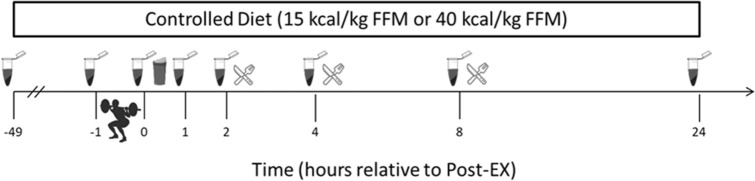
Participants underwent 3-day conditions of caloric restriction (15 kcal kg FFM) with post-exercise carbohydrate (CRC) and with post-exercise protein (CRP), and an energy balance control (40 kcal kg FFM) with post-exercise carbohydrate (CON). Serial blood draws were taken following five sets of five repetitions of the barbell back squat exercise on day 3 of each condition.
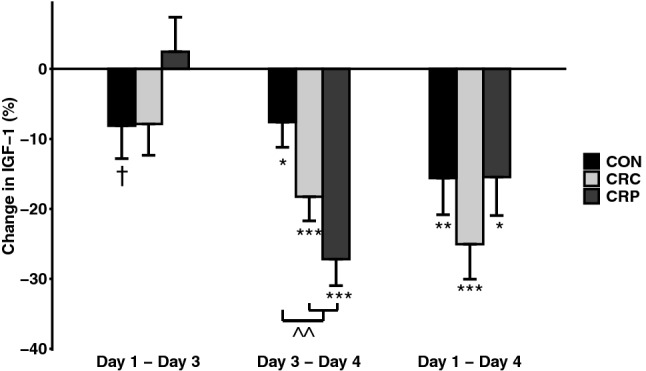
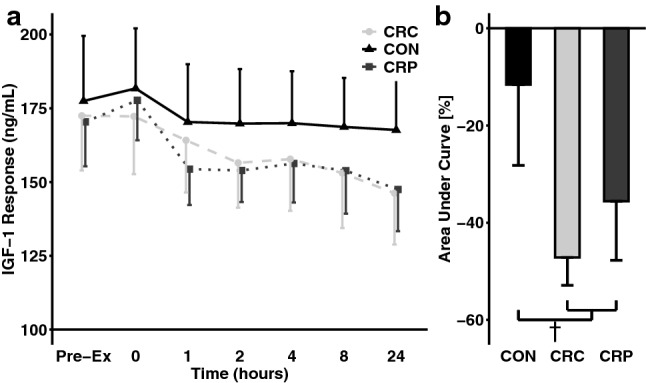
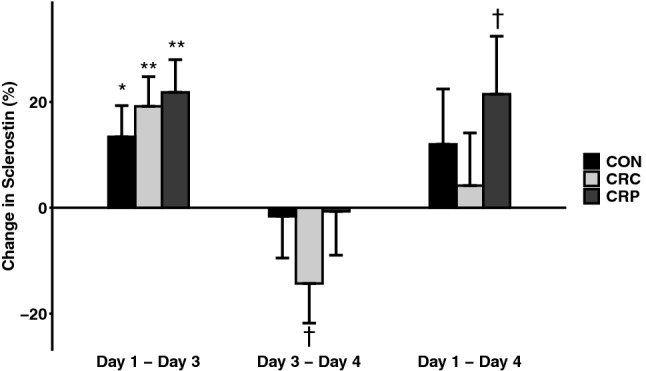
In CRC and CRP, respectively, growth hormone peaked at 2.6 ± 0.4 and 2.5 ± 0.9 times the peak concentrations observed during CON. Despite this, insulin-like growth factor-1 concentrations declined 18.3 ± 3.4% in CRC and 27.2 ± 3.8% in CRP, which was greater than the 7.6 ± 3.6% decline in CON, over the subsequent 24 h. Sclerostin increased over the first 2 days of each intervention by 19.2 ± 5.6% in CRC, 21.8 ± 6.2% in CRP and 13.4 ± 5.9% in CON, but following the resistance exercise bout, these increases were attenuated and no longer significant.
During caloric restriction, there is considerable endocrine anabolic resistance to a single bout of resistance exercise which persists in the presence of post-exercise whey protein supplementation. Alternative strategies to restore the sensitivity of insulin-like growth factor-1 to growth hormone need to be explored.
减肥会导致肌肉质量和骨矿物质密度的损失。阻力运动通常被规定为减轻这些影响。然而,热量限制期间抵抗运动的合成代谢内分泌反应尚未确定。
参与者接受了 3 天的热量限制条件(15 kcal kg FFM),运动后补充碳水化合物(CRC)和运动后补充蛋白质(CRP),以及能量平衡控制(40 kcal kg FFM),运动后补充碳水化合物(CON)。在每个条件的第 3 天,分别进行 5 组 5 次杠铃深蹲运动后,进行连续采血。
在 CRC 和 CRP 中,生长激素分别达到 CON 期间观察到的峰值浓度的 2.6 ± 0.4 和 2.5 ± 0.9 倍。尽管如此,胰岛素样生长因子-1 浓度在 CRC 中下降了 18.3 ± 3.4%,在 CRP 中下降了 27.2 ± 3.8%,这比 CON 中下降了 7.6 ± 3.6%,在接下来的 24 小时内。在每个干预的前 2 天,CR 中的骨硬化蛋白增加了 19.2 ± 5.6%,CRP 中的骨硬化蛋白增加了 21.8 ± 6.2%,CON 中的骨硬化蛋白增加了 13.4 ± 5.9%,但在抗阻运动后,这些增加被削弱,不再显著。
在热量限制期间,单次抗阻运动的内分泌合成代谢抵抗相当大,即使在运动后补充乳清蛋白后也是如此。需要探索恢复胰岛素样生长因子-1对生长激素敏感性的替代策略。