Centre for Bacterial Cell Biology, Biosciences Institute, Newcastle University, NE2 4AX Newcastle Upon Tyne, United Kingdom.
Centre for Bacterial Cell Biology, Biosciences Institute, Newcastle University, NE2 4AX Newcastle Upon Tyne, United Kingdom
Proc Natl Acad Sci U S A. 2020 Apr 14;117(15):8462-8467. doi: 10.1073/pnas.1919985117. Epub 2020 Apr 1.
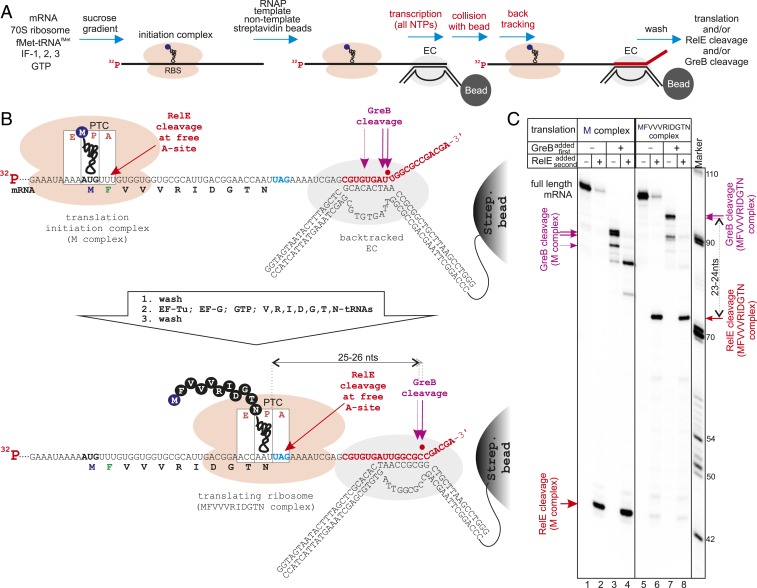
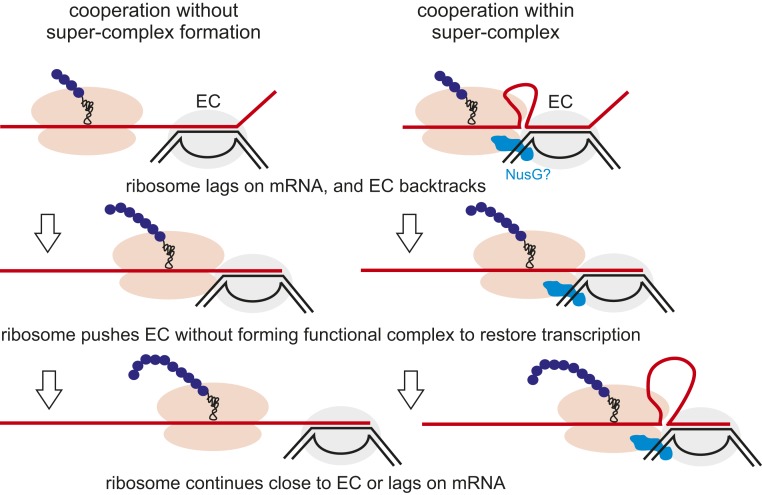
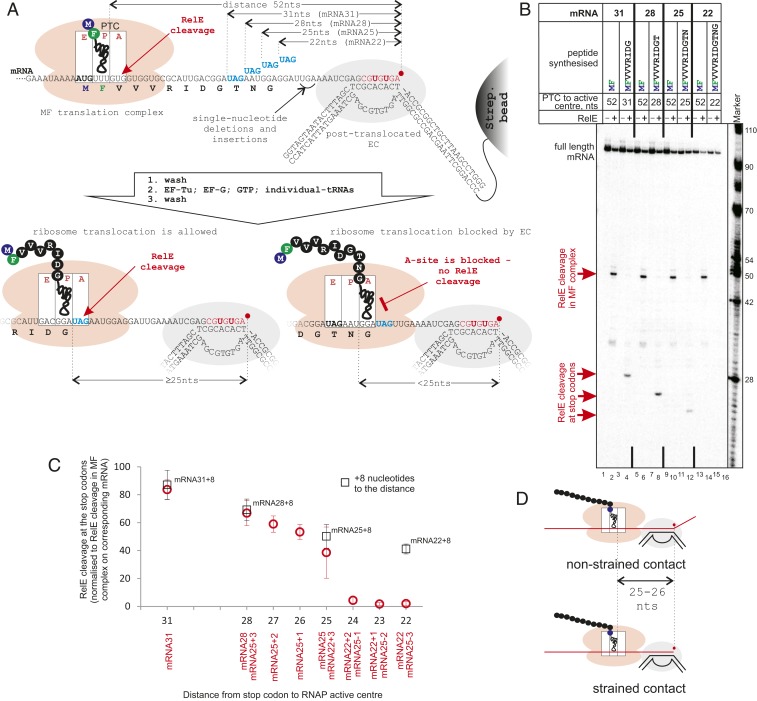
In bacteria, the first two steps of gene expression-transcription and translation-are spatially and temporally coupled. Uncoupling may lead to the arrest of transcription through RNA polymerase backtracking, which interferes with replication forks, leading to DNA double-stranded breaks and genomic instability. How transcription-translation coupling mitigates these conflicts is unknown. Here we show that, unlike replication, translation is not inhibited by arrested transcription elongation complexes. Instead, the translating ribosome actively pushes RNA polymerase out of the backtracked state, thereby reactivating transcription. We show that the distance between the two machineries upon their contact on mRNA is smaller than previously thought, suggesting intimate interactions between them. However, this does not lead to the formation of a stable functional complex between the enzymes, as was once proposed. Our results reveal an active, energy-driven mechanism that reactivates backtracked elongation complexes and thus helps suppress their interference with replication.
在细菌中,基因表达的前两个步骤——转录和翻译——在空间和时间上是偶联的。解偶联可能导致 RNA 聚合酶回溯而使转录停止,这会干扰复制叉,导致 DNA 双链断裂和基因组不稳定性。转录-翻译偶联如何缓解这些冲突尚不清楚。在这里,我们表明,与复制不同,翻译不会被受阻的转录延伸复合物所抑制。相反,翻译核糖体积极地将 RNA 聚合酶推出回溯状态,从而重新激活转录。我们表明,在 mRNA 上两者接触时,两个机器之间的距离比以前认为的要小,这表明它们之间存在密切的相互作用。然而,这并不会导致酶之间形成稳定的功能复合物,正如曾经提出的那样。我们的结果揭示了一种主动的、能量驱动的机制,该机制可以重新激活回溯的延伸复合物,从而有助于抑制它们对复制的干扰。