Department of Chemistry, Columbia University, 3000 Broadway, MC3126, New York, NY 10027, USA.
Department of Microbiology and Immunology, Columbia University Medical Center, 701 West 168 Street, New York, NY 10032, USA.
J Mol Biol. 2022 Jan 30;434(2):167330. doi: 10.1016/j.jmb.2021.167330. Epub 2021 Oct 25.
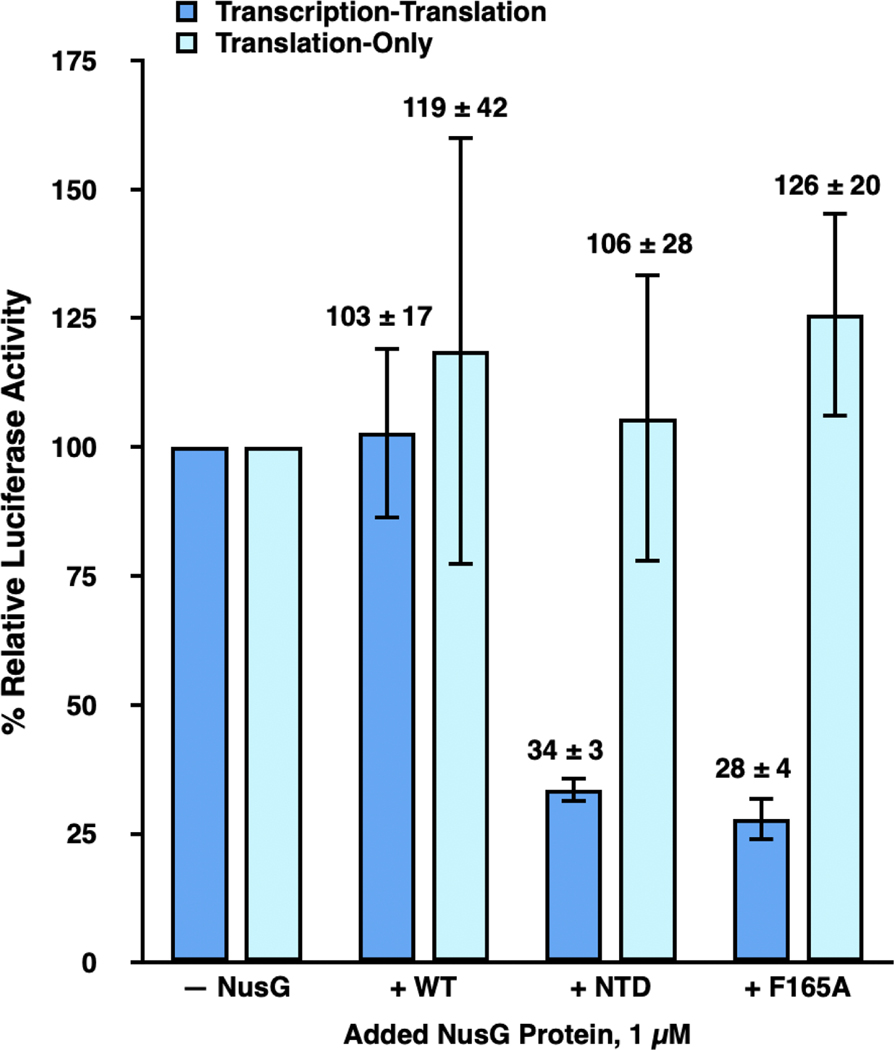
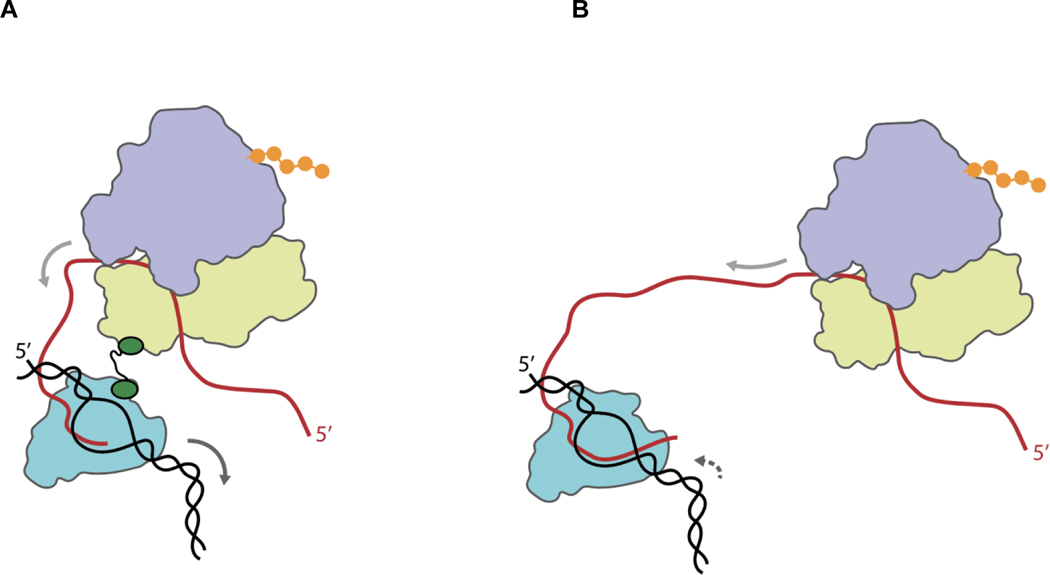
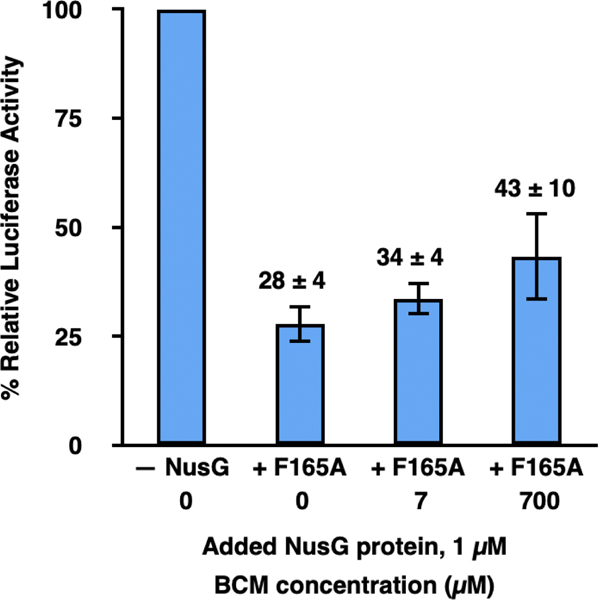
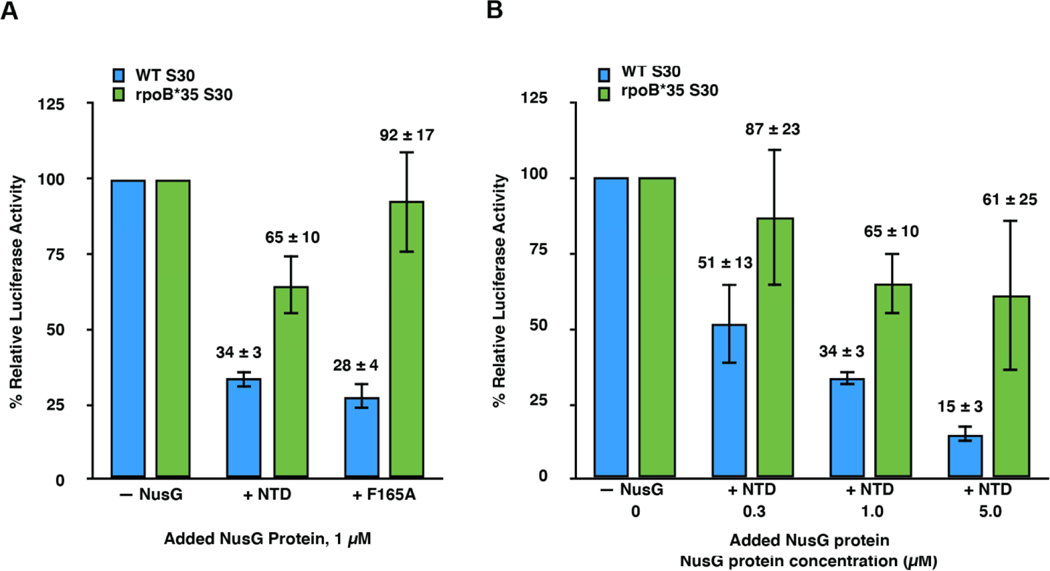
In bacteria, transcription is coupled to, and can be regulated by, translation. Although recent structural studies suggest that the N-utilization substance G (NusG) transcription factor can serve as a direct, physical link between the transcribing RNA polymerase (RNAP) and the lead ribosome, mechanistic studies investigating the potential role of NusG in mediating transcription-translation coupling are lacking. Here, we report development of a cellular extract- and reporter gene-based, in vitro biochemical system that supports transcription-translation coupling as well as the use of this system to study the role of NusG in coupling. Our findings show that NusG is required for coupling and that the enhanced gene expression that results from coupling is dependent on the ability of NusG to directly interact with the lead ribosome. Moreover, we provide strong evidence that NusG-mediated coupling enhances gene expression through a mechanism in which the lead ribosome that is tethered to the RNAP by NusG suppresses spontaneous backtracking of the RNAP on its DNA template that would otherwise inhibit transcription.
在细菌中,转录与翻译偶联,并可受到翻译的调控。尽管最近的结构研究表明,N 利用物质 G(NusG)转录因子可以作为正在转录的 RNA 聚合酶(RNAP)和领头核糖体之间的直接物理连接,但缺乏研究 NusG 在介导转录-翻译偶联中的潜在作用的机制研究。在这里,我们报告了开发基于细胞提取物和报告基因的体外生化系统,该系统支持转录-翻译偶联,并利用该系统研究 NusG 在偶联中的作用。我们的研究结果表明,NusG 是偶联所必需的,并且偶联导致的基因表达增强依赖于 NusG 与领头核糖体直接相互作用的能力。此外,我们提供了强有力的证据表明,NusG 介导的偶联通过一种机制增强基因表达,其中通过 NusG 与 RNAP 连接的领头核糖体抑制 RNAP 在其 DNA 模板上自发回溯,否则这会抑制转录。