Sylvester Comprehensive Cancer Center, Department of Public Health Sciences, Division of Epidemiology & Population Health Sciences, University of Miami School of Medicine, Clinical Research Building, 1120 N.W. 14th Street, Miami, FL, 33136, United States.
Department of Public Health Sciences, University of Miami School of Medicine, United States.
Cancer Epidemiol. 2020 Jun;66:101709. doi: 10.1016/j.canep.2020.101709. Epub 2020 Mar 30.
Aggregation of all Black populations in US cancer mortality profiles masks remarkable heterogeneity by place of birth. Comparing U.S-born African Americans with African and Afro-Caribbean immigrants may highlight specific cancer prevention and control needs and clarify global cancer epidemiology. Such a comparison has yet to be undertaken on a population basis.
Using 2012-2017 vital statistics data from California, Florida, Minnesota and New York, age-standardized cancer mortality rates were computed for distinct Black populations. Comparisons were made to the majority White population using mortality rate ratios (MRR) obtained from negative binomial regression.
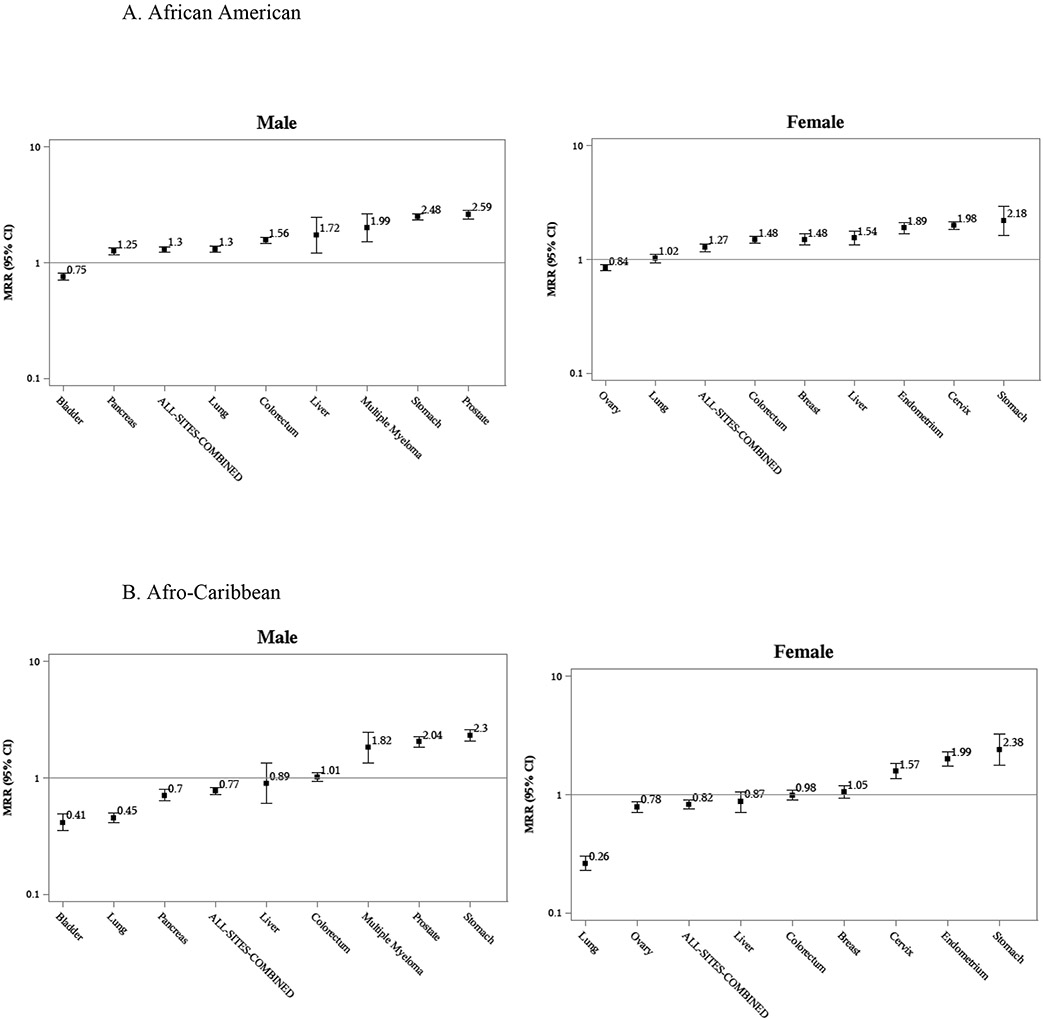
Of the 83,460 cancer deaths analyzed among Blacks, nearly 20 % were immigrants. African males and females had the lowest all-sites-combined cancer mortality rates (121 and 99 per 100,000, respectively), African Americans had the highest (232 and 163), while Afro-Caribbean were in between (140 and 106 respectively). The average Black:White MRR was significant for prostate (2.11), endometrial (2.05), stomach (2.02), multiple myeloma (1.87), premenopausal breast (1.66), liver (1.58) and cervical (1.56) cancers, (P < 0.05).
While, in aggregate, Blacks in the US have high cancer mortality rates, race itself is not the primary determinant of these disparities. Black immigrant populations show lower cancer mortality than both African Americans and Whites, especially for cancers where environmental factors feature more predominantly: lung, colorectal and breast. Even for cancers with high mortality among all African-descent groups, this study suggests a complex interplay between genetic and environmental factors. Endometrial cancer was unique; mortality rates were similarly high for all three analyzed Black groups.
在美国癌症死亡率概况中,将所有黑人人口聚集在一起掩盖了出生地的显著异质性。将美国出生的非裔美国人与非洲和加勒比裔移民进行比较,可能会突出特定的癌症预防和控制需求,并阐明全球癌症流行病学。迄今为止,尚未在人群基础上进行此类比较。
使用来自加利福尼亚州、佛罗里达州、明尼苏达州和纽约州的 2012-2017 年生命统计数据,为不同的黑人人口计算了年龄标准化的癌症死亡率。使用负二项回归获得的死亡率比 (MRR) 将其与多数白人人口进行比较。
在所分析的 83460 例黑人癌症死亡中,近 20%是移民。非洲男性和女性的所有部位癌症死亡率最低(分别为 121 和 99/100000),非裔美国人最高(分别为 232 和 163),而加勒比裔黑人处于中间位置(分别为 140 和 106)。前列腺癌(2.11)、子宫内膜癌(2.05)、胃癌(2.02)、多发性骨髓瘤(1.87)、绝经前乳腺癌(1.66)、肝癌(1.58)和宫颈癌(1.56)的平均黑人:白人 MRR 具有统计学意义(P<0.05)。
虽然美国黑人的癌症死亡率总体较高,但种族本身并不是造成这些差异的主要决定因素。与非裔美国人和白人相比,黑人移民群体的癌症死亡率较低,特别是在环境因素更为突出的癌症中:肺癌、结直肠癌和乳腺癌。即使在所有非洲裔群体中死亡率较高的癌症中,本研究也表明遗传和环境因素之间存在复杂的相互作用。子宫内膜癌是独特的;三个分析的黑人群体的死亡率都同样高。