J Natl Cancer Inst. 2019 Dec 1;111(12):1279-1297. doi: 10.1093/jnci/djz106.
The American Cancer Society, Centers for Disease Control and Prevention, National Cancer Institute, and North American Association of Central Cancer Registries provide annual updates on cancer occurrence and trends by cancer type, sex, race, ethnicity, and age in the United States. This year's report highlights the cancer burden among men and women age 20-49 years.
Incidence data for the years 1999 to 2015 from the Centers for Disease Control and Prevention- and National Cancer Institute-funded population-based cancer registry programs compiled by the North American Association of Central Cancer Registries and death data for the years 1999 to 2016 from the National Vital Statistics System were used. Trends in age-standardized incidence and death rates, estimated by joinpoint, were expressed as average annual percent change.
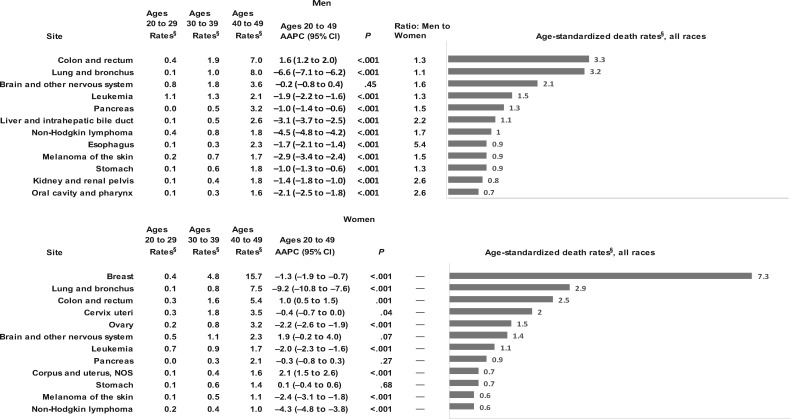
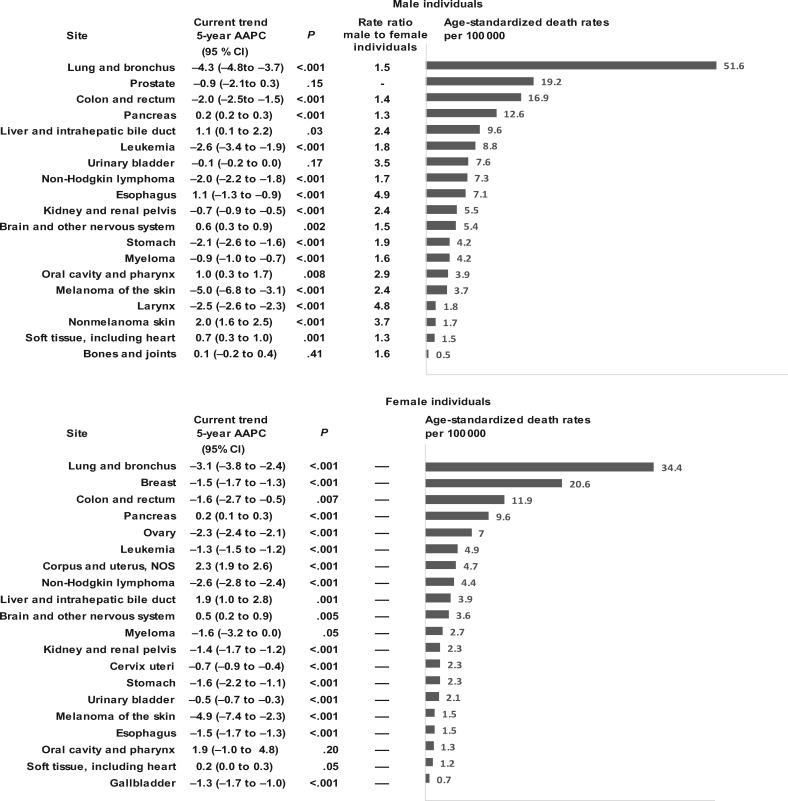
Overall cancer incidence rates (per 100 000) for all ages during 2011-2015 were 494.3 among male patients and 420.5 among female patients; during the same time period, incidence rates decreased 2.1% (95% confidence interval [CI] = -2.6% to -1.6%) per year in men and were stable in females. Overall cancer death rates (per 100 000) for all ages during 2012-2016 were 193.1 among male patients and 137.7 among female patients. During 2012-2016, overall cancer death rates for all ages decreased 1.8% (95% CI = -1.8% to -1.8%) per year in male patients and 1.4% (95% CI = -1.4% to -1.4%) per year in females. Important changes in trends were stabilization of thyroid cancer incidence rates in women and rapid declines in death rates for melanoma of the skin (both sexes). Among adults age 20-49 years, overall cancer incidence rates were substantially lower among men (115.3 per 100 000) than among women (203.3 per 100 000); cancers with the highest incidence rates (per 100 000) among men were colon and rectum (13.1), testis (10.7), and melanoma of the skin (9.8), and among women were breast (73.2), thyroid (28.4), and melanoma of the skin (14.1). During 2011 to 2015, the incidence of all invasive cancers combined among adults age 20-49 years decreased -0.7% (95% CI = -1.0% to -0.4%) among men and increased among women (1.3%, 95% CI = 0.7% to 1.9%). The death rate for (per 100 000) adults age 20-49 years for all cancer sites combined during 2012 to 2016 was 22.8 among men and 27.1 among women; during the same time period, death rates decreased 2.3% (95% CI = -2.4% to -2.2%) per year among men and 1.7% (95% CI = -1.8% to -1.6%) per year among women.
Among people of all ages and ages 20-49 years, favorable as well as unfavorable trends in site-specific cancer incidence were observed, whereas trends in death rates were generally favorable. Characterizing the cancer burden may inform research and cancer-control efforts.

美国癌症协会、疾病控制与预防中心、国家癌症研究所和北美癌症登记协会每年都会提供美国癌症发病和趋势的最新数据,按癌症类型、性别、种族、族裔和年龄进行分类。今年的报告重点介绍了 20-49 岁男性和女性的癌症负担。
使用北美癌症登记协会汇编的疾病控制与预防中心和国家癌症研究所资助的基于人群的癌症登记计划中 1999 年至 2015 年的发病率数据和国家生命统计系统中 1999 年至 2016 年的死亡率数据。使用 joinpoint 估计年龄标准化发病率和死亡率趋势,以平均年百分比变化表示。
2011-2015 年所有年龄段的男性患者总体癌症发病率(每 100000 人)为 494.3,女性患者为 420.5;同期,男性发病率每年下降 2.1%(95%置信区间[CI]=-2.6%至-1.6%),女性发病率保持稳定。2012-2016 年所有年龄段的男性患者总体癌症死亡率(每 100000 人)为 193.1,女性患者为 137.7。2012-2016 年,所有年龄段的男性癌症死亡率每年下降 1.8%(95%CI=-1.8%至-1.8%),女性死亡率每年下降 1.4%(95%CI=-1.4%至-1.4%)。重要的趋势变化是女性甲状腺癌发病率的稳定和皮肤黑色素瘤死亡率的迅速下降(两性)。在 20-49 岁的成年人中,男性的总体癌症发病率明显低于女性(男性为 115.3/100000,女性为 203.3/100000);男性发病率最高的癌症(每 100000 人)是结肠癌和直肠癌(13.1)、睾丸(10.7)和皮肤黑色素瘤(9.8),女性是乳腺癌(73.2)、甲状腺癌(28.4)和皮肤黑色素瘤(14.1)。2011 年至 2015 年,20-49 岁成年人所有侵袭性癌症的发病率综合下降了-0.7%(95%CI=-1.0%至-0.4%),而女性发病率则有所上升(1.3%,95%CI=0.7%至 1.9%)。2012 年至 2016 年,所有癌症部位合并的 20-49 岁成年人死亡率为每 100000 人 22.8 男性和 27.1 女性;同期,男性死亡率每年下降 2.3%(95%CI=-2.4%至-2.2%),女性死亡率每年下降 1.7%(95%CI=-1.8%至-1.6%)。
在所有年龄组和 20-49 岁年龄组中,观察到特定部位癌症发病率的有利和不利趋势,而死亡率趋势总体上是有利的。描述癌症负担可以为研究和癌症控制工作提供信息。