Blien Stefan, Steger Patrick, Hüttner Niklas, Graaf Richard, Hüttel Andreas K
Institute for Experimental and Applied Physics, University of Regensburg, 93040, Regensburg, Germany.
Department of Applied Physics, Aalto University, Puumiehenkuja 2, 02150, Espoo, Finland.
Nat Commun. 2020 Apr 2;11(1):1636. doi: 10.1038/s41467-020-15433-3.
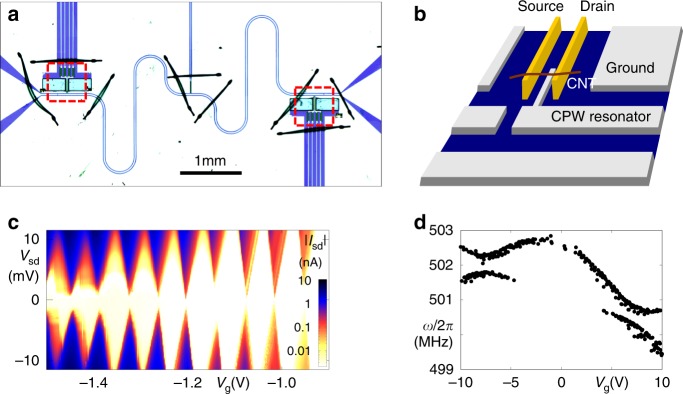
Cavity optomechanics allows the characterization of a vibration mode, its cooling and quantum manipulation using electromagnetic fields. Regarding nanomechanical as well as electronic properties, single wall carbon nanotubes are a prototypical experimental system. At cryogenic temperatures, as high quality factor vibrational resonators, they display strong interaction between motion and single-electron tunneling. Here, we demonstrate large optomechanical coupling of a suspended carbon nanotube quantum dot and a microwave cavity, amplified by several orders of magnitude via the nonlinearity of Coulomb blockade. From an optomechanically induced transparency (OMIT) experiment, we obtain a single photon coupling of up to g = 2π ⋅ 95 Hz. This indicates that normal mode splitting and full optomechanical control of the carbon nanotube vibration in the quantum limit is reachable in the near future. Mechanical manipulation and characterization via the microwave field can be complemented by the manifold physics of quantum-confined single electron devices.
腔光力学能够利用电磁场对振动模式进行表征、冷却以及量子操控。就纳米力学和电子特性而言,单壁碳纳米管是一个典型的实验系统。在低温下,作为高品质因数的振动谐振器,它们展现出运动与单电子隧穿之间的强相互作用。在此,我们展示了悬浮碳纳米管量子点与微波腔之间的大光机械耦合,通过库仑阻塞的非线性将其放大了几个数量级。从光机械诱导透明(OMIT)实验中,我们获得了高达g = 2π⋅95 Hz的单光子耦合。这表明在不久的将来,有望在量子极限下实现碳纳米管振动的正常模式分裂和完全光机械控制。通过微波场进行的机械操控和表征可以由量子限制单电子器件的多种物理特性来补充。