Department of Molecular and Integrative Physiology, University of Michigan Medical School, Ann Arbor, MI, 48105, USA.
Department of Molecular and Integrative Physiology, University of Michigan Medical School, Ann Arbor, MI, 48105, USA; Department of Medicine, Division of Endocrinology, Diabetes and Metabolism, University of Rochester School of Medicine and Dentistry, Rochester, NY, USA.
Mol Metab. 2020 May;35:100957. doi: 10.1016/j.molmet.2020.01.021. Epub 2020 Feb 7.
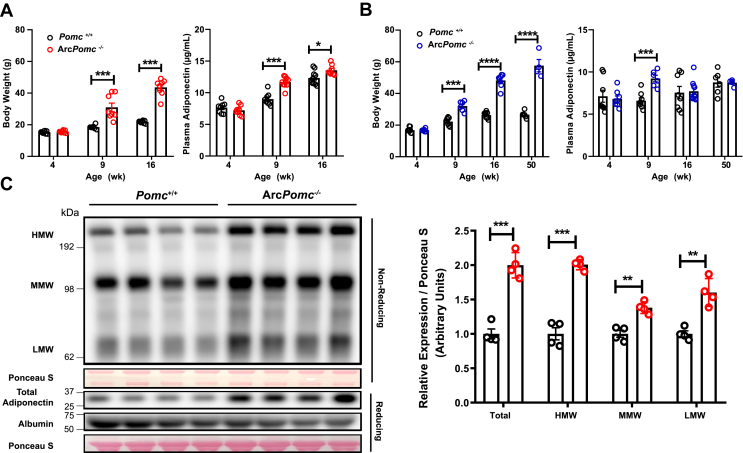
The steep rise in the prevalence of obesity and its related metabolic syndrome have become a major worldwide health concerns. Melanocortin peptides from hypothalamic arcuate nucleus (Arc) POMC neurons induce satiety to limit food intake. Consequently, Arc Pomc-deficient mice (ArcPomc) exhibit hyperphagia and obesity. Previous studies demonstrated that the circulating levels of adiponectin, a protein abundantly produced and secreted by fat cells, negatively correlate with obesity in both rodents and humans. However, we found that ArcPomc mice have increased circulating adiponectin levels despite obesity. Therefore, we investigated the physiological function and underlying mechanisms of hypothalamic POMC in regulating systemic adiponectin levels.
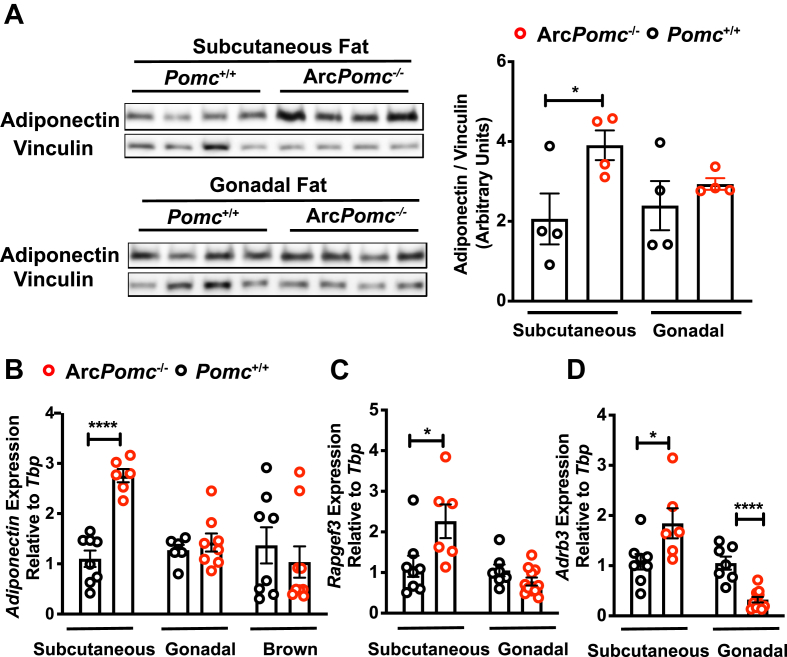
Circulating adiponectin was measured in obese ArcPomc mice at ages 4-52 weeks. To determine whether increased adiponectin was a direct result of ArcPomc deficiency or a secondary effect of obesity, we examined plasma adiponectin levels in calorie-restricted mice with or without a history of obesity and in ArcPomc mice before and after genetic restoration of Pomc expression in the hypothalamus. To delineate the mechanisms causing increased adiponectin in ArcPomc mice, we determined sympathetic outflow to adipose tissue by assessing epinephrine, norepinephrine, and tyrosine hydroxylase protein levels and measured the circulating adiponectin in the mice after acute norepinephrine or propranolol treatments. In addition, adiponectin mRNA and protein levels were measured in discrete adipose tissue depots to ascertain which fat depots contributed the most to the high level of adiponectin in the ArcPomc mice. Finally, we generated compound Adiopoq:ArcPomc mice and compared their growth, body composition, and glucose homeostasis to the individual knockout mouse strains and their wild-type controls.
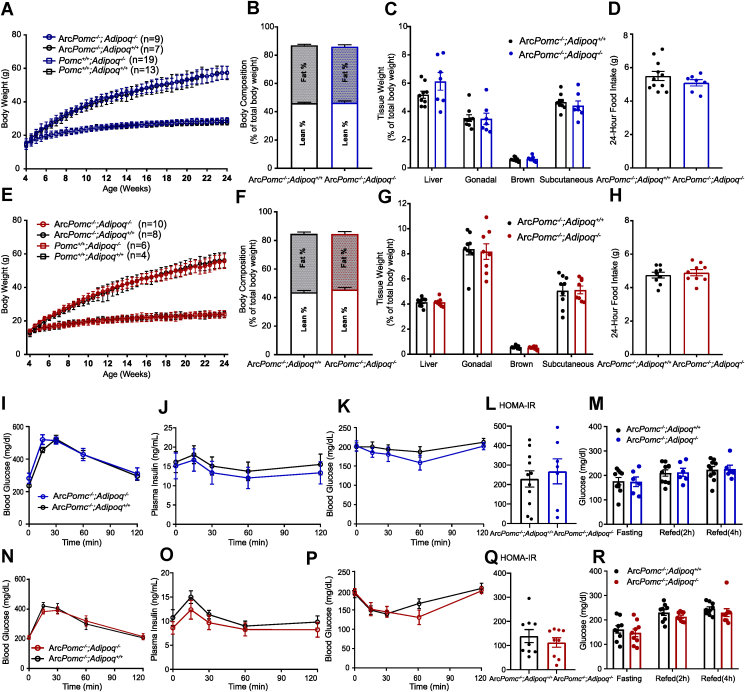
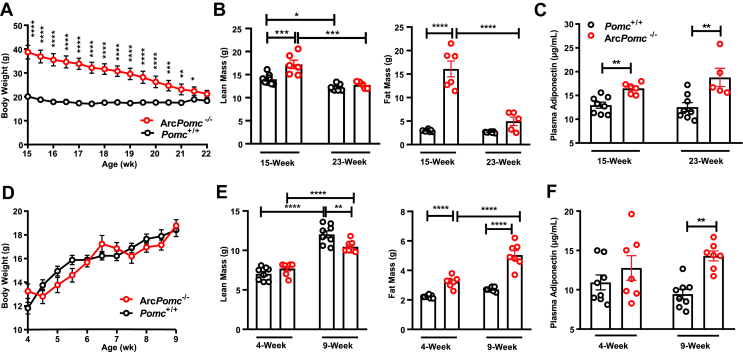
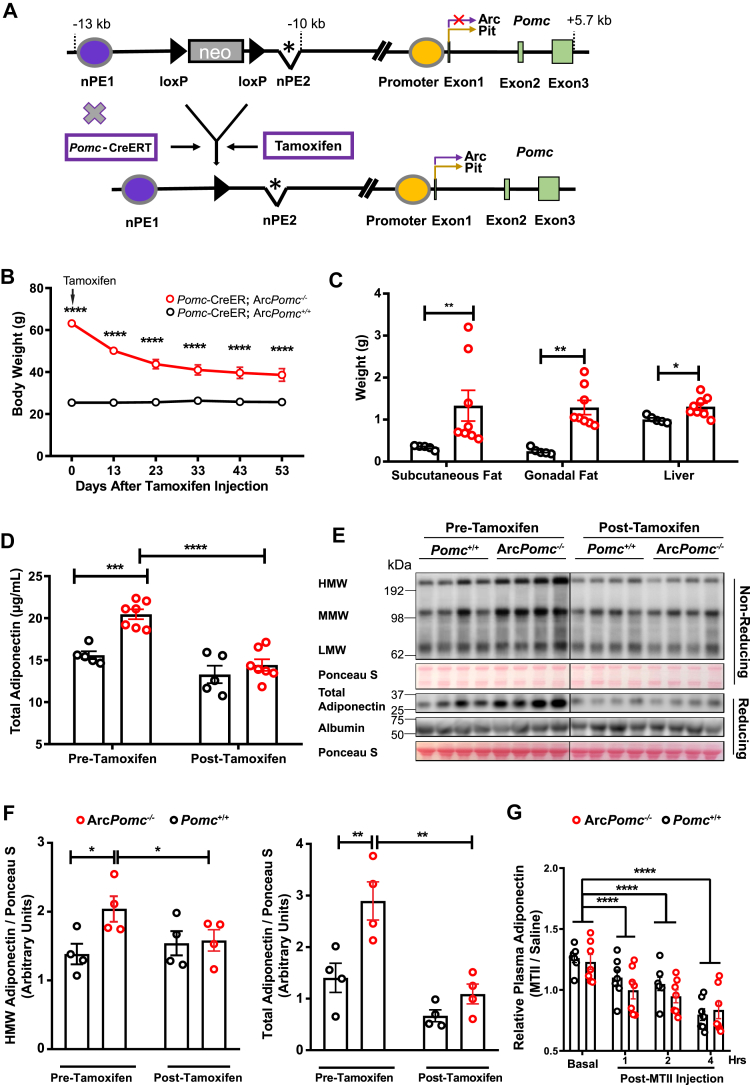
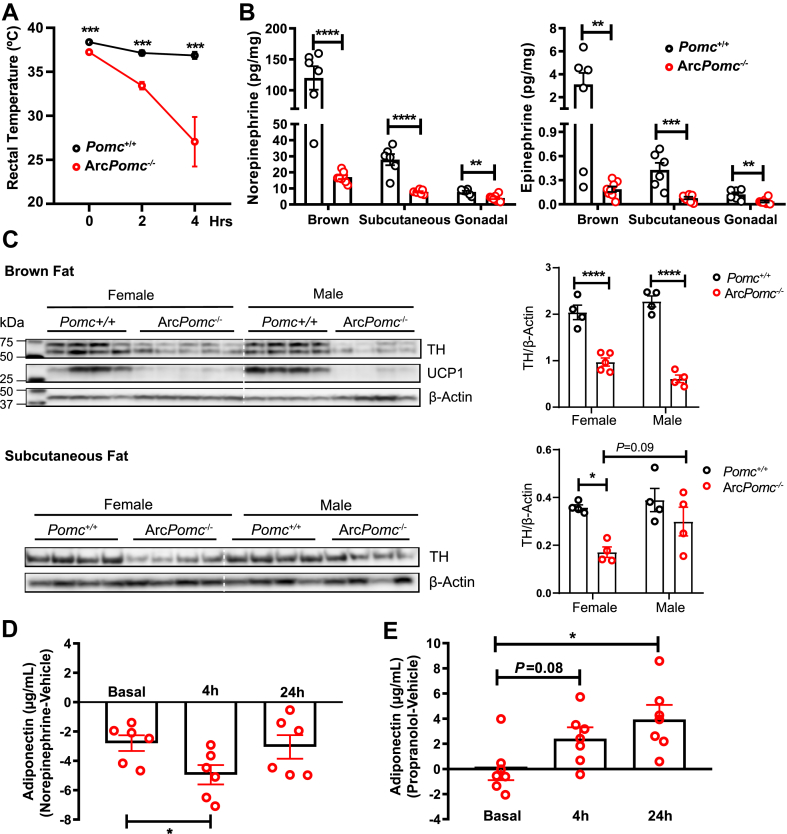
Obese ArcPomc female mice had unexpectedly increased plasma adiponectin compared to wild-type siblings at all ages greater than 8 weeks. Despite chronic calorie restriction to achieve normal body weights, higher adiponectin levels persisted in the ArcPomc female mice. Genetic restoration of Pomc expression in the Arc or acute treatment of the ArcPomc female mice with melanotan II reduced adiponectin levels to control littermate values. The ArcPomc mice had defective thermogenesis and decreased epinephrine, norepinephrine, and tyrosine hydroxylase protein levels in their fat pads, indicating reduced sympathetic outflow to adipose tissue. Injections of norepinephrine into the ArcPomc female mice reduced circulating adiponectin levels, whereas injections of propranolol significantly increased adiponectin levels. Despite the beneficial effects of adiponectin on metabolism, the deletion of adiponectin alleles in the ArcPomc mice did not exacerbate their metabolic abnormalities.
In summary, to the best of our knowledge, this study provides the first evidence that despite obesity, the ArcPomc mouse model has high circulating adiponectin levels, which demonstrated that increased fat mass is not necessarily correlated with hypoadiponectinemia. Our investigation also found a previously unknown physiological pathway connecting POMC neurons via the sympathetic nervous system to circulating adiponectin, thereby shedding light on the biological regulation of adiponectin.
肥胖及其相关代谢综合征患病率的急剧上升已成为全球主要的健康关注点。来自下丘脑弓状核(Arc)POMC 神经元的黑素细胞刺激素肽可引发饱腹感,从而限制食物摄入。因此,ArcPomc 缺陷小鼠(ArcPomc)表现出多食和肥胖。先前的研究表明,循环脂联素水平与肥胖呈负相关,脂联素是一种大量由脂肪细胞产生和分泌的蛋白质,在啮齿动物和人类中均如此。然而,我们发现尽管肥胖,ArcPomc 小鼠的循环脂联素水平却升高了。因此,我们研究了下丘脑 POMC 调节全身脂联素水平的生理功能和潜在机制。
在 4-52 周龄肥胖的 ArcPomc 小鼠中测量循环脂联素。为确定增加的脂联素是 ArcPomc 缺乏的直接结果还是肥胖的继发效应,我们检查了有或没有肥胖史的热量限制小鼠以及下丘脑 Pomc 表达恢复前后的 ArcPomc 小鼠的血浆脂联素水平。为阐明导致 ArcPomc 小鼠脂联素增加的机制,我们通过评估去甲肾上腺素、肾上腺素和酪氨酸羟化酶蛋白水平来确定脂肪组织的交感神经输出,并在 ArcPomc 小鼠中测量急性去甲肾上腺素或普萘洛尔处理后的循环脂联素。此外,我们还测量了不同脂肪组织储库中的脂联素 mRNA 和蛋白水平,以确定哪个脂肪储库对 ArcPomc 小鼠中脂联素的高水平贡献最大。最后,我们生成了复合 Adiopoq:ArcPomc 小鼠,并将它们的生长、体成分和葡萄糖稳态与单个基因敲除小鼠株及其野生型对照进行了比较。
与 8 周龄以上的野生型同窝小鼠相比,肥胖的 ArcPomc 雌性小鼠出人意料地具有更高的血浆脂联素水平。尽管进行了慢性热量限制以达到正常体重,但 ArcPomc 雌性小鼠的脂联素水平仍持续升高。Arc 或急性用黑素细胞刺激素 II 处理的 ArcPomc 雌性小鼠中 Pomc 表达的基因恢复将脂联素水平降低至对照同窝小鼠的水平。ArcPomc 小鼠的产热功能有缺陷,脂肪垫中的去甲肾上腺素、肾上腺素和酪氨酸羟化酶蛋白水平降低,表明脂肪组织的交感神经输出减少。将去甲肾上腺素注射到 ArcPomc 雌性小鼠中会降低循环脂联素水平,而注射普萘洛尔则会显著增加脂联素水平。尽管脂联素对代谢有有益作用,但在 ArcPomc 小鼠中删除脂联素等位基因并没有使它们的代谢异常恶化。
总之,据我们所知,这项研究首次提供了证据表明,尽管肥胖,ArcPomc 小鼠模型仍具有较高的循环脂联素水平,这表明增加的脂肪量不一定与低脂联素血症相关。我们的研究还发现了一个以前未知的生理途径,该途径通过交感神经系统将 POMC 神经元连接到循环脂联素,从而阐明了脂联素的生物学调节。