Department of Geography, Pennsylvania State University, State College, PA 16802, USA.
Department of Geography and Environmental Management, University of Waterloo, Waterloo, ON N2L 3G1, Canada.
Int J Environ Res Public Health. 2020 Mar 31;17(7):2347. doi: 10.3390/ijerph17072347.
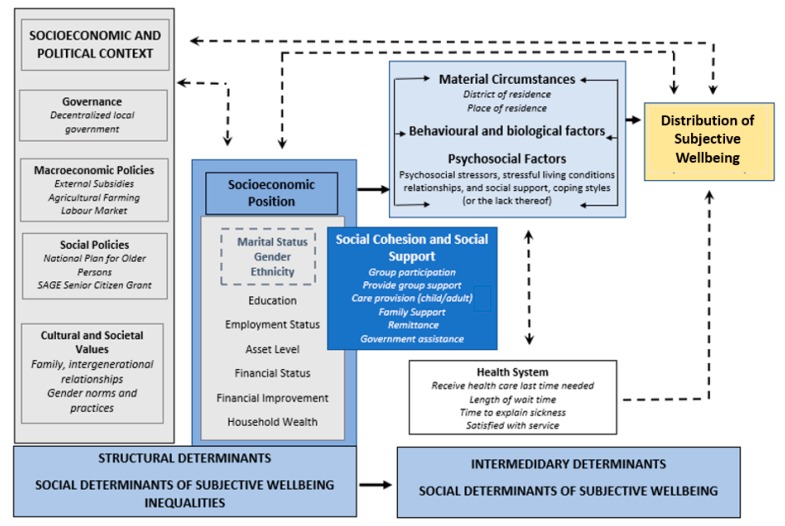
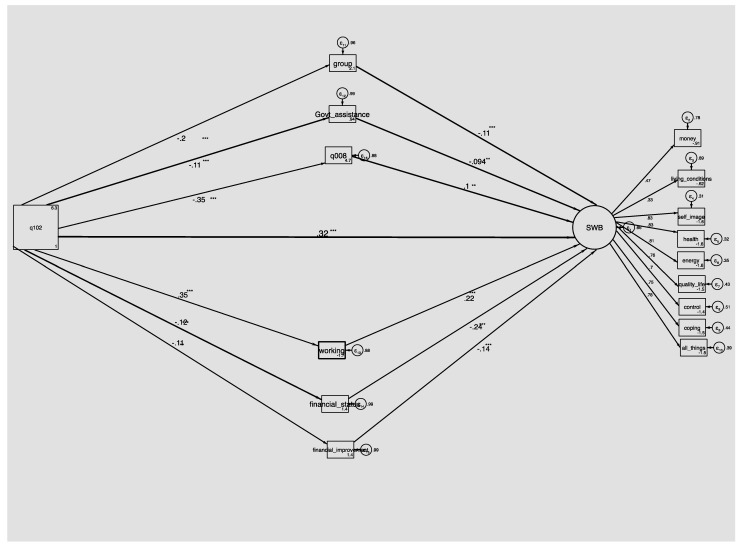
While literature attempts to explain why self-reported subjective wellbeing (SWB) generally increases with age in most high-income countries based on a social determinants of a health framework, little work attempts to explain the low levels of self-report SWB among older persons in sub-Saharan Africa. Using the 2013 Uganda Study on Global Aging and Health with 470 individuals, this research examines (i) direct and indirect effects of age on SWB through social and structural determinants, and (ii) how direct and indirect effects vary by gender. Results show a significant direct and negative effect of age on SWB ( = 0.42, = 0.01). Six indirect paths were statistically significant and their indirect effects on wellbeing varied by gender. Providing support, education, working status, asset level, financial status and financial improvement were significantly positively associated with men's SWB, whereas younger age, providing community support, participating in group activities, number of close friends/relatives, government assistance and all socio-economic variables were significantly positively associated with women's SWB. Strategies to address gendered economic, social and political inequalities among and between elderly populations are urgently needed.
虽然文献试图根据健康的社会决定因素框架解释为什么在大多数高收入国家,自我报告的主观幸福感(SWB)通常会随着年龄的增长而增加,但很少有研究试图解释撒哈拉以南非洲老年人自我报告的 SWB 水平较低的原因。本研究使用了 2013 年乌干达全球老龄化和健康研究的数据,该研究调查了(i)年龄通过社会和结构决定因素对 SWB 的直接和间接影响,以及(ii)直接和间接影响如何因性别而异。结果表明,年龄对 SWB 有显著的直接和负向影响( = 0.42, = 0.01)。有六个间接路径在统计学上具有显著意义,它们对幸福感的间接影响因性别而异。提供支持、教育、工作状况、资产水平、财务状况和财务改善与男性的 SWB 呈显著正相关,而年龄较小、提供社区支持、参与团体活动、亲密朋友/亲戚的数量、政府援助和所有社会经济变量与女性的 SWB 呈显著正相关。迫切需要针对老年人群体内部和之间的性别经济、社会和政治不平等采取策略。